Introduction
A single mislabeled catheter or misprogrammed infusion pump can mean the difference between a successful procedure and a patient emergency. Quality control is the last checkpoint standing between a device leaving the factory floor and reaching a patient's bedside.
Many MedTech companies underestimate what a lapse in QC actually costs. According to McKinsey's benchmarking of 30 leading medical-device companies, the industry spends $26 billion to $36 billion annually on quality-related costs, or 6.8% to 9.4% of sales. Roughly two-thirds of that is failure-related: rework, recalls, and warning letters, not prevention.
This guide breaks down what quality control actually means in medical device manufacturing, how it differs from quality assurance, and the step-by-step QC process itself. It also covers the regulations that govern it, including ISO 13485, ISO 14971, and 21 CFR 820, along with why so much of this comes down to having the right people in place.
Key Takeaways
- QC is reactive and product-focused, testing devices against acceptance criteria before release
- QA takes a proactive, process-focused approach, preventing defects throughout the device lifecycle
- ISO 13485, ISO 14971, and FDA's 21 CFR 820 (soon the QMSR) govern medical device QC
- Weak QC risks patient safety, regulatory action, and lasting reputational damage
- Strong QC starts with hiring quality and regulatory experts who know the rules cold
What Is Quality Control in Medical Devices?
Quality control is the set of reactive, hands-on activities that happen during and after production to confirm a device is free of defects and meets its specifications. It sits in the inspection and testing layer, separate from the planning work documented earlier in the quality system.
ISO's quality vocabulary defines quality control as "part of quality management focused on fulfilling quality requirements." That's a simple phrase, but it puts the emphasis exactly where it belongs: on people actually fulfilling requirements, not just writing procedures about them.
Staff competence is baked into that definition. A QC program is only as strong as the inspectors and engineers executing it.
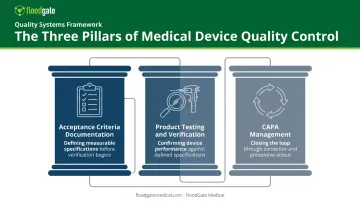
Three Core Focus Areas
Medical device QC breaks down into three interconnected activities:
- Acceptance criteria documentation: defining exactly what "pass" and "fail" look like for a component, subassembly, or finished device
- Product testing and verification: physically inspecting, measuring, and testing samples or full lots against those criteria
- CAPA management: investigating nonconformances and building corrective and preventive actions so the same defect doesn't recur
Who Actually Does the Work
Trained QC inspectors and quality engineers carry out this work day to day. Their judgment calls, like whether a scratch on a catheter shaft is cosmetic or a functional risk, or whether a batch of sensors passes calibration tolerances, directly determine what reaches patients.
A poorly trained inspector doesn't just slow down a production line; they can let unsafe product through.
When QC Fails: A Real Example
FDA's recall notice on reworked Philips Respironics DreamStation CPAP and BiPAP machines is a useful illustration. During rework, some devices were assigned incorrect or duplicate serial numbers, meaning a unit could end up running another patient's prescription settings or defaulting to factory settings instead of delivering prescribed therapy.
FDA classified it as a Class I recall covering 1,088 devices in the US, with 43 complaints reported. The failure traces back to a gap in production identity controls, precisely the kind of checkpoint QC exists to catch.
Quality Control vs. Quality Assurance in Medical Devices
QC and QA get used interchangeably in casual conversation, but they're structurally different functions.
Quality assurance is preventive and process-focused. It works upstream, throughout manufacturing, to stop defects from happening in the first place: validating equipment, auditing suppliers, and developing standard operating procedures that hold up under scrutiny.
Quality control is reactive and product-focused. It inspects and tests what's already been made, sample by sample or batch by batch, against defined acceptance criteria.
Here's a simple side-by-side:
| Scenario | QA activity | QC activity |
|---|---|---|
| New injection-molding line | Validates process parameters (temperature, pressure, cycle time) before production starts | Tests finished parts from that line against dimensional specs |
| Finished device batch | N/A (QA's work happens earlier) | Inspects and tests the batch before release for shipment |
Both functions live under the same quality management system, and they depend on each other. QA without QC has no way to confirm the process actually worked. QC without QA is just catching problems that have already been baked into every unit on the line. But they require distinct skill sets: QA leans on process engineering and statistical thinking, while QC leans on hands-on inspection and rigorous testing, backed by precise metrology.
The Medical Device Quality Control Process
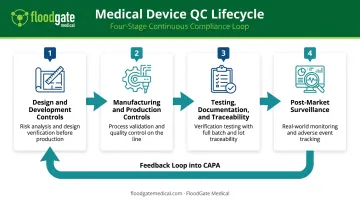
QC isn't a single inspection at the end of the line. It runs through four stages of the device lifecycle.
Design and Development Controls
Before mass production starts, design verification confirms the device meets its documented design-input specifications. Design validation goes further, confirming the device actually meets real user needs under realistic or simulated conditions. Skip this step, and devices end up technically compliant on paper but unusable, or unsafe, in an actual cath lab or ICU.
Manufacturing and Production Controls
Once production begins, QC checkpoints include:
- Material and component inspection: verifying incoming raw materials and subassemblies meet specifications before entering the line
- In-process controls: monitoring temperature, pressure, humidity, and cleanliness, critical for anything built in a cleanroom, such as microcatheters
- Equipment calibration: confirming measurement and test equipment itself is accurate, on a documented schedule
Testing, Documentation, and Traceability
Devices go through functional testing (does it work), performance testing (does it work to spec), and stress testing (does it survive worst-case conditions). Teams must document every result in a way that satisfies 21 CFR Part 11 requirements for electronic records and signatures.
A traceability matrix ties it all together, linking design inputs, verification results, and any design changes. If something goes wrong years post-launch, the failure can be traced back to the exact production run and design revision.
Post-Market Surveillance
QC doesn't stop at shipment. Complaint handling and real-world performance monitoring feed directly back into CAPA, closing the loop between what happens in the field and what gets fixed in the next design or production revision. This is the mechanism that would flag a serial-number mix-up like the DreamStation case early, before it reaches Class I recall scale.
Key Regulations and Standards Governing Medical Device Quality Control
Medical device QC doesn't operate in a vacuum. It runs on a specific regulatory scaffolding, and the frameworks below define how that scaffolding holds together.
| Regulation | Scope | Key Detail |
|---|---|---|
| 21 CFR 820 / QMSR | US device manufacturing (FDA) | Transitioning to the Quality Management System Regulation, effective February 2, 2026; incorporates ISO 13485:2016 by reference |
| ISO 13485 | International QMS requirements | Covers design, manufacturing, and regulatory compliance across the device lifecycle |
| ISO 14971 | Risk management process | Identifies, estimates, and controls risk from concept through post-market monitoring |
| EU MDR 2017/745 | EU market access | Requires a risk-proportionate QMS covering design, manufacturing, supplier controls, post-market surveillance, and CAPA |
Quality teams still building programs around the old standalone QSR language have a gap worth closing now.
ISO 13485 and ISO 14971 work together rather than separately: ISO 13485 governs the overall quality management system, while ISO 14971 governs the risk management process that sits inside, and is referenced by, that system.
Companies selling in both the US and EU need QC and regulatory staff fluent in both frameworks, since audit expectations and documentation formats differ between the two.
Types of Quality Control and Why It Matters
Four QC methods show up consistently in medical device manufacturing:
- Process control: developing, monitoring, and validating production processes so output consistently conforms to specifications
- Acceptance sampling: inspecting a representative sample from a lot to make an accept/reject decision, rather than testing every single unit
- Statistical process control: plotting process data over time against upper and lower control limits to catch drift before it produces defective product
- Product control: the receiving, in-process, and finished-device inspections and tests that determine whether a specific unit or batch gets released
Mature QC programs use these methods together, since each catches different failure modes.
Why it matters, in blunt terms: patient safety, regulatory standing, and financial performance are all tied to QC quality.
Deloitte's analysis of a decade of FDA recall data found that companies in the bottom 30% for recalls per $1M in revenue outperformed the worst-performing 30% by 256 percentage points in capital-market returns. The market rewards companies that get quality right.
None of this happens without the right people executing it. QC inspectors, quality engineers, and regulatory affairs specialists need deep familiarity with these standards and the judgment to apply them consistently. MedTech companies routinely struggle to find and retain that talent, and the challenge resurfaces with every open role rather than fading after one hire.
This is where FloodGate Medical operates. We recruit quality and regulatory professionals for MedTech companies, through permanent placement and contract staffing alike, with a deliberate focus on building diverse teams equipped to uphold rigorous QC standards.
Whether a company is scaling a new interventional device line or shoring up an existing QMS ahead of an audit, having the right quality talent in place makes the difference. It's what turns regulatory frameworks into working, reliable QC programs.

Frequently Asked Questions
What is quality control in medical devices?
Quality control is the reactive, product-focused process of testing and inspecting devices or batches against defined acceptance criteria before release. It confirms a device meets its safety and performance specifications, rather than preventing defects upstream.
What is the difference between ISO 13485 and 14971?
ISO 13485 covers the overall quality management system for medical device organizations. ISO 14971 focuses specifically on the risk management process that operates within that broader system.
What is 21 CFR 820 quality system regulation?
21 CFR 820 is the FDA's regulation governing medical device manufacturing quality systems. It's transitioning into the Quality Management System Regulation (QMSR) effective February 2, 2026, which incorporates ISO 13485 by reference.
What are the 4 types of quality control?
Process control, acceptance sampling, statistical process control, and product control are the four methods commonly applied in medical device manufacturing.
What is the difference between quality control and quality assurance in medical devices?
Quality assurance is preventive and process-focused, working throughout manufacturing to stop defects before they occur. Quality control, by contrast, catches issues after the fact by inspecting finished products against those specifications.
Who is responsible for quality control in a medical device company?
Trained QC inspectors, quality engineers, and regulatory affairs staff carry out day-to-day QC work. Staffing these roles with experienced hires directly affects defect-detection rates and audit readiness.