Introduction
When Netflix released The Bleeding Edge in 2018, it exposed how a roughly $400 billion medical device industry could bring products to market with startlingly limited testing.
Patients described life-altering complications from hip implants, vaginal mesh, and a birth control coil called Essure, devices cleared for sale with far less scrutiny than most people assume.
The documentary is several years old now, and the global device market has grown substantially larger since. Its central warning still applies: speed without matching oversight creates risk that eventually surfaces, whether in a courtroom, a recall notice, or a patient's hospital bed.
This article moves past the shock value. We'll unpack what medical device companies and MedTech professionals can actually apply from the film's lessons, from regulatory pathways to team composition.
Key Takeaways
- The 510(k) "substantial equivalence" pathway lets most devices skip clinical trials, creating hidden risk
- Speed-to-market pressure without regulatory rigor leads to costly recalls, lawsuits, and reputational damage
- Cross-functional teams spanning engineering, regulatory, clinical, and quality catch risks before launch
- Responsible innovation depends on who builds the device, not just the technology
What "The Bleeding Edge" Revealed About the MedTech Industry
The Bleeding Edge profiles patients harmed by four device categories: metal-on-metal hip implants, transvaginal mesh, robotically assisted surgery systems, and Essure, a permanent birth control coil. Their stories share a common thread: severe complications that surfaced only after the devices reached widespread use.
The film's real target is the testing gap between drugs and devices, not device failure itself. Pharmaceuticals typically undergo multiple large-scale human trials before approval. Many devices reach patients after far less clinical evidence, sometimes none at all.
That gap hasn't closed. In 2024, the FDA classified a Vyaire respiratory-device recall at its most serious severity level, tied to 37 reported incidents, two injuries, and two deaths. Reuters also reported a separate Boston Scientific device recall that same year, flagged at the same top severity tier.
These recurring failure points reveal a system still built around comparison rather than independent proof.
Here's a nuance the documentary doesn't fully unpack: not every featured device followed the same regulatory road.
- Essure was approved through the FDA's more rigorous Premarket Approval (PMA) pathway, not 510(k)
- A metal-on-metal hip implant referenced in FDA records was cleared through 510(k)
- Transvaginal mesh was later reclassified from Class II to Class III, forcing manufacturers into PMA territory
- Robotic surgery systems carry procedure-specific clearances, meaning approval for one use doesn't cover every application
The real lesson is that pathway choice, evidence quality, and post-market vigilance all matter, regardless of which pathway a device follows. Getting any one of them wrong can hurt patients.
The 510(k) Pathway: Innovation Shortcut or Regulatory Loophole?
The FDA's 510(k) pathway was designed as a narrow exception. It lets manufacturers clear a device by proving "substantial equivalence" to an already-marketed predicate, rather than running new clinical trials from scratch.
That narrow exception became the default. Former FDA Commissioner David Kessler, featured in The Bleeding Edge, told TIME magazine that 510(k) "was never intended to be the major way in which we approve medical devices" but "became the rule, so that the vast majority of devices today are regulated under this framework."
He wasn't exaggerating. A 2024 peer-reviewed analysis published in npj Digital Medicine found that roughly 99% of the more than 155,000 device authorizations issued since 1976 went through 510(k) rather than full Premarket Approval.
The Daisy Chain Problem
Substantial equivalence sounds reassuring until you trace how it works in practice. A new device can be cleared by pointing to a predicate already on the market. That predicate might itself have been cleared by pointing to an earlier predicate.
- Each link in the chain adds distance from the original clinical evidence
- A predicate device can even be one that was later recalled for safety issues, and existing clearances based on it don't automatically get revisited
- The result: some devices can trace their approval lineage back to products no longer considered safe
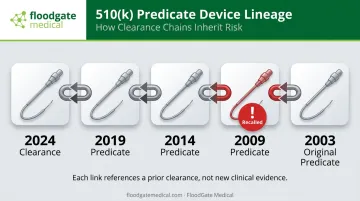
The Bleeding Edge documents this exact scenario with Johnson & Johnson's Pinnacle hip implant, cleared through a chain of predicates that traced back to devices later linked to metal poisoning and revision surgeries.
Devices vs. Drugs: A Different Evidence Bar
Drug approval generally requires:
- Preclinical testing in labs and animal models
- Multiple phases of human clinical trials
- An application built on that accumulated evidence before FDA review
Device clearance under 510(k) asks a narrower question: is this substantially equivalent to something already sold? Clinical data may be required when bench or animal testing can't resolve safety questions, but it isn't the default requirement it is for drugs.
Clearance is not approval. A cleared device has demonstrated equivalence. An approved device, under the PMA pathway, has demonstrated independent evidence of safety and effectiveness. Mixing up those two terms, as media coverage often does, obscures a distinction MedTech companies and hospital buyers both need to understand.
The Real Cost of Rushing Medical Device Innovation
Every MedTech company faces the same tension: investors and boards want products launched fast, while thorough safety validation takes time that biology and regulators don't rush. Speed wins in the short term. It rarely wins in the long run.
Essure is the clearest cautionary tale. Bayer eventually committed roughly $1.6 billion to resolve about 90% of nearly 39,000 U.S. claims tied to the permanent birth control coil, without admitting wrongdoing. The company ended U.S. distribution after December 31, 2018, following years of mounting complaints and tightening regulatory restrictions.
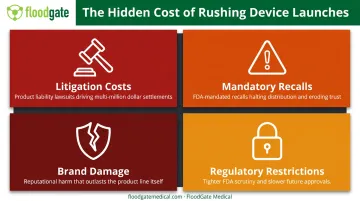
Inadequate testing doesn't just harm patients. It creates downstream business exposure that can dwarf whatever speed advantage a company gained at launch:
- Litigation costs that stretch into the billions
- Mandatory recalls that disrupt manufacturing and distribution
- Brand damage that outlasts any single product line
- Regulatory restrictions that limit future marketing and sales
Patients Are Watching, and Talking
The "Essure Problems" Facebook group grew past 36,000 members before the FDA added its most significant restrictions. Members compared symptoms, encouraged each other to file FDA adverse-event reports, and built pressure regulators couldn't ignore.
This matters for how companies assess risk today. Patient communities now function as informal surveillance networks, surfacing problems faster than some official reporting channels. A company that ignores these conversations is operating with a blind spot.
The fix isn't complicated, though it does require discipline: build regulatory, quality, and clinical expertise into product development from day one. Not as a late-stage compliance check. Not as a reaction to the first lawsuit. As a structural part of how the product gets designed.
Building a Culture of Responsible Innovation: Why Talent and Diversity Matter
Several of the failures documented in The Bleeding Edge trace back to a narrower problem: R&D and trial teams that didn't reflect the patients who would eventually use the device. When the people building and testing a product share similar backgrounds, blind spots about how it performs across different bodies, ages, and use cases become much easier to miss.
Diverse teams catch more. A 2016 Harvard Business Review analysis found that diverse groups scrutinize facts more carefully and make fewer factual errors than homogeneous ones, partly because members feel less pressure to simply agree with the majority. That kind of scrutiny is exactly what a hazard analysis or design review needs before a device ever reaches a patient.
In MedTech specifically, the safest development teams tend to combine:
- Engineering and human factors expertise
- Regulatory affairs professionals who understand pathway implications early
- Clinical researchers connected to real patient populations
- Quality assurance staff trained to flag risk before it reaches manufacturing
- Patient advocacy perspectives that surface use cases engineers might otherwise miss
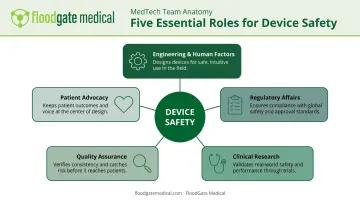
Recruitment strategy directly shapes device safety when teams are built this way, well beyond typical HR duties. FloodGate Medical works exclusively within the MedTech industry, and its recruitment approach centers on building exactly these kinds of balanced, cross-functional teams rather than leaving diversity to chance.
That balance gets harder to maintain as devices grow more complex, especially with software and AI-enabled components now common. Demand for specialized regulatory affairs and quality assurance talent keeps climbing, and companies that treat these hires as an afterthought often discover the gap only after a submission stalls or a recall hits.
FloodGate Medical tracks these regulatory and hiring shifts through a monthly newsletter for MedTech professionals, giving hiring teams an early read on where talent gaps are likely to surface next.
What's Next for Medical Device Regulation and Innovation
Regulators are shifting focus from a single pre-market checkpoint to oversight across a device's entire lifecycle.
AI-enabled devices now have a defined pathway for controlled evolution. The FDA finalized guidance in December 2024 allowing manufacturers to submit a predetermined change control plan. This is a pre-approved roadmap for how an AI model can update itself without triggering a brand-new submission each time. Draft lifecycle guidance followed in January 2025, covering documentation, transparency, and ongoing performance monitoring.
Real-world evidence is filling gaps pre-market testing can't. Updated FDA guidance finalized in December 2025 clarifies how real-world data, from registries, clinical records, and complaint databases, can support both pre-market and post-market decisions. This doesn't replace rigorous pre-market evidence; it complements it, catching problems that only surface once a device reaches broader, more varied patient populations.
For MedTech companies, this shift changes what "market-ready" actually means:
- Post-market monitoring plans need to exist before launch, not after a complaint
- Patient-centered design is becoming a competitive differentiator, not just a regulatory checkbox
- Transparency about performance across different populations builds trust faster than marketing claims ever will
Companies that build these expectations into their culture now will spend less time reacting to them later.
Frequently Asked Questions
What is The Bleeding Edge documentary on Netflix?
The Bleeding Edge is a Netflix documentary examining the medical device industry's approval process and its impact on patients. Its themes remain widely discussed today.
Where can I watch The Bleeding Edge documentary?
The Bleeding Edge is available for streaming on Netflix. Check current platform listings before watching, since streaming availability can change by region over time.
What is the FDA's 510(k) pathway?
It's a clearance route that lets manufacturers bring a device to market by proving substantial equivalence to an existing product, often without new clinical trials. It's faster than full approval but carries a lighter evidence bar.
Is The Bleeding Edge documentary still relevant today?
Yes. While some featured devices, like Essure, are off the market, the underlying regulatory framework the film critiques largely remains in place, keeping its core lessons current for MedTech professionals.
How can MedTech companies prevent the issues shown in the documentary?
Stronger internal testing rigor, early cross-functional regulatory involvement, and diverse product development teams are the key preventive measures. Building these in from day one costs far less than fixing problems after launch.
Why does diversity in MedTech teams matter for device safety?
Varied professional and demographic perspectives help identify risks and use cases that homogeneous teams may overlook. That scrutiny often catches design flaws long before they reach a patient.