Introduction
The medical device industry, often called medtech, includes every company that designs, manufactures, and distributes the devices, diagnostics, and health technologies used to diagnose, treat, or monitor patients. That scope keeps expanding.
2026 brings three forces converging at once: AI is moving from pilot projects into daily clinical use, regulators are rewriting the rulebook for software-driven devices, and the race for specialized talent is intensifying faster than most HR teams can keep up with.
For MedTech companies, investors, and professionals, these shifts directly shape competitiveness, innovation speed, and hiring strategy.
This article breaks down the top trends defining medtech in 2026, what's driving them, how they're reshaping the industry, and what to watch beyond this year.
Key Takeaways
- The global medical device market hit $572.31 billion in 2025, growing at a 6.5% CAGR through 2032
- AI, connected care, and advanced manufacturing are converging to redefine device design and delivery
- Regulatory complexity is rising, making compliance agility a real competitive edge
- Specialized talent in regulatory, data science, and clinical engineering is now as critical to innovation as R&D spend
- Companies that build diverse, skilled teams early will outpace slower-moving competitors
Key Trends Shaping the Medical Device Industry in 2026
Five forces are collectively redefining how devices get designed, built, regulated, and staffed. Here's what's actually happening in each.
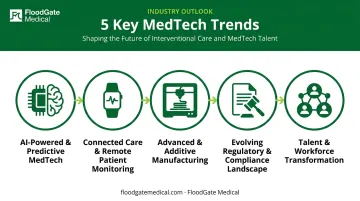
AI-Powered & Predictive MedTech
AI in medtech has moved well past reading scans. It's now embedded in predictive diagnostics, robotic-assisted surgery, and an entire category called Software as a Medical Device (SaMD).
A real-world example: Intuitive's da Vinci 5 surgical platform received FDA clearance in March 2024 and began a limited clinical rollout, with Hackensack Meridian among the first 14 hospitals to adopt it.
The system adds advanced force feedback and expanded data capture, pushing robotic-assisted surgery closer to precision-guided care.
This isn't a fringe trend. According to AdvaMed's tracking of AI adoption in clinical care, more than 1,300 FDA-authorized AI-enabled medical devices were on the market as of December 2025.
The FDA has kept pace on its end. Its Predetermined Change Control Plan (PCCP) framework now lets manufacturers pre-authorize certain AI model updates, and a January 2025 draft guidance applies full lifecycle risk management to AI-enabled software.
Regulators are no longer treating AI devices like static hardware.
Connected Care & Remote Patient Monitoring
Chronic disease management is shifting out of the clinic and into daily life. Wearables, IoT-enabled diagnostics, and telehealth-integrated devices are becoming the default, not the exception.
Continuous glucose monitors (CGMs) illustrate the shift well. Dexcom and Abbott launched the first over-the-counter CGMs in March and June 2024, respectively, opening access beyond prescription-only channels. Wearable cardiac monitors are following a similar path.
The market data backs this up. Grand View Research projects the remote patient monitoring systems market will grow from $26.0 billion in 2025 to $110.7 billion by 2033, a 20% CAGR. That's one of the fastest-growing corners of medtech right now.
Why it matters: connected care shifts revenue models toward recurring data services instead of one-time device sales. Reimbursement structures, like Medicare's RPM coverage, are catching up too, making this shift financially viable at scale.
Advanced & Additive Manufacturing
3D printing has moved from novelty to legitimate production method for patient-specific implants, faster prototyping, and lower unit costs on complex geometries.
The FDA granted a Humanitarian Device Exemption in 2021 for a 3D-printed, patient-specific titanium total talus replacement, treating avascular necrosis with an implant designed for one person's anatomy. That's the customization promise of additive manufacturing in action.
That said, the evidence base is still thin. The American Academy of Orthopaedic Surgeons has flagged limited long-term safety and efficacy data for patient-specific 3D-printed implants.
Adoption is real, but it's concentrated in specific applications, like oncology reconstruction and cranial implants, rather than scaled across the entire supply chain.
Evolving Regulatory & Compliance Landscape
Regulatory frameworks are scrambling to keep up with AI, software, and wellness devices that don't fit neatly into old categories.
Recent developments include:
- FDA's QMSR, finalized January 2024, aligning US quality system requirements more closely with ISO 13485, effective in 2026
- EU Regulation 2024/1860 (Article 10a), requiring manufacturers to report anticipated supply interruptions or discontinuations
- FDA's TPLC guidance for AI-enabled software, adding lifecycle expectations beyond initial clearance
Compliance isn't getting cheaper or faster, either. MedTech Europe's 2024 survey found certification under MDR/IVDR commonly takes around 18 months, with average notified-body fees running roughly €108,000 for quality management system assessments alone.
Companies that can move through these cycles efficiently are winning market share simply by getting there first.
Talent & Workforce Transformation
Devices are getting more complex. AI, robotics, and connected systems all demand specialized skills in regulatory affairs, R&D, and clinical engineering, and the talent pool isn't growing fast enough to match demand.
Industry estimates put the global regulatory-affairs workforce across pharma, devices, and biotech at nearly 125,000 professionals. Spread that across an expanding device landscape, and gaps show up quickly in specialties like AI/software regulatory review and clinical data science.
This is exactly where DEI-driven recruitment becomes a strategic advantage, well beyond a simple compliance checkbox. Diverse teams bring broader problem-solving perspectives, which matters when you're designing devices for increasingly diverse patient populations.
FloodGate Medical works exclusively in this space, connecting MedTech companies with specialized, diverse talent across commercial, regulatory, and quality functions. Its approach centers on matching candidate strengths to company culture beyond simply filling a job description, which tends to produce better long-term fits.
What's Driving These Medtech Trends
Five forces are driving this shift: technology, demographics, cost pressure, regulation, and competition. The market's trajectory reflects that momentum, with KPMG projecting it will approach $800 billion globally by 2030.
- Technology advances: AI, automation, robotics, and industrial IoT are lowering the barrier to building genuinely smarter devices
- Shifting patient expectations: Aging populations (the WHO projects 1 in 6 people globally will be 60 or older by 2030) and rising chronic disease rates are driving demand for less-invasive, connected solutions
- Cost pressures and value-based care: Providers and payers increasingly want measurable outcomes, not just hardware
- Regulatory modernization: Frameworks for software, AI, and post-market safety are being rewritten in real time
- Competitive dynamics: Tech entrants like Apple, which added FDA-authorized sleep apnea detection in 2024, are reshaping who competes. M&A activity added fuel too, with estimates ranging from 61 to over 300 deals in 2024, depending on scope
How These Trends Are Impacting the Medical Device Industry
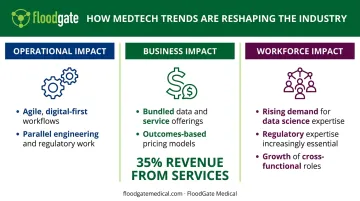
These shifts aren't staying theoretical. They're changing how companies operate, sell, and staff up, often all at once.
Operational Impact
Product development workflows are moving toward agile, digital-first design. Teams are building for faster regulatory submissions from day one instead of bolting compliance on at the end. This means engineering and regulatory affairs teams now work in parallel, not sequence. For manufacturers of complex devices like microcatheters, that parallel approach can trim months off time-to-market.
Business Impact
Manufacturers are moving "beyond the device" toward bundled data, services, and outcomes-based pricing. McKinsey's research shows service-focused medtech companies can generate up to 35% of revenue from services rather than product sales alone. This changes how manufacturers capture value, moving revenue from one-time device sales to ongoing service relationships.
Workforce Impact
Skill requirements are shifting fast toward data science, regulatory expertise, and cross-functional innovation roles. This intensifies the talent race across nearly every medtech function.
Specialized recruitment partners help close these gaps quickly. FloodGate Medical's expanded talent solutions, including a recent partnership with Talencio, broaden staffing capabilities for MedTech employers. The DEI-driven approach behind these placements helps build stronger, more resilient teams. Tools like a Vacant Territory Calculator also help companies quantify exactly how much an open role is costing them, which tends to speed up hiring decisions.
Future Signals for the Medical Device Industry Beyond 2026
Trends don't stop evolving once the calendar flips. Here's what's worth watching over the next one to three years:
- AI regulation maturing globally: IMDRF (International Medical Device Regulators Forum) released a draft lifecycle framework for AI-enabled device risk management in 2026, signaling movement toward standardized international rules
- Closed-loop implantable devices: Medtronic's BrainSense Adaptive DBS system, FDA-approved in February 2025, adjusts Parkinson's therapy using real-time brain activity data
- Decentralized clinical trials: FDA guidance now supports telehealth visits, remote data collection, and direct shipment of investigational products, changing how devices get validated
- Consolidation and reshoring: Continued M&A activity and renewed interest in domestic manufacturing capacity are likely, sharpening competition for specialized talent that recruiters like FloodGate Medical are increasingly tapped to fill
Conclusion
AI, connected care, advanced manufacturing, evolving regulation, and workforce transformation point to one shift: this industry is getting more complex, faster, and more competitive at once.
Companies that adapt early, particularly by building diverse, skilled teams rather than scrambling to fill roles after the fact, will hold a lasting edge. Strategy and technology matter. But without the right people executing on them, neither goes anywhere. Firms like FloodGate Medical pair MedTech recruiting expertise with a DEI-driven approach, helping companies close that gap before it becomes a crisis.
Strategic foresight paired with a deliberate talent strategy is what separates medtech companies that lead in 2026 from those playing catch-up.
Frequently Asked Questions
What is the medical device industry?
The medical device industry includes companies that develop, manufacture, and distribute devices, diagnostics, and health technologies used to diagnose and treat medical conditions, as well as monitor them over time. This spans everything from surgical instruments to wearable monitors.
What medical devices are in high demand?
Wearables, continuous glucose monitors, AI-enabled diagnostic imaging tools, and robotic-assisted surgical systems are all seeing strong demand right now. Connected, data-driven devices are outpacing standalone hardware.
What is the biggest trend in medical devices for 2026?
AI integration across diagnostics and robotics is the most transformative trend, with predictive care applications close behind. This shift is changing how devices reach the market and how they're used in clinical practice.
How is AI transforming the medical device industry?
AI enables predictive diagnostics and improves precision in robotic-assisted surgery. It has also created an entirely new category, Software as a Medical Device, and regulatory frameworks are adapting quickly to keep pace.
What skills will be in demand for medical device jobs in 2026?
Regulatory affairs expertise, data science and AI knowledge, and cross-disciplinary R&D skills are all in high demand. Companies are competing hard for professionals who can bridge engineering and compliance.
How can medical device companies prepare for future industry shifts?
Invest in agile innovation processes, build regulatory readiness early, and prioritize diverse, specialized talent pipelines. Partnering with a MedTech-focused recruiter, like FloodGate Medical, speeds up the talent side of that process.