Introduction
Talent sourcing—the proactive process of identifying and engaging candidates before roles open—now shapes who wins specialized hires in US MedTech and healthcare. As we head into 2026, US life-sciences employment reached a record 2.1 million in March 2025, yet growth remains fragile and uneven across specializations.
AI is reshaping recruiting workflows while skills shortages deepen in biomedical engineering and health-technology roles. Teams that ignore these shifts face thinner pipelines and slower critical hires.
This guide breaks down the talent sourcing strategies MedTech organizations need to compete in 2026.
Key Takeaways
- AI tools scan and rank thousands of profiles by skills and fit in seconds
- Skills-based sourcing widens talent pools by favoring verified capabilities over credentials
- Passive pipelining and DEI-focused sourcing build resilient, diverse MedTech teams
- Internal mobility and alumni networks deliver high-ROI hires most organizations still underuse
Key Trend 1: AI-Powered Candidate Discovery
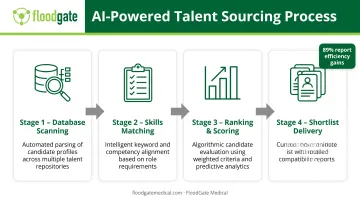
AI-driven sourcing tools are changing how MedTech recruiters find talent. Instead of manually combing through hundreds of profiles, AI platforms scan and rank thousands of candidates in seconds on skills, experience, and cultural-fit signals.
About 25% of US organizations used AI in HR by January 2024, and among adopters, 64% applied it in talent acquisition. AI-powered discovery is shifting from experiment to standard practice.
How it works in practice:
- AI scans resumes, LinkedIn profiles, and internal databases to surface candidates who match role requirements
- Tools such as LinkedIn Hiring Assistant build shortlists, review application data, and draft personalized outreach
- AI-enabled CRMs rediscover prior applicants and "silver medalists" already familiar with your company, cutting manual research time
Why this matters: Among organizations using AI in recruiting, 89% reported time or efficiency savings. For MedTech companies competing for niche biomedical engineers and clinical specialists, speed and scale often decide whether you land top talent or lose them to a faster competitor. AI speeds up discovery so recruiters can spend more time on relationship building and cultural assessment. Final judgment on fit still sits with people.
Key Trend 2: Skills-Based Sourcing Over Credentials
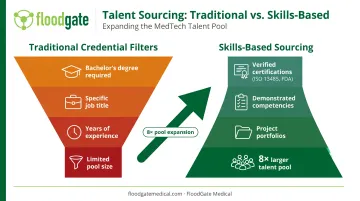
Traditional sourcing filters (bachelor's degree required, five years in title X) often exclude qualified candidates who gained relevant skills through nontraditional paths. Skills-based sourcing flips this model by prioritizing verified skills, certifications, and project portfolios over rigid credential requirements.
Why this approach expands reach:
- Surfaces MedTech talent with FDA compliance certs and quality-system experience, even without a four-year degree
- Expands talent pools up to 8x while increasing female representation
- Opens access to overlooked candidates traditional degree-and-title filters screen out
Real-world application: Instead of filtering LinkedIn by "Bachelor's degree + Quality Engineer title," search for ISO 13485 proficiency, FDA 21 CFR Part 820 knowledge, and documented CAPA experience.
That shift surfaces people standard ATS keyword searches miss:
- Project managers with transferable regulatory skills
- Technicians with certification-based expertise
- Career-changers with proven, role-relevant competencies
Skills-based sourcing fits specialized MedTech roles where verified capability matters more than pedigree. It tracks a wider shift too: between 2017 and 2019, 46% of middle-skill and 31% of high-skill job postings dropped degree requirements. For hiring teams, that means rewriting must-have degree lines into skill, cert, and portfolio checks before the next req goes live.
Key Trend 3: Proactive Passive-Candidate Pipelining
Top MedTech talent, especially in niche fields like interventional cardiology device design or biomedical signal processing, is rarely actively job hunting. These professionals are employed, engaged, and won't respond to a generic job post. Sourcing them requires long-term relationship building rather than reactive requisition filling.
How proactive pipelining works:
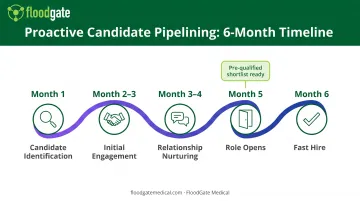
- Recruiters identify and engage high-potential candidates months before a role opens
- Regular touchpoints (industry insights, career coaching, market intelligence) keep candidates warm until timing aligns
- When a position opens, recruiters already have a shortlist of interested, pre-qualified candidates ready to move quickly
Why this trend is accelerating: Organizations like Johnson & Johnson maintain dedicated talent communities where professionals share career goals and stay connected well before applying. This nurture-first approach works especially well in specialized MedTech hiring. A healthcare organization might build a clinical-specialist pipeline six months ahead of a new facility launch or product rollout.
Proactive pipelining cuts time-to-fill and raises candidate quality. It also builds employer reputation long before competitors post a job. The approach requires investment in candidate relationship management tools, but faster hiring of better-matched talent justifies the cost.
Key Trend 4: DEI-Driven Sourcing as a Competitive Advantage
Diversity, equity, and inclusion are no longer afterthoughts in MedTech sourcing. Leading organizations now embed explicit diversity targets into their sourcing strategies so they stop drawing from the same narrow candidate pools. DEI-focused sourcing widens access, reduces unconscious bias, and surfaces talent traditional pipelines miss.
How DEI sourcing creates value:
- Recruiters use diverse candidate databases, inclusive job descriptions, and unbiased screening processes
- Sourcing teams set representation goals upfront rather than treating diversity as a checkbox after the shortlist is built
- Companies partner with recruitment firms that center equity and inclusion in every search
FloodGate Medical builds this into MedTech search work from the start. Equity, diversity, and inclusion sit at the center of how it runs recruiting, helping healthcare device and life sciences companies hire teams that better reflect the patients they serve. That approach supports stronger hiring outcomes, not checkbox compliance.
The business case: Diverse healthcare workforces improve patient access and outcomes, particularly for communities of color. Beyond patient care, diverse teams bring broader perspectives, challenge groupthink, and generate more creative solutions, advantages that matter in a competitive MedTech market where innovation still decides who leads.
Key Trend 5: Internal Mobility and Alumni Sourcing
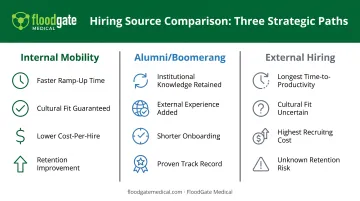
Before posting externally, smart MedTech companies look inward. They identify employees ready for lateral moves and re-engage former employees (boomerang hires). Internal and alumni sourcing deliver faster ramp-up and lower cost-per-hire than external recruiting, with stronger cultural fit as a built-in advantage.
Why internal and alumni channels work:
- Current employees already understand company systems, values, and workflows
- Alumni candidates bring institutional knowledge plus fresh external experience
- Both groups require shorter onboarding and reach full productivity faster than external hires
Real-world examples:
- Organizations like Pfizer maintain dedicated alumni communities that advertise job opportunities to former employees, keeping top talent connected even after they leave
- AI-enabled CRM platforms automatically rediscover past applicants and "silver medalists" (candidates who interviewed well but weren't hired) when new roles open
- Structured internal mobility programs surface high performers for open roles before recruiters post externally
Those same mobility paths improve retention: high performers see a future inside the company instead of looking elsewhere. For specialized MedTech roles where external talent is scarce, promoting from within and bringing back proven alumni is often the fastest, most cost-effective sourcing strategy available.
What's Driving These Talent Sourcing Trends
These shifts come from labor-market and technology pressures that are changing how MedTech companies compete for talent.
Technology advances: AI, automation, and talent CRM platforms are accelerating candidate discovery and engagement. What once took recruiters hours of manual LinkedIn research now happens in seconds through intelligent search and automated outreach.
Market demand: Skills shortages are widening in critical MedTech roles. The BLS projects 5% employment growth for biomedical engineers and 15% growth for health information technologists from 2024 to 2034—faster than average across all occupations. Demand for specialized technical and clinical talent is outpacing supply, forcing companies to source more proactively.
Competitive intensity: MedTech companies face stiff competition for skilled talent from inside and outside the industry. When multiple employers pursue the same narrow pool of interventional cardiology specialists or regulatory affairs experts, early engagement is what wins.
Cost pressures: Rising recruiting costs push organizations toward pipeline-based sourcing. Building candidate pools upfront costs less than running reactive searches for hard-to-fill roles—especially when time-to-fill stretches into months.
How These Trends Are Impacting the MedTech and Healthcare Industry
These sourcing shifts are reshaping hiring workflows, investment priorities, and workforce composition across MedTech organizations.
Operational Impact
Recruiting teams are moving time from reactive screening to proactive research, outreach, and pipeline nurturing. Sourcers spend more hours building relationships with passive candidates months before requisitions open, and less time sifting through inbound applications.
That shift requires new workflows, CRM tools, and metrics tied to pipeline health—not fill rates alone.
Business Impact
Companies are putting more budget into specialized recruitment partners and sourcing technology, and less into broad job-board spend. MedTech organizations increasingly work with firms that know their niche talent pools and can deliver pre-vetted candidates who fit the role and team quickly.
Spend is moving away from post-and-pray job ads toward:
- AI-powered sourcing platforms
- Talent communities
- Relationship-driven recruiting models
Workforce Impact
Hiring teams need skills beyond transactional recruiting:
- Data analysis
- AI tool fluency
- Relationship-based sourcing
Strong MedTech recruiters blend Boolean search with AI platform proficiency and ongoing candidate nurture. Teams that build those capabilities early compete more effectively for scarce specialists in R&D, quality, and commercial roles.
Future Signals for Talent Sourcing in MedTech
Watch these early signals—they will shape MedTech talent sourcing over the next 1–3 years:
- AI agents managing early-stage outreach: Autonomous systems will handle candidate identification, initial messaging, and scheduling, freeing recruiters for relationship building and final-stage evaluation.
- Expanded skills-verification tools: Assessment platforms, digital credentials, and competency-validation services will become standard sourcing inputs, cutting reliance on self-reported skills and unverified resumes.
- Demand for specialized, DEI-committed partners: Generic staffing firms rarely build differentiated MedTech pipelines. Demand will rise for partners like FloodGate Medical that pair industry depth with DEI-centered recruiting.
- Rising fake-profile risk: Gartner predicts 1 in 4 candidate profiles worldwide may be fake by 2028, making identity verification and skills validation increasingly critical.
Conclusion
AI-powered discovery, skills-based sourcing, passive-candidate pipelines, DEI-focused outreach, and internal mobility are changing how MedTech companies hire in 2026. Teams that build these practices early move faster in a tight, specialized market—where precision and relationships decide who lands critical roles.
Proactive pipelines, inclusive sourcing, and tech-enabled discovery work best when paired with deep MedTech expertise. FloodGate Medical helps hiring leaders put that mix into practice so they can fill specialized roles with less friction and keep innovation moving.
Frequently Asked Questions
What are the most common talent sourcing strategies?
The most widely used strategies include AI-driven candidate search and ranking, employee referrals, social and professional networks like LinkedIn, job boards, and proactive outreach to passive candidates. Smart organizations combine multiple channels to build diverse, high-quality pipelines.
What is strategic talent sourcing?
Strategic talent sourcing is the proactive, long-term process of identifying and nurturing candidates before roles open, distinct from reactive recruiting that starts after a requisition is approved. It focuses on building relationships and reusable talent pools rather than filling individual openings.
What skills are needed for talent sourcing?
Effective sourcers need research and Boolean search skills, data analysis capabilities, AI tool fluency, and strong relationship-building and communication skills. The best MedTech sourcers combine technical search expertise with the interpersonal ability to engage passive candidates over time.
How is AI changing talent sourcing?
AI accelerates candidate matching by scanning thousands of profiles in seconds, automates initial outreach and engagement, and scales personalized communication. It shifts sourcers from manual research to strategic relationship management, making sourcing faster and more data-driven.
Why is DEI important in talent sourcing?
DEI-focused sourcing widens talent pools, reduces unconscious bias, and surfaces overlooked but qualified candidates. FloodGate Medical centers equity, diversity, and inclusion in every search so MedTech companies can build teams that reflect the patients they serve.
How do you build a talent pipeline for specialized roles like MedTech?
Define detailed candidate personas based on required skills and experience, then source through niche channels like industry associations, specialized LinkedIn groups, and conferences. Nurture relationships with regular touchpoints, career coaching, and market insights—specialized candidates rarely job hunt actively.