Outsourced talent acquisition and RPO (Recruitment Process Outsourcing) services offer a solution: access to recruiting expertise, specialized networks, and proven processes without building an in-house team. This guide explains what outsourced recruiting is, when it makes sense, different service models, and how to choose the right partner for your MedTech organization.
Key Takeaways
- Outsourced recruiting adds specialized networks and full-time sourcing capacity that speeds up hiring
- RPO manages your full recruitment process; staffing agencies mainly supply temporary workers
- Full-service, project-based, hybrid, and embedded models let you match support to hiring scope and timeline
- Choosing a partner with MedTech industry expertise and DEI commitment delivers better hiring outcomes
What Is Outsourced Talent Acquisition?
Outsourced talent acquisition means partnering with external recruiting experts to run some or all of the hiring process, from sourcing through offer negotiation. Rather than relying only on internal HR or hiring managers, you bring in specialists whose primary job is to find, evaluate, and advance candidates.
RPO (Recruitment Process Outsourcing) is a specific type of outsourcing where an external provider manages the entire recruitment function as an extension of your team. The key distinction: RPO providers take ownership of recruitment-process design, management, and results, not just supply resumes.
What Outsourced Recruiting Is NOT
- Not a staffing agency: Staffing firms usually supply temporary workers who stay on the agency payroll. Outsourced recruiting helps you hire employees onto your own team.
- Not a job board: Job boards are sourcing channels only. Outsourced recruiting covers the full cycle: sourcing, screening, interviewing, and closing.
- Not a generic process: Strong partners adapt to your culture, role requirements, and hiring goals instead of running a fixed playbook.
Common Services Included
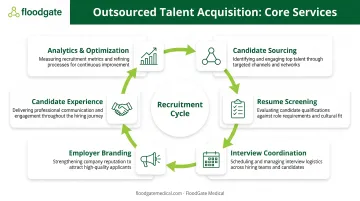
Outsourced talent acquisition typically covers:
- Candidate sourcing through industry networks and specialized channels
- Resume screening and initial candidate assessments
- Interview coordination and scheduling
- Employer branding and recruitment marketing
- Candidate experience management throughout the hiring journey
- Hiring analytics, metrics tracking, and process optimization
Why Companies Outsource Recruiting
Companies outsource recruiting when internal hiring can't match the speed, specialty reach, or cost control the business needs. The advantages show up most clearly in six areas.
Access to Specialized Talent Networks
Recruiting firms build extensive networks in specific industries or roles that most companies don't have internally. In MedTech, for example, specialized recruiters understand technical requirements for roles in regulatory affairs, clinical research, quality assurance, and medical device sales—plus the regulatory considerations and compliance frameworks that shape hiring decisions.
FloodGate Medical, a recruitment firm focused exclusively on medical technology, maintains a network of more than 150,000 MedTech professionals. Coverage spans cardiology devices, healthcare IT, imaging, wound care, and related specialty markets.
That industry depth means faster access to candidates who already understand medical-device development, commercialization, and regulatory compliance.
The advantage extends beyond volume. Specialized recruiters know where to find passive candidates: the 70% of professionals not actively job-hunting but open to the right opportunity. They also know compensation benchmarks, emerging skill gaps, and how to position your company in crowded markets.
Faster Time-to-Hire
External recruiting partners dedicate full-time resources to sourcing and screening, accelerating the hiring timeline. While internal teams juggle multiple priorities, outsourced recruiters focus exclusively on filling your open positions.
According to SHRM's 2025 recruiting benchmark research, positions continue to take about 1.5 months to fill on average. Outsourced recruiting can compress that timeline by providing immediate sourcing capacity, established candidate pipelines, and proven screening processes.
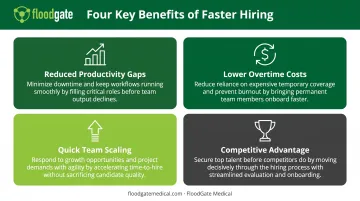
The business impact of faster hiring is significant:
- Reduced productivity gaps when critical roles remain open
- Lower overtime costs for existing staff covering vacant positions
- Ability to capitalize on market opportunities that require quick team scaling
- Competitive advantage in securing top candidates before competitors do
One FloodGate Medical case study illustrates the speed advantage: the firm filled six sales representative positions across five locations nationwide in 21 business days, beating the client's 30-day target during the middle of the pandemic.
Cost-Effectiveness Compared to In-House Teams
The true cost of in-house recruiting extends far beyond recruiter salaries. According to Bureau of Labor Statistics data from May 2024, the median wage for HR specialists (an occupation that includes recruiting and screening) was $72,910 annually, or $35.05 per hour.
That's salary only. A complete in-house recruiting budget includes:
- Recruiter salaries and benefits (health insurance, retirement contributions, paid leave)
- Recruiting technology: applicant tracking systems (ATS), candidate relationship management (CRM) platforms, sourcing tools
- Job board fees and premium job-posting subscriptions
- Sourcing tools and professional databases
- Training and professional development
- Management overhead
Outsourced models often use project-based or success-based fees that scale with hiring needs. When you're not hiring, you're not paying for idle recruiting capacity.
Outsourcing is particularly cost-effective when:
- Hiring needs are intermittent or seasonal rather than continuous
- You need specialized expertise for hard-to-fill roles
- Your organization lacks the volume to justify full-time internal recruiters
- You want predictable recruiting costs tied to outcomes rather than fixed overhead
According to the 2022 RPOA Value and Insights Study of 519 talent-acquisition decision-makers, 42% reported reduced hiring costs after implementing RPO services.
Improved Quality of Hire
Experienced recruiting partners use structured screening, behavioral assessments, and interview frameworks to evaluate technical skill and cultural fit. They also spot warning signs internal teams often miss.
Better hires pay off in clear ways:
- Higher retention and lower turnover cost
- Stronger on-the-job performance
- Fewer mis-hires that trigger expensive replacement searches
The same RPOA study found that 43% of organizations reported higher-quality hires after outsourcing recruitment. FloodGate Medical reports an 89% one-year retention rate for placed professionals.
For MedTech companies, quality of hire is especially critical. Regulatory expertise, clinical knowledge, and FDA pathway experience can't be taught quickly. Hiring the right professional the first time prevents project delays and compliance risk.
Focus Internal Teams on Core Business
Outsourcing recruiting frees internal HR and hiring managers to focus on higher-value activities: onboarding new hires effectively, building retention programs, strengthening company culture, and strategic workforce planning.
The productivity impact is real. Hiring managers spend less time reviewing hundreds of resumes and conducting initial screens, which means more time for:
- Developing their teams
- Driving product innovation
- Building customer relationships
- Strategic planning and execution
For small and mid-sized MedTech companies, this leverage is especially valuable. Leadership teams can focus on regulatory approvals, clinical trials, and market expansion while recruiting experts handle the time-intensive work of finding and vetting candidates.
Enhanced Employer Branding and Candidate Experience
Professional recruiting firms create consistent, positive candidate experiences through timely communication, transparent processes, and respectful interactions at every stage.
The impact extends beyond the hire. Talent Board's 2023 North American CandE Benchmark Research found that companies recognized for candidate experience excellence had a 38% higher willingness-to-refer Net Promoter Score than average North American employers (22 versus 15).
Candidates who have positive experiences—even if not hired—become brand advocates. They refer qualified colleagues, reapply for future openings, and speak positively about your organization in professional networks.
Conversely, poor candidate experiences damage your employer brand. CareerArc's research of 1,200 professionals found nearly 60% of candidates reported a poor experience, and 72% of that group shared it online or directly with others. In specialized fields like MedTech where professional communities are tightly connected, reputation matters.
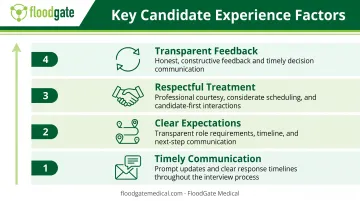
Key candidate experience factors that professional recruiters manage well:
- Timely communication at every stage
- Clear expectations about timeline and process
- Respectful treatment regardless of outcome
- Transparent feedback when candidates aren't selected
Models of Talent Acquisition Outsourcing
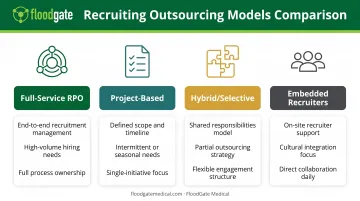
Companies can outsource recruiting in several ways. The right model depends on hiring volume, budget, and how much capability you want to keep in-house.
Full-Service RPO (End-to-End Outsourcing)
Definition: The external partner manages the entire recruiting process from workforce planning to onboarding, replacing internal recruiting resources.
Best for:
- Companies with high-volume hiring needs
- Organizations with no internal recruiting team
- Businesses undergoing rapid growth or expansion
How it works: The RPO provider becomes your recruiting department. That usually covers defining hiring needs, sourcing, screening and interviewing, coordinating with hiring managers, extending offers, and supporting onboarding. Providers typically work in your ATS and operate under your employer brand.
Typical fee structures: According to RPOA's pricing guide, full-service RPO commonly uses:
- Management-fee models: Monthly or hourly fixed fees covering staff, technology, sourcing, and overhead
- Pay-for-performance models: Fees per filled position
- Hybrid models: A mix of fixed fees and per-hire fees
Project-Based or On-Demand Outsourcing
Definition: Engaging external recruiters for specific hiring projects, seasonal needs, or particular roles with a defined timeline and scope.
Best for:
- Companies with intermittent hiring needs
- Seasonal hiring spikes (e.g., sales team expansion before product launch)
- One-off specialized roles that require niche expertise
How it works: You engage the recruiting partner for a defined project, such as filling 10 device-manufacturing roles for a new production line or hiring a VP of Regulatory Affairs. When the project ends, so does the engagement. You can re-engage later as new needs come up.
Typical engagement: Fixed project fees or time-based contracts with clear deliverables and timelines.
Hybrid or Selective Outsourcing
Definition: Outsourcing specific parts of the recruiting process (such as sourcing and initial screening) while keeping other parts in-house (such as final interviews and offer negotiations).
Best for:
- Companies with some internal recruiting capacity who need support for high-volume periods
- Organizations that want to maintain control over final hiring decisions
- Teams that need specialized sourcing support for hard-to-fill roles
How it works: Responsibilities split between internal and external teams. The partner might own sourcing, resume screening, and first-round interviews, then hand qualified candidates to your hiring managers for final interviews and offers.
Recruiting-as-a-Service (Embedded Recruiters)
Definition: External recruiters work on-site or as dedicated resources embedded within your organization, operating as extensions of your internal team.
Best for:
- Companies that want external expertise but need recruiters who deeply understand company culture
- Organizations that prefer recruiters who operate as internal team members
- Situations requiring close collaboration between recruiters and hiring managers
How it works: The embedded recruiter works only on your hiring needs, joins team meetings, learns your culture, and builds relationships with hiring managers. They still remain employed by the recruiting firm.
Typical arrangements: Contract-based with defined time periods (e.g., six months) or hiring targets (e.g., until 20 positions are filled).
When to Consider Outsourcing Your Recruiting
Outsourcing recruiting makes sense when these signals show up:
- High hiring volume overwhelms your team—multiple open roles at once and recruiters can't keep pace
- Specialized MedTech or hard-to-find roles need niche technical, regulatory, or industry expertise
- Time-to-hire drags on and top candidates accept other offers mid-process
- HR owns benefits and employee relations but lacks dedicated recruiting depth
- Hiring must scale up or down with product launches, new markets, or seasonal demand
- Internal leaders need capacity for retention, culture, and workforce strategy—not resume screens
Choosing the Right Outsourced Recruiting Partner
Not all recruiting partners deliver equal value. Choose one by evaluating expertise, approach, cultural fit, and service model.
Industry Specialization vs. Generalist Approach
Industry expertise matters significantly in specialized fields like MedTech. Specialized recruiters understand:
- Technical requirements for roles (such as FDA regulatory pathways, ISO 13485 quality systems)
- Regulatory considerations that shape hiring decisions
- Industry terminology and credentials
- Competitive compensation benchmarks
- Where to find passive candidates in your specific market
Generalist firms may offer broader reach across industries but typically lack the deep networks, technical understanding, and regulatory knowledge that specialized recruiters provide.
Example: FloodGate Medical focuses exclusively on medical technology, with established networks across cardiology and cardiovascular devices, healthcare IT and imaging, wound care, urology, GI, OBGYN, interventional oncology, and related markets.
That focus shows up in the details: recruiters know the difference between a Clinical Affairs Manager and a Clinical Research Associate, which certifications matter for regulatory roles, and how to evaluate experience with 510(k) submissions or PMA applications. Generalist recruiters often miss those distinctions.
Commitment to Diversity, Equity, and Inclusion
DEI in recruiting improves decision-making, strengthens innovation, and supports stronger business outcomes.
McKinsey's 2023 research analyzing 1,265 companies in 23 countries found that executive teams in the top quartile for gender diversity and ethnic diversity each had a 39% greater likelihood of financial outperformance than bottom-quartile peers.
In healthcare and MedTech specifically, diversity matters even more. Research shows diverse teams improve patient outcomes, enhance innovation, strengthen communication, and make better risk assessments. The Commonwealth Fund notes that a representative healthcare workforce is associated with better access, patient perceptions, and health outcomes, especially for patients of color.
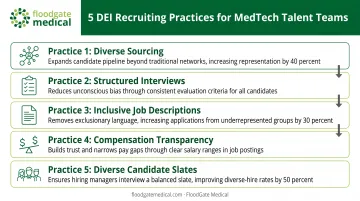
What DEI-focused recruiting looks like:
- Intentional sourcing from diverse talent pools and professional networks
- Structured interviews that reduce unconscious bias
- Inclusive job descriptions that avoid gendered or exclusionary language
- Transparency about compensation ranges to address equity gaps
- Commitment to diverse candidate slates for every role
FloodGate Medical builds DEI into sourcing, screening, and slate design so clients see diverse, qualified candidates for every search.
Cultural Fit and Employer Brand Alignment
The right recruiting partner understands and authentically represents your company culture and values to candidates. A mismatch here creates problems: candidates who aren't culturally aligned won't succeed long-term, and poor representation damages your employer brand.
Key evaluation questions:
- How will they learn about our culture, values, and work environment?
- How do they communicate our value proposition to candidates?
- Can they represent our employer brand authentically in the market?
- Will they identify candidates who will thrive in our specific environment?
FloodGate Medical invests time upfront through discovery processes to understand both organizational culture and position-specific requirements. The firm's team is trained and certified in Hiring for Attitude through Leadership IQ, helping recruiters identify the attitudes most important to each client and match candidates accordingly.
Transparent Communication and Partnership Approach
Effective recruiting partnerships require regular communication, clear expectations, and collaborative problem-solving.
What a true partnership looks like:
- Regular check-ins and status updates
- Shared metrics and transparent performance tracking
- Openness to feedback and willingness to adjust processes
- Proactive communication about challenges and market conditions
- Accessibility through multiple channels (phone, email, text)
Strong partners treat recruiting as a consultative relationship: they share market and compensation insight, then adjust the process based on your feedback.
Track Record and References
Vet recruiting partners through client references, case studies, and demonstrated results in similar roles or industries.
Questions to ask:
- What is your average time-to-fill for roles like ours?
- What percentage of your placements are still with the company after one year?
- Can you provide references from similar organizations in our industry?
- What metrics do you track to measure recruiting success?
- How do you handle situations when a hire doesn't work out?
Look for specific, quantifiable results. General claims about "quality candidates" or "fast hiring" matter less than documented outcomes with measurable retention rates, time-to-hire benchmarks, and client satisfaction data.
Service Model Flexibility
The right partner can scale services up or down based on your hiring needs and offer multiple engagement models: project-based, retained, hybrid, or embedded recruiters.
This flexibility helps you:
- Manage costs by paying only for services you need
- Align recruiting support with business cycles and hiring volume
- Start with a project to test the partnership before committing to larger engagements
- Scale quickly when market opportunities require rapid hiring
FloodGate Medical offers retained, embedded, project-based, and team-build models, supporting hiring requests ranging from individual specialized roles to expansions of 5 to 70+ new hires within a three-month period.
Frequently Asked Questions
How much does RPO cost?
RPO pricing depends on service scope, industry focus, and hiring volume. Common pricing models include management fees (monthly or hourly), pay-for-performance (per hire), and hybrid models that combine both.
What are the recruitment process stages?
There’s no single standard, but most processes move through these phases:
- Workforce planning and sourcing
- Screening, assessment, and interviewing
- Offer negotiation, onboarding, and post-hire follow-up
Are BPO and RPO the same?
No. BPO (Business Process Outsourcing) covers outsourcing many functions, such as accounting, customer service, or IT support. RPO is a form of BPO focused only on recruiting and talent acquisition.
What's the difference between outsourced recruiting and using a staffing agency?
Staffing agencies typically provide temporary workers who remain employees of the agency for employment and benefits purposes. Outsourced recruiting partners manage your recruitment process to help you hire permanent employees who work directly for your organization.
How do I know if my company needs outsourced talent acquisition?
Consider outsourcing if hiring volume overwhelms your team, you need niche networks for specialized roles, or slow time-to-hire costs you top candidates. Teams without dedicated recruiting expertise—or that need capacity that scales with business cycles—also gain from outside support.
Can outsourced recruiters understand our company culture and technical requirements?
Yes, when partners invest time upfront. Strong firms run discovery on your culture, values, technical needs, and hiring priorities. Dedicated recruiters learn your organization over time and work as extensions of your internal team.
For MedTech companies, outsourced talent acquisition can add specialized recruiting depth, faster hiring, and stronger quality of hire without locking in full in-house headcount. Choose full-service RPO, project support, or embedded recruiters based on need—and prioritize partners with MedTech experience, a real DEI commitment, and a working style that fits your culture.