Introduction
A thermometer, an insulin pump, a surgical robot guiding a heart procedure. These are all medical devices, and they touch nearly every patient interaction in modern healthcare.
The industry behind them is massive. The global medical device market hit $572.31 billion in 2025 and is projected to climb toward $1.03 trillion by 2034, according to a 2025 market report from Fortune Business Insights.
That growth brings a challenge many companies underestimate: building the right teams fast enough to keep pace. New device categories, tighter regulatory scrutiny, and a shift toward software-driven products mean MedTech companies need talent that didn't exist a decade ago.
This article breaks down what medical devices actually are, how they're classified, where the fastest growth is happening, and the career paths powering this industry.
Key Takeaways
- Global medical device market hit $572.31 billion in 2025, growing nearly 7% annually
- FDA sorts devices into three risk classes (I-III), each with distinct regulatory pathways
- Wearable devices like continuous glucose monitors represent one of MedTech's fastest-growing segments
- 94% of U.S. medtech companies have fewer than 50 employees, driving constant hiring demand
- Digital and software skills are increasingly critical alongside traditional engineering backgrounds
What Is a Medical Device? Definitions and Classifications
The FDA defines a medical device under Section 201(h) as an instrument, apparatus, implant, or similar article intended to diagnose, treat, or prevent disease. The key distinction: it works through physical or mechanical action, not chemical action inside the body.
That's the line separating devices from pharmaceuticals. A stent physically props open an artery. A drug changes body chemistry to lower cholesterol. Some companies, like Johnson & Johnson and Abbott, operate in both spaces, which is why their portfolios span everything from catheters to injectable medications.
FDA Device Classifications: Class I, II, and III
The FDA sorts every device into one of three risk-based tiers, and the tier determines how much regulatory scrutiny applies before it reaches patients.
| Class | Risk Level | Example | Regulatory Pathway |
|---|---|---|---|
| Class I | Lowest risk | Elastic bandage | General Controls; most are exempt from premarket review |
| Class II | Moderate risk | Powered wheelchair, infusion pump | 510(k) clearance required |
| Class III | Highest risk | Replacement heart valve, pacemaker | Premarket Approval (PMA) required |
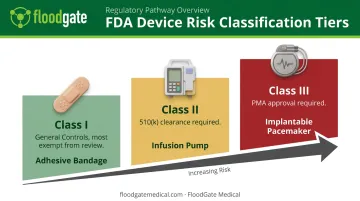
A 510(k) submission demonstrates that a new device is substantially equivalent to one already on the market. A PMA is far more rigorous, requiring valid scientific evidence that proves reasonable assurance of safety and effectiveness.
The two pathways lead to different outcomes:
- 510(k): results in clearance, based on equivalence to an existing device
- PMA: results in approval, based on independent proof of safety and effectiveness
Mixing up "clearance" and "approval" is a common mistake, even inside the industry.
Navigating these pathways takes specialized regulatory affairs expertise. Timelines can stretch for months or years, and a single misstep can delay a product launch by a full budget cycle. This is exactly why companies fight hard to recruit experienced regulatory professionals, not just engineers.
Types and Examples of Medical Devices Across Healthcare
Medical devices span five broad categories, each solving a different clinical problem.
- Diagnostic and imaging devices – MRI, ultrasound, and X-ray equipment, such as Siemens Healthineers' MAGNETOM Vida 3T MRI system.
- Surgical and robotic systems – Surgeon-controlled platforms like Intuitive Surgical's da Vinci system that extend precision during minimally invasive procedures.
- Implantable devices – Pacemakers, stents, and joint replacements, including Medtronic's Micra leadless pacemaker, which treats slow heart rhythms without traditional leads.
- Patient monitoring devices – Continuous monitors tracking vitals, glucose, or cardiac activity in real time.
- Disposable and consumable devices – Syringes, wound-closure products, and specialty microcatheters like ASAHI's Corsair Pro, used in complex coronary interventions.
The Rise of Software as a Medical Device
One category didn't exist in this form a generation ago: Software as a Medical Device (SaMD). The FDA defines SaMD as software intended for a medical purpose that performs that function without being part of a physical device.
SaMD can run on a smartphone, a hospital server, or a cloud platform. Its classification, and whether it needs 510(k), De Novo, or PMA review, depends entirely on intended use and risk, not on the fact that it's software.
Clinical trial volumes in medtech grew 11% annually from 2019 to 2023, more than double the pace of the prior four years, according to a McKinsey analysis of medtech clinical-trial activity. R&D spending is climbing even faster than sales, a signal that companies are betting heavily on next-generation products, including AI-driven diagnostics.
Wearable Medical Devices: The Fastest-Growing MedTech Category
Wearable medical devices are body-worn technologies that continuously monitor, diagnose, or treat a condition using embedded sensors. What separates a clinical-grade wearable from a fitness tracker comes down to three things: the medical claim it makes, the regulatory clearance behind it, and the accuracy standards it must meet.
Common clinical wearables include:
- Continuous glucose monitors (Dexcom G7, Abbott's FreeStyle Libre)
- Wearable ECG and heart rhythm monitors
- Smart insulin delivery patches
- Remote patient monitoring biosensors
Why This Category Is Exploding
Several forces are converging at once:
- Aging populations need continuous chronic disease management outside hospital walls
- Telehealth adoption normalized remote data collection during and after the pandemic
- Patient demand for at-home monitoring keeps rising as chronic conditions like diabetes and heart disease increase
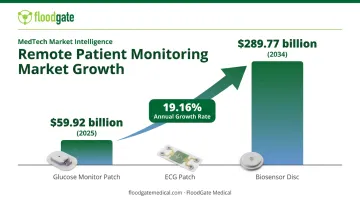
The numbers back this up. The remote patient monitoring market alone is projected to grow from $59.92 billion in 2025 to $289.77 billion by 2034, a 19.16% annual growth rate.
Regulatory Nuance Matters Here
The FDA doesn't regulate wearables by form factor. A smartwatch tracking steps for general wellness sits outside heavy oversight, while a CGM making a specific diabetes management claim does not. Companies building these products need teams who understand this distinction well before a product reaches a design freeze.
This regulatory complexity, paired with rapid product iteration, is fueling hiring demand for software engineers, data scientists, and biomedical engineers who can build connected, compliant devices from day one.
The Medical Device Industry Landscape Today
The U.S. medtech sector is enormous, and it's built on small businesses more than headline-grabbing giants. According to AdvaMed:
- 14,500+ medtech companies operate in the U.S.
- 94% employ fewer than 50 people
That structure matters for hiring. Most companies aren't Medtronic or Abbott with deep internal recruiting benches. They're lean teams competing for the same specialized talent pool as the industry's largest players.
Speaking of the giants: Medtronic, J&J MedTech, Abbott, and Siemens Healthineers anchor the top of the market, while thousands of smaller innovators drive the next wave of products through partnerships and acquisitions.
M&A activity tells its own story. Deal volume dropped from 184 transactions in 2023 to 61 in 2024, according to EY, but disclosed deal value actually rose from $44.2 billion to $50.5 billion. Fewer, bigger bets. That pattern usually means established players are consolidating around proven technology rather than chasing volume.
Careers in the Medical Device Industry
MedTech has evolved into a cross-functional industry, with roles now spanning far beyond the lab bench to include software, data, and regulatory expertise alongside traditional engineering.
Core career paths include:
- R&D and product engineering
- Regulatory affairs
- Quality assurance
- Clinical affairs
- Commercial and sales roles
The economic footprint is significant too. AdvaMed's economic impact analysis puts direct U.S. medtech employment at over 450,000 jobs, making it a genuine driver of regional economies, particularly in states with dense device manufacturing clusters.
The Digital Skills Shift
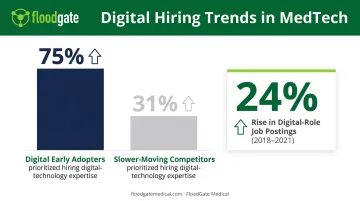
As devices lean more heavily on connectivity and AI, the talent equation is changing. U.S. digital-role postings in medtech rose 24% between 2018 and 2021, according to Deloitte's research on medtech's digital talent challenge. Among companies Deloitte classified as digital early adopters, 75% prioritized hiring digital-technology expertise, compared to just 31% of slower-moving competitors.
Traditional engineering isn't going away, but companies now increasingly need software developers, data scientists, and cybersecurity specialists working alongside mechanical and biomedical engineers on the same product teams.
Finding this hybrid talent is its own challenge. FloodGate Medical, a MedTech-focused staffing firm, helps companies fill these roles as hiring needs evolve.
Building the Right MedTech Team with FloodGate Medical
Finding people who understand both the clinical stakes and the regulatory maze of MedTech isn't easy, especially for the small-to-midsize companies that make up most of this industry.
FloodGate Medical works exclusively within this space. We connect skilled professionals with MedTech companies through permanent placement and contract staffing, covering everything from device development and regulatory affairs to commercial and clinical roles.
What sets our approach apart:
- A recruitment methodology built around equity, diversity, and inclusion
- Deep, exclusive focus on MedTech rather than general healthcare staffing
- Career coaching and hiring-manager training that supports both sides of the hire
This DEI-driven approach shapes results, not just optics. Companies with varied perspectives on their teams tend to design safer, more usable devices for a broader patient population.
That same focus on fit applies to every search we run. If your company is scaling device development, tightening regulatory compliance, or building out a commercial team, we can help you find the right talent.
Candidates looking for career insight and open roles can subscribe to FloodGate Medical's monthly newsletter for MedTech-specific updates.
Frequently Asked Questions
What are examples of MedTech devices?
MedTech devices span diagnostic imaging (MRI, ultrasound), implants (pacemakers, stents), surgical robots like the da Vinci system, and everyday disposables like catheters and syringes. Insulin pumps and glucose monitors also fall into this category.
What are wearable MedTech devices?
Wearable medical devices are body-worn technologies with sensors that monitor or treat a medical condition, distinct from consumer fitness trackers. Common examples include continuous glucose monitors like Dexcom G7 and wearable ECG patches.
What is the difference between Class I, II, and III medical devices?
Class I covers low-risk devices like bandages, subject to general controls. Class II covers moderate-risk devices like infusion pumps, requiring 510(k) clearance. Class III covers high-risk devices like pacemakers, requiring full PMA approval.
How big is the medical device industry?
The global medical device market reached $572.31 billion in 2025, growing toward $1 trillion by 2034. In the U.S. alone, the industry supports more than 450,000 direct jobs.
What skills are in demand for medical device careers?
Traditional engineering and regulatory affairs remain essential, but software development, data science, and cybersecurity skills are increasingly critical as devices become more connected and AI-driven.
How is AI changing medical devices?
AI now powers diagnostic tools, personalized treatment platforms, and a growing share of Software as a Medical Device products. The FDA has already authorized numerous AI-enabled devices and now permits pre-approved update plans for faster algorithm upgrades.