
Introduction: The Strategic Importance of Candidate Recruitment
Finding and securing top talent in medical technology has never been more challenging. Deloitte's 2024 survey of 100 large MedTech organizations found that 75% of digital early adopters prioritized hiring digital expertise, compared with just 31% of laggards.
That gap shows why strategic candidate recruitment fuels innovation and competitive advantage in healthcare technology.
Yet the talent pool is tight. The Bureau of Labor Statistics counted just 19,320 bioengineers and biomedical engineers employed across the entire United States in May 2023, with only 3,050 working specifically in medical-equipment and supplies manufacturing.
When demand for specialized MedTech skills outpaces supply, companies that master candidate recruitment gain a measurable edge.
This guide walks through the essential concepts, seven-stage process, technology enablers, and proven strategies that help MedTech organizations build the specialized teams they need to innovate and grow.
Key Takeaways
- Build pipelines through workforce planning before roles open—not after
- Skills-based hiring expands talent pools; 72% of employers now practice it
- Passive candidates represent 70% of the workforce and require proactive engagement rather than traditional job ads
- Structured, scored interviews reduce bias and improve hire quality
- Track conversion rates and time-to-fill by stage to spot bottlenecks fast
Understanding Candidate Recruitment: Key Concepts
What Candidate Recruitment Really Means
Candidate recruitment is the proactive process of attracting, screening, selecting, and onboarding talent for current and future needs. Posting jobs and reviewing applications is only one part of the cycle.
SHRM defines recruitment as the broad process that includes background checking, offering, and often the initial onboarding phase. In contrast, hiring refers specifically to the evaluation and selection decision made within the larger recruitment cycle.
Key distinctions:
- Recruitment builds ongoing pipelines before roles open
- Hiring is the tactical decision to evaluate and select someone for a specific requisition
- Sourcing is the proactive search for qualified candidates for current or planned openings
Active vs. Passive Candidate Sourcing
Understanding your target candidate's job-search behavior shapes your entire recruitment approach:
Passive candidates (about 70% of the global workforce) are not job hunting but will consider the right role. Reaching them takes relationship-building, direct outreach, and messaging tied to their career goals.
Active candidates (about 30% of the workforce) are job hunting now. They respond to postings and move quickly through applications, yet they form a smaller, more competitive pool.
For specialized MedTech roles—regulatory affairs managers, clinical engineers, quality systems specialists—the majority of qualified talent is passive. FloodGate Medical reports that 70% of its MedTech placements come from passive candidates, supported by a network of more than 150,000 MedTech professionals cultivated over 30+ years.
How Recruitment Aligns with Workforce Planning
Effective recruitment doesn't start when a position opens. It begins with workforce planning: analyzing organizational growth objectives, identifying capability gaps, forecasting hiring needs by function and timeline, and building talent pipelines in advance.
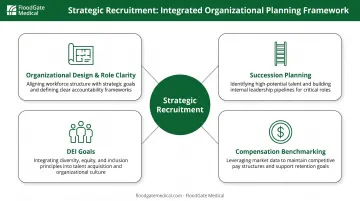
Strategic talent acquisition integrates recruitment with:
- Organizational design and role clarity
- Succession planning for critical positions
- Compensation benchmarking and market intelligence
- DEI goals that widen talent pools
When recruitment runs as a strategic function instead of a reactive service, companies fill roles faster and raise quality of hire—even when growth accelerates or the market shifts.
The Candidate Recruitment Process: 7 Essential Stages
Stage 1: Workforce Planning and Needs Assessment
Begin by translating business strategy into talent requirements. Identify current skills gaps through team assessments, review upcoming projects and product launches, and anticipate hiring volumes and timelines based on growth targets.
Essential activities:
- Conduct talent audits to evaluate existing capabilities
- Define critical roles required for commercialization, R&D, or regulatory milestones
- Build workforce forecasts by department, role family, and quarter
- Align hiring priorities with budget cycles and strategic initiatives
MedTech organizations should plan especially carefully for specialized roles such as biomedical engineers, clinical specialists, and regulatory professionals, where candidate scarcity demands longer lead times.
FloodGate Medical helps clients turn growth objectives into prioritized hiring roadmaps through organizational design, role profiling, and succession planning.
Stage 2: Job Requirements Definition
Translate each role into a clear, compelling job description that attracts qualified candidates and sets evaluation standards.
Effective job descriptions include:
- Specific technical skills, certifications, and regulatory knowledge required
- Day-to-day responsibilities and key deliverables
- Success metrics that define excellent performance in the first 90 days and first year
- Compensation range (transparency improves application quality and reduces drop-off)
- Growth opportunities and career-development pathways
Avoid generic language. A "Quality Engineer" description should specify ISO 13485 experience, risk-management documentation requirements, CAPA process ownership, and familiarity with FDA 21 CFR Part 820, not just "quality systems knowledge."
Skills-based job definitions expand candidate pools. A 2023 survey found that 72% of employers practice skills-based hiring, and 45% removed degree requirements from some roles during the prior year. Focus on validated competencies and certifications rather than credentials alone.
Stage 3: Candidate Sourcing
Build diverse candidate pools through multiple channels, prioritizing those that consistently deliver quality over volume.
High-impact sourcing channels:
- Professional networks and LinkedIn: Direct outreach to passive candidates with relevant MedTech experience
- Employee referrals: Tap trusted networks within the healthcare technology sector; referrals often convert faster and stay longer
- Industry associations: Engage with AdvaMed, Medical Alley Association, BioFlorida, and specialty groups
- University partnerships: Build pipelines with biomedical engineering programs and co-op/internship arrangements
- Specialized recruiters: Firms with MedTech focus provide access to pre-qualified passive talent and competitive intelligence
- Job boards and career sites: Post openings on general boards (Indeed, LinkedIn Jobs) and niche MedTech sites
CareerPlug's 2024 analysis of 10 million+ applications found that job boards produced 60% of applications, but volume doesn't equal quality. Track which sources yield interviews and hires, not just clicks.
FloodGate Medical's FloodGate Finder referral program illustrates how MedTech networks accelerate sourcing: professionals can refer qualified contacts for open positions and earn up to $2,500 when a referral is successfully hired.
Stage 4: Screening and Initial Assessment
Review applications using structured criteria to separate qualified candidates from those missing essential requirements. Consistency at this stage reduces bias and ensures you don't overlook strong matches.
Screening best practices:
- Define must-have versus nice-to-have qualifications before reviewing applications
- Use a standardized checklist or scoring rubric for every resume
- Conduct brief phone screens (15-20 minutes) to verify key qualifications, confirm interest, and assess communication skills
- Share role details, compensation range, and next steps transparently
Applicant tracking systems speed up this stage. Jobscan found that 98.4% of Fortune 500 companies use an ATS in 2024. While smaller MedTech firms may not require enterprise ATS platforms, basic candidate-management tools improve speed and organization.
CareerPlug's 2024 benchmarks show an average 3% applicant-to-interview conversion rate across small businesses, meaning screeners reviewed approximately 180 applicants per hire. Your conversion rate should reflect role complexity and required specialization.
Stage 5: Interviewing and In-Depth Evaluation
Conduct structured interviews with standardized questions to assess technical skills, problem-solving ability, experience relevance, and cultural alignment. Consistency improves candidate comparison and reduces unconscious bias.
Structured interview framework:
- Prepare standardized questions aligned to job requirements and success metrics
- Use behavioral and situational prompts such as "Tell me about a time when..." or "How would you handle..."
- Assign scoring criteria for each question or competency area
- Train interviewers on evaluation standards, legal guidelines, and bias reduction
- Document responses using an interview scorecard so multiple stakeholders can compare candidates fairly
The STAR method (Situation, Task, Action, Result) helps candidates structure answers and gives interviewers clearer evidence of past performance.
FloodGate Medical equips MedTech hiring managers with interview question guides, scorecard templates, and SOPs that keep evaluations consistent and tied to company values. That discipline lowers the odds of a bad hire, which costs an average of $140,000.
Plan interviews to respect candidate time. A typical interview cycle might include a 30-minute phone screen, a 45-60 minute hiring-manager interview, a technical or case-study assessment, and a final culture-fit or leadership panel interview.
Stage 6: Selection and Offer Extension
Make data-driven hiring decisions by reviewing scorecards, comparing candidates against success profiles, and confirming references. Then present competitive offers that reflect market conditions and candidate expectations.
Selection checklist:
- Consolidate interview scores and feedback from all stakeholders
- Verify that the top candidate meets all must-have qualifications and shows strong potential on key success metrics
- Conduct reference checks to validate past performance and cultural fit
- Review compensation benchmarks and confirm offer competitiveness
Offer components:
- Base salary aligned to market data and internal equity
- Bonus, equity, or commission structure where applicable
- Benefits summary (health, retirement, PTO, professional development)
- Start date, reporting structure, and onboarding timeline
- Clear next steps and decision deadline
Move quickly. Employ's 2024 data shows an average 41-day time-to-fill across industries, with 35 days for enterprises and 46 days for SMBs. Top candidates often have competing offers; delays increase the risk they'll accept elsewhere.
Stage 7: Onboarding and Integration
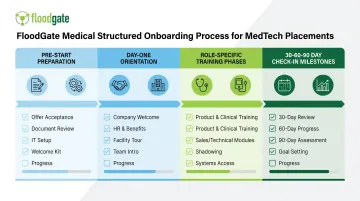
Welcome new hires with comprehensive onboarding that accelerates productivity, clarifies expectations, and builds early engagement. Onboarding begins before day one and extends through the first 90 days.
Structured onboarding includes:
- Pre-start communication: welcome email, paperwork, first-day logistics, and equipment setup
- Orientation: company mission, values, organizational structure, policies, and compliance training
- Role-specific training: systems access, process documentation, product knowledge, and regulatory requirements
- Relationship-building: introductions to team members, cross-functional partners, and key stakeholders
- 30-60-90 day check-ins: regular manager meetings to review progress, answer questions, and adjust support
Early experience shapes whether people stay. Approximately 53% of 2022-23 interns converted to full-time hires, down from nearly 58% the prior year. The same idea applies to full-time roles: strong onboarding improves retention and helps new hires contribute faster.
FloodGate Medical emphasizes post-placement support, including follow-up several weeks after a candidate starts, to catch friction early and keep transitions on track.
Top Recruitment Strategies for MedTech Companies
Build and Maintain Talent Pipelines
Proactive pipeline development means cultivating relationships with potential candidates before positions open. Rather than starting searches from scratch each time, maintain ongoing engagement with high-potential talent.
Pipeline-building tactics:
- Identify target companies, roles, and professionals in your MedTech niche
- Engage passive candidates through LinkedIn outreach, industry events, and informational conversations
- Share company updates, product launches, and thought leadership to stay visible
- Map organizational needs 6-12 months ahead and begin relationship-building early
FloodGate Medical uses workforce planning, candidate market mapping, and continuous engagement to build MedTech pipelines across functional areas—commercial, R&D, quality, regulatory, clinical—before specific requisitions open. Its Talent Spotlight program provides clients with curated, pre-screened candidates through exclusive monthly updates.
Leverage Employee Referral Programs
Employee referrals tap trusted professional networks and often deliver higher-quality candidates who convert faster and stay longer. Referrals are especially valuable in MedTech, where specialized expertise and cultural fit are critical.
Effective referral programs:
- Offer meaningful incentives ($1,000-$2,500 per successful hire is common)
- Make referral submission simple through online portals or email
- Provide regular updates on referral status to maintain engagement
- Recognize and thank employees publicly when referrals are hired
LinkedIn research suggests that employee networks can expand a talent pool 10-fold and that referrals rank among the top sources of quality hires. FloodGate Medical's FloodGate Finder allows professionals to monetize their MedTech networks by referring candidates and earning finder's fees when referrals are hired.
Partner with Universities and Professional Associations
Access emerging MedTech talent and specialized skill sets by building relationships with universities and industry groups.
Partnership opportunities:
- Sponsor capstone projects and campus events with biomedical engineering, regulatory science, and clinical research programs
- Build co-op and internship pipelines designed to convert into full-time hires
- Join groups such as Medical Alley Association, BioFlorida, AdvaMed, and specialty societies
- Network at conferences including HIMSS, RSNA, ACC, and AdvaMed
- Mentor students and early-career professionals to grow brand awareness and relationships
Internship-to-hire conversion averages approximately 53%, making structured intern and co-op programs a measurable talent source.
Implement Skills-Based Hiring
Prioritize demonstrated competencies and certifications over traditional credentials alone. Skills-based hiring expands candidate pools, improves diversity, and focuses evaluation on job-relevant capabilities.
How to adopt skills-based hiring:
- Identify the technical and behavioral competencies truly required for success
- Remove degree requirements where they're not legally or operationally necessary
- Assess candidates through work samples, technical exercises, or certifications such as Certified Quality Engineer or Regulatory Affairs Certification
- Provide training programs to develop skills internally
In 2023, 72% of surveyed employers practiced skills-based hiring, and 45% had removed degree requirements from some roles during the prior year. Employers who implemented training programs reported that 53% saw strong improvements in recruitment and retention.
Adopt DEI-Driven Recruitment Methodologies
Diversity, equity, and inclusion expand candidate pools and build diverse teams that drive innovation in healthcare outcomes. McKinsey's research of 1,265 companies found that top-quartile gender-diverse executive teams had a 39% higher likelihood of financial outperformance; the ethnic-diversity comparison was also 39%.
Note that McKinsey reports correlation, not causation.
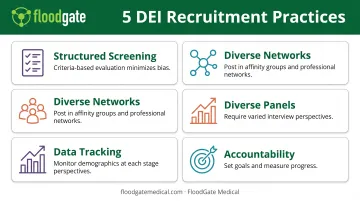
DEI recruitment practices:
- Use structured, criteria-based screening that minimizes demographic bias
- Post openings in diverse professional networks and affinity groups
- Require diverse interview panels to broaden perspective
- Track demographic data at each recruitment stage to identify drop-off points
- Set diversity goals and hold hiring managers accountable
FloodGate Medical centers its MedTech recruitment on equity, diversity, and inclusion. Its approach uses AI-assisted, criteria-based candidate searching that does not consider demographic information, race, or age. That reduces conscious and subconscious bias while supporting diverse, qualified candidate pools.
Leveraging Technology in Modern Recruitment
Implement Applicant Tracking Systems (ATS)
An ATS centralizes candidate data, automates workflow, and maintains organized hiring processes. While nearly universal among Fortune 500 companies, adoption varies widely among smaller firms.
ATS benefits:
- Centralized candidate database with searchable profiles and resumes
- Automated job posting to multiple boards and social channels
- Workflow management with stage-based candidate tracking and team collaboration
- Compliance documentation for EEOC, OFCCP, and audit requirements
- Reporting dashboards for time-to-fill, source of hire, and conversion metrics
Jobscan detected an ATS at 98.4% of Fortune 500 companies in 2024, up from 97.4% in 2023. However, this large-enterprise benchmark doesn't represent smaller MedTech firms. Choose platforms scaled to your hiring volume and complexity.
Use AI-Powered Tools
AI speeds up resume screening, candidate matching, and initial assessments. How common it is depends on how each survey defines AI and who answers.
SHRM's 2024 survey of 2,366 US HR respondents found that about one-quarter of employers used AI for HR, with 64% of AI adopters applying it in talent acquisition.
Specific recruiting uses included job descriptions (65%), customized postings (42%), and roughly one-third for screening, candidate communication, or automated search.
Employ's 2024 survey of 1,200+ North American talent acquisition professionals found a higher figure: 63% used AI to support recruitment technology, up from 58% in 2023. Different definitions and respondent pools explain the gap.
AI applications in recruiting:
- Resume parsing and keyword matching to identify qualified candidates faster
- Chatbots for candidate Q&A and interview scheduling
- Predictive analytics to score candidate fit and likelihood of acceptance
- Automated outreach and follow-up messaging
Balance efficiency with human judgment. AI can surface candidates and automate administrative tasks, but structured human interviews remain essential for assessing cultural fit, communication skills, and nuanced qualifications.
Use Social Media and Professional Networks
LinkedIn, Facebook, Instagram, and industry forums enable both active job posting and passive candidate engagement.
Social recruiting tactics:
- Maintain an active company page with employee stories, product updates, and culture content
- Post openings and share directly in relevant professional groups
- Use LinkedIn Recruiter or Sales Navigator for targeted outreach to passive candidates
- Engage with industry hashtags and participate in conversations to build visibility
- Showcase your employer brand through video, employee testimonials, and behind-the-scenes content
LinkedIn remains the dominant platform for MedTech recruiting, but niche communities on Slack, Discord, or specialty forums can surface hard-to-find expertise.
Building a Positive Candidate Experience
Candidate experience shapes your ability to attract, hire, and retain top talent, and it influences your employer brand long after hiring decisions are made.
Maintain Clear, Consistent Communication
Candidates consistently cite communication as the top driver of positive or negative recruiting experiences. Keep candidates informed at every stage.
Communication best practices:
- Acknowledge applications within 24-48 hours with a confirmation email and timeline
- Provide updates after each interview, even if the decision isn't final
- Assign clear points of contact so candidates know whom to reach with questions
- Respond promptly to candidate emails and calls (aim for same-day or next-day responses)
LinkedIn reported that recruiter contact could accelerate offer acceptance for 89% of talent, and contact from the prospective manager could do so for 94%. Assign communication owners and deadlines at each recruitment stage.
FloodGate Medical clients highlight responsiveness and consistent check-ins (before and after interviews, throughout the process, and even weeks after starting a new job) as key differentiators.
Provide Transparency
Share compensation ranges, growth opportunities, and role expectations upfront. Transparency improves application quality, reduces mid-process drop-off, and builds trust.
What to disclose early:
- Salary range and bonus/equity structure
- Benefits overview (health, retirement, PTO, professional development budget)
- Career progression paths and typical timelines
- Work arrangement (on-site, hybrid, remote flexibility)
- Key challenges or expectations in the first 90 days
A 2015 CareerBuilder survey found that 77% of workers would accept 5% less than expected after a great hiring-process impression, and 83% would do so for a company with a great employer reputation. Candidate experience still shapes what people will accept on pay.
Design Respectful Interview Processes
Respect candidate time while thoroughly assessing fit through structured, efficient interviews.
Interview process design:
- Limit interview rounds to 3-4 stages maximum for most roles
- Schedule interviews within a 2-3 week window to maintain momentum
- Share interview logistics, participant names and titles, and preparation guidance in advance
- Conduct interviews on time and avoid rescheduling unless unavoidable
- Standardize questions and scoring so candidates are evaluated fairly
FloodGate Medical provides candidates with instructional videos for phone and in-person interviews, reducing stress and helping candidates perform at their best.
Follow Up with All Candidates
Close the loop with every candidate, including those not selected. Personalized feedback leaves a positive impression and keeps doors open for future opportunities.
Rejection communication:
- Send timely rejection emails within 1-2 weeks of the final decision
- Offer brief, constructive feedback when possible (for example, "We selected a candidate with more regulatory submission experience")
- Encourage candidates to apply for future roles and stay connected
- Invite feedback on the interview process to improve continuously
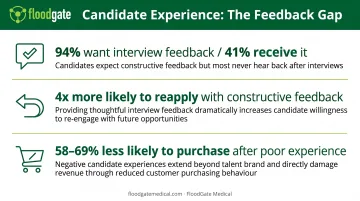
LinkedIn found that 94% of candidates wanted interview feedback, but only 41% received it. Constructive feedback made talent 4x more likely to consider a future opportunity.
Poor follow-up also hits the brand. CareerBuilder reported that 58% of candidates were less likely to buy from an employer that ignored an application, 69% after a bad interview, and 65% after interview silence.
Measuring Recruitment Success: Key Metrics
Track quantitative metrics to identify bottlenecks, optimize processes, and demonstrate recruitment ROI.
Time-to-Fill and Time-in-Stage
Time-to-fill measures days from requisition posting to accepted offer. Employ's 2024 data shows a cross-industry average of 41 days, with 35 days for enterprises and 46 days for SMBs.
Time-in-stage breaks down how long candidates spend in each recruitment phase: sourcing, screening, interviewing, offer negotiation. This granular view reveals where delays occur.
Benchmark by company size, role family, and complexity. Specialized MedTech roles often require longer timelines due to smaller candidate pools and multi-stakeholder decision processes.
Candidate Conversion Rates
Measure conversion between stages to pinpoint where qualified candidates drop out.
Key conversion metrics:
- Application-to-screen: Percentage of applicants who advance to phone or initial interview
- Screen-to-interview: Percentage who move from initial screen to in-depth interviews
- Interview-to-offer: Percentage of interviewed candidates who receive offers
- Offer-to-acceptance: Percentage of offers accepted
CareerPlug's 2024 analysis found a 3% applicant-to-interview rate and a 27% interview-to-hire rate among small businesses. Low conversion at any stage signals process problems—unclear job descriptions, misaligned screening criteria, uncompetitive offers, or poor candidate experience.
Source of Hire
Measure which recruitment channels consistently deliver the best-fit candidates. Track not just application volume but interviews, offers, and hires by source.
Common sources to measure:
- Job boards (Indeed, LinkedIn, niche MedTech sites)
- Employee referrals
- LinkedIn outreach and InMail
- Recruiting agencies or search firms
- University partnerships and career fairs
- Company career site
- Social media
CareerPlug found that job boards produced 60% of applications in 2024, but that doesn't mean they produced 60% of hires. Compare cost-per-hire, time-to-fill, and retention by source to allocate recruiting budget effectively.
For hard-to-fill MedTech roles, specialized partners often beat high-volume channels on quality and retention. FloodGate Medical places more than 450 MedTech professionals annually with an 89% one-year retention rate.
Frequently Asked Questions
What are the 7 stages of the recruitment process?
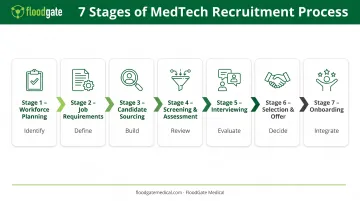
The seven stages are:
- Workforce planning — identify skills gaps and hiring demand
- Job definition — set qualifications and success metrics
- Sourcing — build pools across multiple channels
- Screening — review applications against structured criteria
- Interviewing — assess skills and fit
- Selection and offer — decide and extend competitive terms
- Onboarding — integrate new hires to ramp productivity faster
What are the 5 C's of recruitment?
The Five Cs (Competencies, Capability, Character, Curiosity, and Culture) come from Cisco executive Alexandra Zagury’s 2023 channel-talent framework. They cover current skills, learning aptitude, role-fit attributes, adaptability, and mutual culture fit. It is a useful evaluation lens, not a universal HR standard.
What is the difference between recruitment and hiring?
Recruitment is the full process of finding, attracting, screening, and evaluating candidates to build pipelines for current and future needs. Hiring is the selection decision inside that process: choosing one candidate and extending an offer. Recruitment is strategic and ongoing; hiring is tactical.
How long should the recruitment process take?
Industry averages often land around 41 days from posting to accepted offer (about 35 days for large enterprises and 46 for SMBs). Specialized MedTech roles such as regulatory affairs, clinical engineering, and quality systems usually take longer because talent pools are smaller. Move fast enough to keep top candidates, but not so fast that you skip thorough evaluation.
What recruitment strategies work best for hard-to-fill specialized roles?
Build passive-candidate pipelines before roles open, and partner with specialized MedTech recruiters who already know the market. Use employee referrals, market-informed compensation, and skills-based criteria instead of rigid credentials. Communicate consistently and move decisively once a strong candidate emerges.
How can companies improve their candidate experience during recruitment?
Communicate clearly at every stage: acknowledge applications, share interview updates, and close the loop with everyone. Be upfront about pay, growth, and expectations, and keep interviews efficient. Offer brief feedback to declined candidates and track experience with short surveys or NPS to spot gaps.