Introduction
Ask someone what healthcare staffing looks like, and they'll probably picture nurses and doctors. But the industry runs on far more than clinical talent.
Hospitals need billing specialists, and MedTech companies need regulatory experts, sales reps, data scientists, and compliance leads. None of these roles touch a patient directly, yet they keep the entire system functioning.
Here's the problem: many employers and job seekers still lump "non-clinical healthcare staffing" in with traditional clinical recruiting. That confusion leads to missed opportunities and wasted time on both sides.
That confusion doesn't change the numbers, though. The U.S. Bureau of Labor Statistics projects 23% growth for medical and health services managers between 2024 and 2034, far outpacing the average occupation. Demand for non-clinical talent isn't slowing down.
This guide breaks down what non-clinical healthcare staffing agencies actually do, which roles they fill, how their process works, and how to pick the right partner.
Key Takeaways
- Non-clinical agencies fill business and operational roles, not patient-facing positions.
- Placements span administration, sales, regulatory/quality, IT, and executive leadership.
- Vetting focuses on industry knowledge and business acumen, not clinical licensure.
- MedTech-focused agencies deliver faster, better-matched hires than generalists.
What Are Non-Clinical Healthcare Staffing Agencies?
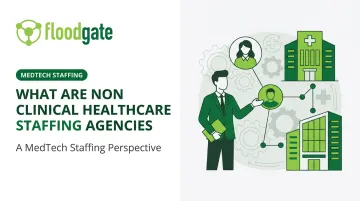
Non-clinical healthcare staffing agencies recruit and place talent into roles that support healthcare and MedTech organizations without requiring direct patient care. Think finance, sales, compliance, and IT, not bedside medicine.
The key distinction is licensure. Clinical staffing agencies place nurses, physicians, and technicians who must hold state or board-issued credentials. Non-clinical agencies work with candidates whose qualifications come from experience, certifications, or education, not a clinical license.
Who These Agencies Serve
Non-clinical staffing firms typically work with:
- Hospital and health system back-office departments
- MedTech and medical device manufacturers
- Pharmaceutical companies
- Health-tech startups and digital health platforms
- Healthcare service and consulting organizations
FloodGate Medical, for instance, focuses exclusively on connecting MedTech companies with non-clinical talent across these functions.
Common Engagement Models
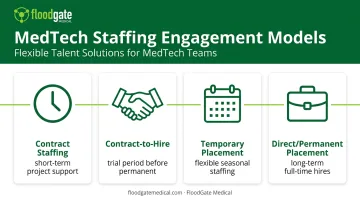
Agencies rarely offer a one-size-fits-all arrangement. Most provide:
- Contract staffing – short-term support for specific projects or coverage gaps
- Contract-to-hire – a trial period before converting to a permanent role
- Temporary placement – flexible staffing for seasonal or fluctuating needs
- Direct/permanent placement – full-time hires matched to long-term roles
This distinction matters because non-clinical roles are growing fast. Beyond the 23% projected growth for health services managers, the BLS Occupational Outlook Handbook also projects 7% growth for medical records specialists through 2034. Administrative and operational roles are expanding right alongside clinical demand.
Types of Non-Clinical Healthcare Jobs and Roles They Fill
Non-clinical roles cut across nearly every business function inside a healthcare or MedTech organization. Here's where agencies like FloodGate Medical typically focus their sourcing efforts.
Administrative & Operations Roles
These are the roles that keep the lights on:
- Practice managers overseeing daily clinic operations
- Medical billing and coding specialists
- Scheduling coordinators
- Supply chain and operations staff
Medical and health services managers alone earn a median salary of $117,960 annually, with roughly 62,100 annual job openings projected through 2034, according to BLS data.
Sales, Marketing & Business Development Roles
MedTech and device companies live or die by revenue growth. That means constant demand for:
- Territory and clinical sales representatives
- Product marketing managers
- Business development leads
These positions require deep product knowledge and the ability to speak fluently with surgeons and procurement teams, even without a clinical background.
Regulatory, Quality & Compliance Roles
Every device that reaches a hospital shelf has to clear regulatory hurdles first. Regulatory professionals help guide products through applicable health-authority requirements. This responsibility grew heavier when the FDA's Quality Management System Regulation took effect, incorporating ISO 13485:2016 directly into device manufacturing rules. Roles here include:
- Regulatory affairs specialists
- Quality assurance managers
- Compliance officers
IT, Data & Technical Support Roles
Healthcare's digital shift created an entirely new hiring category. Health information technologists and medical registrars are projected to see 15% job growth through 2034, according to BLS data. Common roles include:
- Health IT analysts
- Data scientists and analytics specialists
- EHR support specialists
- Biomedical engineers
Executive & Leadership Roles
Someone has to run the business side. C-suite and VP-level hires—CEOs, CFOs, VPs of Sales—lead strategy and operations without ever setting foot in a treatment room. These searches tend to be the most specialized and highest-stakes placements a non-clinical agency handles.
How Non-Clinical Healthcare Staffing Agencies Work
Non-clinical agencies don't operate like generic recruiting firms. Their entire process is built around industry fluency.
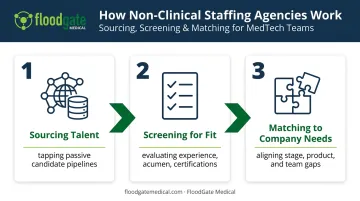
Sourcing Talent
Agencies build pipelines through healthcare and MedTech-specific networks, proprietary databases, and referral relationships cultivated over years. Rather than cold-calling résumés off a job board, they tap into passive candidates who aren't actively searching but might be open to the right opportunity.
Screening for the Right Fit
Since clinical licensure isn't the deciding factor, screening looks different. Agencies evaluate:
- Industry-specific experience (MedTech, pharma, health-tech)
- Business acumen and functional expertise
- Relevant certifications (regulatory, IT, project management)
- Cultural and team fit
Matching Candidates to Company Needs
Fit matters as much as skill: a 15-person startup preparing for a product launch needs different talent than a 500-person device manufacturer scaling its sales team. Strong agencies match candidates based on:
- Company stage and growth trajectory
- Product focus and technical complexity
- Existing team structure and gaps
This specialized matching process is often what separates a fast, accurate hire from months of trial and error with an in-house team stretched too thin. FloodGate Medical, for example, weighs technical background against a company's DEI goals and growth stage before making an introduction.
Key Benefits of Partnering with a Non-Clinical Staffing Agency
The value here runs in both directions, for employers filling roles and candidates looking for their next move.
For Employers
- Reduced time-to-fill by tapping pre-vetted networks instead of starting from zero
- Access to passive talent who aren't browsing job boards but are open to the right role
- Better-matched hires, which can reduce costly turnover down the line
Hiring mistakes aren't cheap. According to SHRM's 2025 benchmarking report, average cost-per-hire runs $5,475 for nonexecutive roles and $35,879 for executive-level hires, making a bad executive match roughly seven times more expensive than a standard one.
For Job Seekers
- Access to unadvertised openings that never hit public job boards
- Resume and interview guidance tailored to healthcare/MedTech hiring
- Ongoing industry insights through career resources and newsletters
FloodGate Medical, for example, sends candidates a monthly newsletter packed with MedTech hiring trends and open roles, helping job seekers stay plugged in even when they're not actively job hunting.
Why Niche Specialists Add More Value
Beyond speed and access to hidden talent pools, the type of agency you choose matters just as much as the choice to use one at all.
Agencies that specialize exclusively in MedTech bring a depth of industry knowledge a general staffing firm can't match. FloodGate Medical's DEI-driven approach, for instance, helps companies build more diverse, innovative teams, an advantage that's increasingly tied to better device innovation outcomes.
That specialization pairs well with flexibility. Product launches and growth spurts don't follow predictable schedules, so contract staffing lets companies scale teams up or down without the long-term commitment of permanent hires, a critical option during unpredictable growth phases.
Non-Clinical vs. Clinical Staffing Agencies: What's the Difference?
The line between these two agency types comes down to one thing: licensure.
| Factor | Clinical Staffing | Non-Clinical Staffing |
|---|---|---|
| Roles placed | Nurses, physicians, technicians | Admin, sales, IT, executive, regulatory |
| Credential requirement | State/board license required | Industry experience, certifications preferred |
| Screening focus | License verification, competency, health screening | Business acumen, technical skill, culture fit |
| Regulatory oversight | Joint Commission certification standards | Role-specific, varies by employer |
Clinical agencies operate under strict compliance frameworks. The Joint Commission's staffing certification process examines license status, competency records, and background checks before a clinical worker ever gets placed.
Non-clinical agencies still follow requirements, but those requirements attach to the specific role rather than a single licensing body. A regulatory affairs specialist needs different qualifications than a health IT analyst, and agencies tailor their screening accordingly.
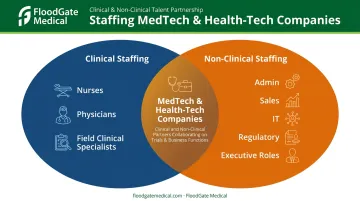
Where the Two Overlap
MedTech and health-tech companies often need both types of partners working together. One team sources clinical trial staff or field clinical specialists, while another fills the business and technical roles that support them.
Frequently Asked Questions
What is non-clinical healthcare staffing?
It's recruitment for non-patient-facing roles that support healthcare and MedTech organizations. Think administrative, sales, IT, and executive positions rather than nursing or physician roles.
What healthcare jobs don't require clinical experience?
Medical billing, regulatory affairs, sales and marketing, IT support, and executive leadership roles generally don't require clinical experience. These positions value industry knowledge and functional expertise instead.
Do non-clinical staffing agencies charge fees to job seekers?
Reputable agencies typically get paid by the employer, not the candidate. Under the standard direct-placement model, the hiring company covers a contingency fee once it fills the role.
How do non-clinical staffing agencies differ from general recruitment agencies?
Non-clinical healthcare agencies bring specialized knowledge of industry compliance, terminology, and hiring patterns that general recruiters often lack. That expertise usually translates to faster, more accurate matches.
What industries do non-clinical healthcare staffing agencies serve?
These agencies usually serve hospitals, MedTech and device manufacturers, pharmaceutical companies, and health-tech organizations. Some firms specialize in just one of these verticals.
Can non-clinical staffing agencies help with executive-level MedTech hiring?
Yes. Specialized firms like FloodGate Medical focus specifically on placing leadership and business talent, CEOs, CFOs, VPs of Sales, within MedTech companies, where industry-specific expertise matters most.