This isn't a minor bureaucratic wrinkle. Confusion over provisions like "preparatory to research" and authorization waivers has been a documented source of recruitment delays for two decades. In 2004, SACHRP flagged a "continued state of confusion" and a "universe of confusing and, in many cases, seemingly contradictory guidance statements" around using PHI to find and contact research subjects.
That confusion still costs sites time and exposes them to compliance risk. This guide breaks down the legal pathways for compliant recruiting, clarifies the most misunderstood provision in the rulebook, and covers what actually protects your organization during an OCR audit.
Key Takeaways
- HIPAA allows research recruiting via five pathways: authorization, IRB waiver, preparatory review, decedent research, or de-identification.
- "Preparatory to research" allows chart review, but only internal staff can contact identified candidates.
- Documentation, including IRB letters, BAAs, and signed authorizations, protects your institution during an audit.
- Staffing quality determines how confidently your team executes these pathways without missteps.
Understanding HIPAA's Role in Research Recruiting
The Privacy Rule governs how covered entities (health plans, clearinghouses, and providers who transmit health data electronically) can use and disclose protected health information. Most hospitals and health systems running clinical trials fall squarely into this category.
Here's where it gets complicated for research teams: recruiting activities often trigger two overlapping regulatory frameworks simultaneously — the HIPAA Privacy Rule, which governs use and disclosure of PHI, and the Common Rule, which governs human subjects protection and informed consent.
Satisfying one doesn't automatically satisfy the other. A study can clear Common Rule requirements for informed consent while still violating HIPAA if PHI was accessed improperly to identify the subject in the first place.
What Actually Triggers HIPAA Restrictions
PHI isn't just "medical information." It's individually identifiable health information, and identifiers are the trigger. Names, phone numbers, email addresses, medical record numbers: these are what convert a data field from freely usable into tightly controlled.
Strip the identifiers, and you're often outside HIPAA's reach entirely. Keep them, and you need a valid legal pathway.
The Enforcement Stakes
This isn't theoretical risk. OCR received 30,256 new HIPAA complaints in 2024 alone, on top of nearly 3,000 carried over from the prior year, per HHS's compliance report to Congress. Impermissible use or disclosure of PHI remains one of OCR's most frequently cited compliance issues.
Civil penalties, adjusted for inflation and effective January 2026, break down by culpability tier:
| Violation Tier | Per-Violation Penalty | Annual Cap |
|---|---|---|
| No knowledge | $145 – $73,011 | $2,190,294 |
| Reasonable cause | $1,461 – $73,011 | $2,190,294 |
| Willful neglect (corrected) | $14,602 – $73,011 | $2,190,294 |
| Willful neglect (not corrected) | $73,011 – $2,190,294 | $2,190,294 |
Criminal violations escalate further, up to $250,000 and 10 years in prison for offenses involving intent to sell or misuse PHI.
The Core HIPAA Pathways for Recruiting Research Participants
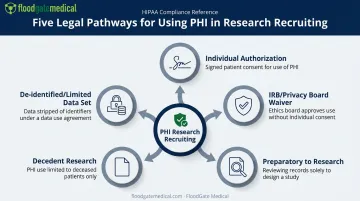
There are five legitimate routes for a covered entity to use or disclose PHI during recruitment. No sixth option exists. If a recruiting activity doesn't fit one of these, it's not compliant.
Individual Authorization
A valid, study-specific authorization must include:
- Plain-language description of the PHI to be used or disclosed
- Who is authorized to use it and who may receive it
- A clear statement of purpose
- An expiration date or event
- The individual's signature and date
- Revocation rights and instructions
Key distinction: Authorization permits use of PHI, while consent permits participation in the study. HHS guidance confirms the two documents can be combined into one form, but each regulation's requirements must be independently satisfied. Checking one box doesn't clear the other.
IRB or Privacy Board Waiver of Authorization
An IRB or Privacy Board can waive the authorization requirement when three criteria are met:
- Minimal privacy risk: supported by an identifier-protection plan and a plan to destroy identifiers when no longer needed
- Waiver necessity: the research couldn't practicably happen without the waiver
- PHI necessity: the research couldn't practicably happen without access to the PHI itself
A full waiver covers the entire authorization requirement. A partial waiver is narrower and specifically useful for recruitment: it lets an outside researcher obtain contact information to reach prospective subjects before securing individual authorization.
Research Involving Decedents
No authorization or waiver is needed for decedents' PHI. Instead, the researcher must represent that:
- The research is solely on decedents' PHI
- The PHI is necessary for the research
- Death can be documented if the covered entity requests proof
De-identified Information and Limited Data Sets
Two tiers exist, and the difference matters for recruiting workflows:
- Safe Harbor de-identification strips all 18 specified identifiers (names, contact info, MRNs, device IDs, and more), leaving data that's no longer PHI but often too scrubbed for outreach.
- Limited Data Set removes 16 identifier categories while keeping dates and general geography. It's still PHI, requiring a data use agreement, but retains enough structure for feasibility work.
Most recruiting teams land on a limited data set as the practical middle ground between compliance and usability.
What Does "Preparatory to Research" Actually Mean?
This is the provision that generates the most confusion, and it's worth slowing down on. Under 45 CFR 164.512(i)(1)(ii), a covered entity can let a researcher review PHI to develop a protocol or gauge feasible sample size, without authorization and without IRB review.
That sounds permissive. It is, up to a point.
The Line Between Internal and External Researchers
Here's the distinction that trips up most institutions: who can act on what they find.
| Researcher Type | What They Can Do |
|---|---|
| Internal workforce researchers | Review charts and contact prospective participants directly |
| External researchers (outside CROs, third-party recruiting vendors) | Cannot make contact or remove any PHI from the site under this provision |
OCR has been explicit on this point. Preparatory-to-research review can be used to identify prospective subjects, but an outside researcher needs a partial waiver, not this provision, to actually reach out.
Required Representations
Knowing who may act doesn't eliminate the covered entity's own gatekeeping role. Before granting that access, the covered entity must obtain representations that:
- The PHI is necessary for the stated research purpose
- Review is limited to that purpose only
- No PHI will leave the covered entity's premises
The Common Compliance Mistake
Institutions tend to err in one of two opposite directions. SACHRP's commentary noted that OCR's original 2004 explanation described what HIPAA permits — not a mandatory recruitment standard. That distinction gets lost in practice:
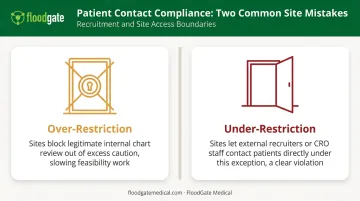
- Over-restriction: Sites block legitimate internal chart review out of excess caution, slowing feasibility assessments unnecessarily.
- Under-restriction: Sites let external recruiters or CRO staff use the exception to contact patients directly, which is a clear violation.
No IRB or Privacy Board documentation is legally required for preparatory-to-research activities, unlike a full waiver. That said, institutions should still keep internal records of the representations obtained. If OCR ever audits the process, "we followed the rule" isn't a defense without paper to back it up.
Best Practices for HIPAA-Compliant Research Recruiting
Getting the legal pathways right is one thing. Operationalizing them consistently across a research organization is another. A few practices separate sites that stay compliant from those that end up in corrective action plans.
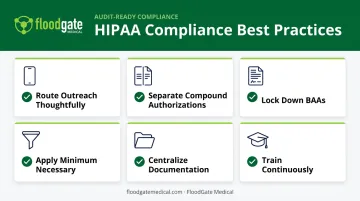
Route initial outreach thoughtfully. Conventional wisdom says always go through the treating clinician first, but the data is more nuanced. One study found that direct researcher contact was acceptable to 95% of participants surveyed, compared to 75% for clinician-mediated contact.
Both approaches work. Blanket assumptions about patient preference shouldn't drive your protocol design without site-specific input.
Separate compound authorizations. Since the 2013 HIPAA Final Rule, one authorization form can combine a conditioned activity (trial participation) with an unconditioned optional activity (future biospecimen or repository use), but only if the form clearly separates the two and gives an unambiguous opt-in for the optional piece. Blending them without that separation is a documented HHS compliance flag.
Lock down business associate agreements. Any third-party recruiting vendor, marketing firm, or CRO touching PHI on your behalf needs a signed BAA before they touch a single record.
Apply minimum necessary rigorously. When screening charts for eligibility, limit reviewer access to only the fields needed for inclusion/exclusion criteria. This standard applies to waiver, preparatory-to-research, and decedent pathways, though it doesn't extend to disclosures made under a valid individual authorization.
Centralize documentation. Keep these audit-ready and easily retrievable:
- IRB/Privacy Board waiver determinations
- Preparatory-to-research representations
- Signed authorization forms
- Business associate agreements
Train continuously. Coordinators, recruiters, and community liaisons all touch PHI differently. Institutional inconsistency in applying these rules, rather than deliberate misconduct, is the most repeatedly cited source of both delays and violations.
Building a Compliant, Well-Staffed Research Recruiting Team
Written policy only goes so far. The people executing recruitment are what prevent the missteps and documentation gaps covered above.
An experienced clinical research coordinator who understands the workforce-member distinction under preparatory-to-research review won't let a contracted recruiter make an improper call. A regulatory affairs professional who's built audit binders before knows what documentation needs to exist before access is granted.
This is where staffing quality becomes a compliance issue, not just an HR one.
FloodGate Medical works exclusively within MedTech, placing talent across clinical affairs, regulatory, R&D, and research functions for device and life sciences companies. These are the exact roles that sit at the center of HIPAA and Common Rule execution.
Building a research recruiting function with people who already understand these regulatory nuances reduces the odds of a preventable violation and tends to strengthen enrollment outcomes at the same time.
Diverse hiring ties into this directly. A 2019 study on research participant contact preferences points to a clear conclusion: research teams that reflect the communities they recruit from build stronger trust with prospective participants. That trust matters for both enrollment speed and retention.
FloodGate Medical's DEI-driven recruitment approach is built around that principle. It connects MedTech companies with clinical and regulatory professionals who can execute compliant recruiting while improving how well that recruiting resonates with diverse patient populations.
Frequently Asked Questions
Does recruiting into research require written authorization?
Generally yes, unless a specific exception applies. Preparatory-to-research review, an IRB/Privacy Board waiver, decedent research provisions, or de-identified/limited dataset use can all substitute for authorization in the right circumstances.
What is recruiting into research?
It's the process of identifying and contacting potential study participants. Under HIPAA, any use of PHI during that process must flow through one of the Privacy Rule's permitted pathways.
What is preparatory to research?
It's the provision at 45 CFR 164.512(i)(1)(ii) allowing PHI review to assess study feasibility and sample size without authorization. Only internal workforce members can use it to contact candidates directly — external researchers cannot.
Can an IRB waive the authorization requirement for research recruitment?
Yes. IRBs and Privacy Boards can grant full or partial waivers when minimal privacy risk, waiver necessity, and PHI necessity are all documented and met.
Is de-identified patient data subject to HIPAA restrictions during recruitment?
Properly de-identified data under Safe Harbor isn't PHI and can be shared freely. Most recruiting workflows still need some identifiers, though, which is why limited datasets are the common practical solution.
What happens if a research team violates HIPAA during recruitment?
Civil penalties range from about $145 to $2 million per year based on culpability, while criminal penalties can reach $250,000 and 10 years for severe violations. OCR typically favors corrective action plans over immediate fines.