Introduction
Picture a MedTech company where R&D hits product milestones, clinical affairs keeps regulatory documentation clean, and commercial teams meet sales targets. Yet experienced engineers leave for competitors, cross-functional handoffs stall launches, and leadership meetings feel tense. The numbers look good, but something underneath isn't working.
Workplace culture directly affects retention, collaboration speed, and innovation in medical technology. A 2023 study of 6,112 workers across 260 Korean medical-device companies found that innovation culture correlated positively with satisfaction and commitment, while hierarchical culture correlated negatively. That finding confirms what MedTech leaders already sense: how teams work together matters as much as what they deliver.
This guide covers what a team and workplace culture assessment is, why it matters in MedTech, which tools are available, and a step-by-step process for running an assessment that drives real change, not a report that sits on a shelf.
Key Takeaways
- Culture assessments reveal real team dynamics—not just stated values on a poster
- Surveys deliver breadth and benchmarks; interviews and focus groups explain the "why"
- Match the method to your goal: hiring fit, engagement gaps, leadership readiness, or transformation
- Diverse MedTech perspectives sharpen culture insights and strengthen team decisions
What Is a Team and Workplace Culture Assessment?
A team and workplace culture assessment is a structured process (survey, interview, focus group, or facilitated diagnostic) used to uncover how work actually gets done in your organization. Per SHRM, it means continuously checking cultural health, spotting gaps between stated values and daily behavior, and building a corrective action plan.
The goal is simple: compare who you say you are with who you actually are, then decide who you want to become and what must change. Most assessments center on a few core questions:
- Who are we at our best?
- Who are we at our worst?
- Who do we want to be?
- What needs to change to close the gap?
In MedTech, that gap often shows up between functions—for example, when R&D, quality, and commercial teams share a mission but run on different norms for speed, risk, and decision rights.
Quantitative vs. Qualitative Approaches
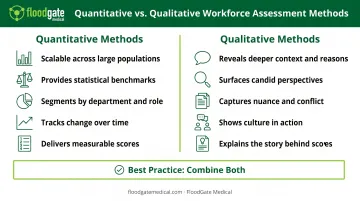
Quantitative tools are data-driven and scalable:
- Engagement surveys measure how committed, motivated, and connected people feel
- Climate surveys capture views on policies, practices, and the day-to-day environment
- eNPS asks how likely employees are to recommend the company as a workplace
- Pulse checks are short, frequent surveys that track change over time
For eNPS, scores of 9–10 are promoters and 0–6 are detractors; eNPS is the percentage of promoters minus the percentage of detractors. Gallup defines engagement surveys as diagnostic tools and pulse surveys as quick measures of change.
Quantitative methods also let you segment by department, location, tenure, or role. That matters when product, clinical, and commercial teams live in different cultural realities inside the same company.
Qualitative methods take more time but go deeper:
- One-on-one interviews surface candid views across levels
- Cross-functional focus groups reveal shared themes and real conflict
- Open-text survey answers capture nuance fixed-choice items miss
- Observation of meetings, handoffs, and decisions shows culture in action
CIPD recommends combining surveys with focus groups so you get the score and the story behind it.
Why Culture Assessments Matter for MedTech Teams
Culture gaps hurt morale, and they also slow innovation cycles, create friction between R&D and commercial teams, and drive voluntary turnover among specialized talent.
Gallup research found that 42% of voluntary leavers said their departure could have been prevented, yet 36% spoke to no one before resigning.
When the analysis drilled into preventable turnover, 70% of reasons involved daily management factors:
- Manager interactions
- Organizational friction
- Advancement opportunities
- Staffing levels and workload
Managers themselves account for 70% of variance in team engagement, making manager-level culture assessment essential.
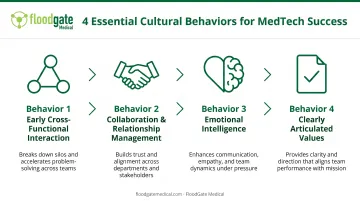
In MedTech specifically, culture misalignment slows collaboration where it matters most. McKinsey interviews with R&D leaders at leading MedTech companies identified greater reliance on cross-functional teamwork, strategic alliances, and new talent models. Leaders stressed cultural behaviors alongside technical skill:
- Earlier cross-functional interaction
- Collaboration and relationship management
- Emotional intelligence
- Clearly articulated values
Diverse and inclusive team cultures support stronger decision-making and patient-centered innovation by bringing clinical, engineering, and user-experience perspectives into product design. FloodGate Medical's DEI-driven recruiting approach is built on that idea: mixed backgrounds and experiences often surface solutions no single profile would reach alone.
Evidence is still mixed. A 2019 healthcare-industry diversity study did not support its primary diversity-innovation hypotheses. Even so, RAND recommends involving relevant groups in healthcare-innovation design discussions to improve accessibility and user experience.
Culture assessments help MedTech companies identify root causes behind hiring struggles or high attrition. FloodGate Medical reports that 89% of new-hire failures stem from poor culture fit rather than insufficient skills, underscoring why assessments must evaluate processes and behaviors alongside engagement scores.
Types of Team and Culture Assessment Tools to Consider
Choose your tool based on the level and question you need to answer.
Organizational-Level Diagnostics
Denison Model: Measures culture across four traits (involvement, consistency, adaptability, and mission) using 48 items and 12 underlying dimensions. The model benchmarks against more than 1,100 organizations and provides deep organizational diagnosis.
OCAI (Organizational Culture Assessment Instrument) / Competing Values Framework: Allocates 100 points across four culture types on two axes: internal/external focus and flexible/stable structure. It delivers a rapid current-versus-preferred culture profile without claiming one type is universally best.
Team-Dynamics Tools
Everything DiSC: Assesses individual behavioral preferences (dominance, influence, steadiness, and conscientiousness) to improve communication and collaboration. It's a team-development tool, not a stand-alone organizational-culture diagnostic.
Five Behaviors: Builds team development around five interaction patterns: trust, productive conflict, commitment, accountability, and collective results. Use it when the question is how the team works together, not what the whole culture is.
Working Genius: Identifies six types of work contributions and frustrations to clarify roles, improve meetings, and build shared team language. The assessment takes 10 minutes.
Individual-Strengths Tools
CliftonStrengths: Measures individual talents through a 30-minute paired-statement assessment. It supports strengths-based development and helps leaders understand how people uniquely contribute to team culture.
Enterprise Engagement Platforms
Culture Amp: Offers 40+ survey templates, benchmarks, heatmaps, dashboards, and manager action plans for enterprise listening and engagement tracking.
Qualtrics: Provides lifecycle listening, open-text analytics, dashboards, and triggered surveys across the employee experience.
| Tool | Level & Focus | Best Use & Depth |
|---|---|---|
| Denison Model | Organization: 48 items across involvement, consistency, adaptability, mission | Deep diagnosis; benchmarks 1,100+ organizations |
| OCAI / Competing Values | Organization: 4 culture types on flexible/stable and internal/external axes | Rapid current vs. preferred profile |
| Everything DiSC | Individual/team: dominance, influence, steadiness, conscientiousness | Communication and collaboration development |
| Five Behaviors | Team: trust, conflict, commitment, accountability, results | Interaction-pattern depth |
| Working Genius | Individual/team: 6 work-contribution types | Role clarity, meetings, staffing, shared language |
| CliftonStrengths | Individual: 34 talent themes | Strengths-based development and team composition |
| Culture Amp | Enterprise: engagement, experience, lifecycle | Broad listening, templates, benchmarks, action plans |
| Qualtrics | Enterprise: lifecycle listening and analytics | Surveys, text analytics, dashboards, recommendations |
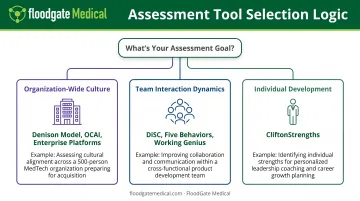
Selection rule:
- Organization-wide culture question → Denison, OCAI, or an enterprise platform
- Team interaction question → DiSC, Five Behaviors, or Working Genius
- Individual development question → CliftonStrengths
Don't substitute a personality tool for an organizational diagnosis.
How to Conduct a Team or Workplace Culture Assessment
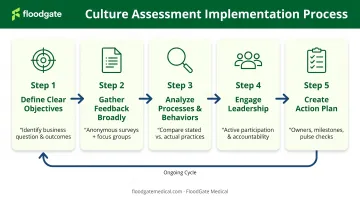
Step 1: Define Clear Objectives
Start with the specific business question the assessment must answer. Are you trying to understand why specialized talent leaves? Whether leadership is ready for a growth phase? Why R&D and commercial teams struggle to collaborate?
Gallup recommends defining actionable, research-grounded factors and usable next steps before you launch. Specify:
- Which populations you'll survey (company-wide, department, role)
- What outcomes you're trying to improve (retention, speed, engagement)
- What actions leadership is prepared to take based on results
Step 2: Gather Feedback Broadly and Deeply
Run an anonymous company-wide survey for breadth. Segment only where confidentiality permits. Teams smaller than five shouldn't be broken out individually.
Add focus groups and interviews for depth. Include representation across:
- Functions (R&D, clinical, commercial, operations, corporate)
- Levels (individual contributors, managers, senior leaders)
- Tenure (new hires, mid-tenure, long-tenured employees)
- Locations (if you operate in multiple sites)
Step 3: Analyze Processes Alongside Behaviors
Stated values often conflict with actual operational practices. Compare survey perceptions and interview themes with:
- Decision rights: Who actually makes key calls?
- Meeting behavior: Who speaks, who's heard, how conflict is handled
- Cross-functional handoffs: Where do projects stall between departments?
- Information flow: What gets communicated transparently, what doesn't?
- Workload and recognition: Are expectations realistic? Is good work acknowledged?
Deloitte describes culture assessment as revealing "how things get done," not just what people say should get done.
Step 4: Engage Leadership as Active Participants
Culture change requires senior-leader commitment, not just HR facilitation. Gallup says leadership response is essential: employees need to see that their input drives real decisions.
Leaders should:
- Participate in focus groups or interviews (not just receive the report)
- Own accountability for follow-through on findings
- Communicate themes and commitments transparently
- Discuss local results with their teams
Step 5: Turn Findings Into a Concrete Action Plan
Prioritize changes that deliver high impact with realistic implementation effort. Assign:
- Specific owners for each initiative
- Milestones with target dates
- Outcome measures to track progress
- Focused pulse checks to monitor whether change is happening
Culture Amp describes pulses as a way to test whether changes and initiatives are working. Gallup warns that surveying without action will likely decrease engagement and increase turnover.
Note for companies building or restructuring teams during this process: Hiring decisions made mid-transformation can reinforce the culture you want or work against it. A MedTech-focused partner like FloodGate Medical helps match candidates to your values and team norms through a DEI-centered recruiting approach, so new hires support the culture you're building.
Common Mistakes to Avoid When Assessing Culture
Even a solid assessment plan can stall when execution slips. Watch for these common missteps:
- Choosing a tool because it's popular: Select based on whether it answers your actual business question (organizational, team, or individual), not because everyone else uses it.
- Rolling out a survey without context: Employees need to know how data will be collected, protected, and used. Gallup recommends explaining purpose and confidentiality upfront.
- Treating assessment as a one-time event: A baseline without action owners, milestones, and follow-up pulses won't show what changed—pair the assessment with ongoing conversation and clear accountability.
- Survey-only design: Scores identify gaps but may not explain why. Add qualitative follow-up to understand the story behind the numbers.
- Over-relying on eNPS: Qualtrics cautions that eNPS alone cannot provide a complete employee-experience picture. Use it with other metrics and follow-up questions.
Frequently Asked Questions
What 3 to 5 words would you use to describe your company's culture?
This is a common self-reflection prompt used in culture assessments. Rather than answering alone, leaders should gather input from employees at all levels, then compare those words to survey and interview evidence to see if perceptions match.
Can you give me some examples of team culture?
Examples include collaborative, innovation-oriented cultures common in MedTech R&D teams versus more process-driven, hierarchical cultures in regulatory and compliance teams. Culture differences across functions are normal; misalignment becomes a problem when collaboration breaks down.
What are the four C's of cultural assessment?
Variations exist, but common frameworks reference Consistency, Collaboration, Communication, and Commitment as recurring themes. Note that the Denison Model uses Consistency, Involvement, Adaptability, and Mission as its four traits.
What is an example of a culture assessment?
A typical example combines a company-wide anonymous survey segmented by function and level, focus groups with cross-functional representation, and a leadership review session that produces prioritized action plans and follow-up pulse checks.
How often should a company conduct a culture assessment?
Most organizations run a full assessment every 1–2 years, with shorter pulse surveys in between. Increase frequency during rapid growth, leadership transitions, mergers, or restructuring when culture is more likely to shift.
Who should lead a culture assessment, HR or leadership?
HR typically facilitates design, data collection, and confidentiality. Senior leadership must sponsor the effort, act on findings, and drive accountability. Managers play a critical role because they account for 70% of team-engagement variance.
Workplace culture in MedTech is the operating system behind how fast teams innovate, how well they collaborate across functions, and whether specialized talent stays. A structured assessment reveals what is really happening beneath performance metrics and gives leaders evidence to close gaps between stated values and daily reality.
Paired with action plans, pulse checks, and hiring aligned to the culture you are building, assessments become the foundation for stronger teams and better outcomes.