
Introduction
MedTech companies juggle tight regulatory timelines, specialized skill gaps, and pressure to scale without overhiring. Choosing a full-time regulatory affairs specialist or a contract clinical trial manager affects how fast you staff critical roles, how you control cost, and how stable your team stays through product development and submissions.
Those decisions shape talent acquisition speed, budget flexibility, and your capacity to ramp up for major milestones. With 31,133 regulatory professionals working in the U.S. medical device sector and 25% of the global regulatory workforce marked "open to work", the right model is a business decision—not only an HR one.
This guide compares permanent and contract staffing on cost, speed, flexibility, and long-term team building so you can match the model to each hire.
Key Takeaways
- Permanent staffing builds long-term stability and deep organizational knowledge for core regulatory, quality, and R&D roles
- Contract staffing delivers flexibility and specialized expertise for project-based needs like FDA submissions or clinical trials
- Permanent roles carry long-term benefits and training costs; contract staffing keeps spend tied to project scope
- Hybrid models win in MedTech: permanent staff for critical functions, contractors for specialized projects
Permanent Staffing vs Contract Staffing: Quick Comparison
Use this side-by-side view to match hiring model to role duration, cost tolerance, and compliance needs—especially in MedTech functions where both models are common.
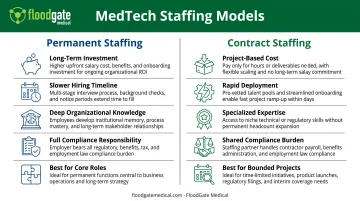
| Factor | Permanent Staffing | Contract Staffing |
|---|---|---|
| Cost Structure | Salary plus benefits (~$14/hr above wages), training, and retention cost | Project or hourly rates; fewer benefits; lower long-term commitment |
| Hiring Timeline | Longer search—typically ~6 weeks from req to offer | Faster start from pre-screened talent pools |
| Workforce Flexibility | Hard to scale quickly without layoffs or restructuring | Easy to scale up or down with project demand |
| Employee Commitment | Higher loyalty, cultural fit, and long-term ownership | Strong task focus; lower long-term org attachment |
| Compliance Responsibility | Full employer duty for labor law, benefits, and payroll taxes | Shared or reduced burden through staffing partners |
| Best Use Cases | Regulatory affairs, quality systems, long-term R&D, clinical leadership | 510(k) filings, clinical trial support, capacity gaps, validation projects |
What is Permanent Staffing?
Permanent staffing means hiring employees for ongoing, long-term roles without a predetermined end date. These team members join your MedTech organization's core workforce and build institutional knowledge that compounds over time.
Key Benefits of Permanent Staffing
Permanent hires strengthen MedTech teams where continuity counts:
- Build deep expertise in your products, regulatory requirements, and quality systems, including design history files, complaint handling, and post-market surveillance
- Invest in culture and cross-functional relationships so R&D, regulatory, quality, and clinical teams can collaborate toward shared goals
- Keep ownership stable in regulated roles—when the same QA manager steers design controls through post-market monitoring, audits see consistent accountability
Drawbacks to Consider
Those gains come with real tradeoffs:
- Cost more than salary alone. SHRM reports recruiting averages nearly $4,700 per hire, before benefits, training, equipment, and retention programs
- Limit headcount flexibility when downturns, project delays, or strategy shifts require a smaller or different team
- Take longer to fill. Specialized MedTech sourcing, multiple interview rounds, and offer negotiation can leave a critical seat empty for weeks
Ideal MedTech Use Cases
Permanent staffing works best for:
- Regulatory affairs specialists managing your entire product portfolio
- Quality assurance managers maintaining your QMS and handling FDA interactions
- R&D engineers working on multi-year product development cycles
- Clinical affairs directors overseeing long-term evidence generation strategies
- Roles requiring sustained organizational knowledge and regulatory accountability

What is Contract Staffing?
Contract staffing means hiring professionals on a temporary or project-specific basis for a fixed duration. This model gives MedTech companies flexible access to specialized skills without long-term employment commitments.
Key Benefits of Contract Staffing
- Reach pre-screened talent fast when you need a biostatistician for a pivotal trial or a regulatory consultant for an urgent 510(k)
- Bring in niche experts for bounded work, such as a validation engineer for a new line or a clinical data manager for a six-month study
- Pay only for project-phase work; higher hourly rates often still beat permanent cost once you skip benefits, training, and long-term retention
- Scale up for launches, studies, or regulatory deadlines, then scale down when the work ends without workforce-reduction complications
Potential Drawbacks
- Limited institutional context: contractors joining mid-project often need heavy onboarding on your quality system, design history, or regulatory strategy
- Knowledge handoff risk: when assignments end, critical know-how can leave with the contractor unless you plan documentation and transfer
- Continuity gaps: if a key contractor exits or cannot extend, sensitive regulatory or clinical work can stall
Ideal MedTech Use Cases
Contract staffing works best for:
- Clinical trial project managers supporting defined study timelines
- Regulatory submission specialists preparing time-sensitive 510(k) or PMA applications
- Quality system auditors conducting specific compliance assessments
- R&D consultants supporting proof-of-concept or feasibility studies
- Interim roles during permanent staff transitions or parental leaves

Permanent vs Contract Staffing: Which is Better for Your MedTech Company?
The better choice depends on your business context. Match the model to each role's requirements rather than defaulting to one approach company-wide.
Evaluate Your Business Needs
Core vs. Project-Specific Work
Ask whether the role supports ongoing operations or addresses a bounded deliverable. Quality system ownership, regulatory strategy, and product lifecycle management are core functions requiring permanent accountability. A six-month 510(k) preparation or a temporary manufacturing validation project aligns better with contract staffing.
Required Knowledge Depth
Consider how much institutional knowledge the role demands. Positions requiring deep understanding of your design history, post-market surveillance data, and regulatory communication history benefit from permanent staff who build that expertise over years. Roles focused on executing defined technical tasks with clear specifications work well with contract professionals.
Strategic vs. Tactical Orientation
Permanent staff should drive long-term strategic goals: regulatory intelligence, clinical evidence strategy, and continuous improvement in your quality system. Contract staff excel at tactical execution, such as completing a validation protocol, analyzing clinical data, or preparing submission documents.
Cost Considerations
Calculate Total Cost of Ownership
Don't compare salaries directly to bill rates. For permanent hires, add recruiting costs, benefits, training, equipment, management time, and the cost of vacancy during the search. For contractors, include sourcing fees, onboarding time, project management overhead, and knowledge transfer at project completion.
Budget Predictability
Permanent staffing creates predictable long-term expenses that support financial planning. Contract staffing offers project-based cost control and lets you align spend with funded initiatives. It can create budget variability if projects extend or need extra expertise.
Time Horizon Matters
A permanent hire for a role needing two years of sustained work typically costs less than contracting the same function over that period. But for a four-month project, contract staffing almost always delivers better total cost.
Talent Availability and Speed
Market Dynamics
The U.S. life sciences staffing market generated $2.7 billion in 2023, reflecting substantial contractor availability. Specialized MedTech skills in niche areas like biocompatibility testing or clinical data management may be easier to access through contract networks than permanent recruitment.
Urgency Requirements
When FDA requests additional information on your submission and you need a regulatory toxicologist within two weeks, contract staffing provides speed permanent hiring cannot match. When building your long-term regulatory team, investing time in permanent recruitment delivers better cultural fit and retention.
Risk Management
Continuity Risk
Permanent staffing reduces turnover risk in roles requiring regulatory compliance continuity. When the same team maintains your complaint handling system, CAPA process, and MDR submissions, you minimize knowledge gaps that create compliance vulnerabilities.
Flexibility Risk
Contract staffing minimizes long-term employment risk when conditions shift (market changes, funding challenges, or strategic pivots). You can finish contracted work without the legal and financial complications of workforce reductions.
Knowledge Transfer Risk
Any transition creates knowledge transfer challenges. Document thoroughly, maintain clear procedures, and build redundancy. Contract roles require explicit knowledge capture plans; permanent roles need succession planning for eventual departures.
The Hybrid Approach
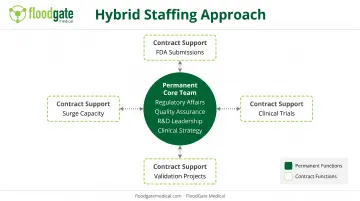
Most successful MedTech companies don't choose one model exclusively. Instead, they:
- Maintain permanent core teams for regulatory affairs, quality assurance, and ongoing R&D programs
- Leverage contract professionals for project peaks, specialized submissions, and temporary capacity gaps
- Use contractors to test new functions before committing permanent headcount
- Build relationships with reliable contract professionals for recurring project-based needs
Keep permanent headcount on roles that own compliance continuity and multi-year strategy. Use contract talent for bounded projects, surge capacity, and skills you need now but may not need next year.
Real-World Example: Accelerating a Critical FDA Submission
A mid-sized medical device manufacturer developing Class II interventional cardiology devices hit a familiar bind. Its permanent regulatory team was fully occupied with existing product clearances, post-market surveillance, and customer complaints—work that could not pause.
At the same time, the company needed to accelerate a 510(k) submission for a new microcatheter design. That meant proving substantial equivalence to marketed predicates, documenting performance testing, and covering biocompatibility and sterilization validation. The work required specialized regulatory writing and deep FDA premarket experience.
The Solution
Instead of overloading the permanent team or delaying compliance work, the company brought in contract regulatory specialists through FloodGate Medical's MedTech recruitment services. Roles split cleanly:
- Contract specialists: Compiled performance data with R&D and quality, drafted submission sections, and prepared responses to likely FDA questions
- Permanent regulatory manager: Owned submission strategy, FDA interactions, and ongoing compliance oversight
- Permanent staff: Stayed on clearances, surveillance, and complaints without interruption
Results
The hybrid model hit the aggressive submission timeline and kept routine regulatory obligations on track. The filing moved toward FDA's 90-day review goal without pulling permanent staff off day-to-day compliance.
For bounded, specialized projects like a 510(k), contract surge capacity plus permanent ownership of strategy and FDA relationships is often the cleaner path than hiring full-time for a short spike—or burning out the team you already have.
Conclusion
Neither permanent nor contract staffing is universally "better" for MedTech companies. The optimal choice depends on role requirements, business stage, budget constraints, and talent availability in your therapeutic area. Successful organizations treat both models as complementary tools, not competing options.
The strongest MedTech workforce strategies blend both:
- Permanent staffing for core roles that need deep regulatory and product knowledge, sustained compliance accountability, and long-term continuity
- Contract staffing for project-based work, specialized expertise gaps, and flexible capacity during demand swings
Assess each role by strategic importance, knowledge depth, time horizon, and cost structure. Specialized MedTech recruiters like FloodGate Medical understand both models, maintain networks of pre-screened professionals, and can help you build the right workforce mix for your organization.
Frequently Asked Questions
What are the three main types of staffing?
The three main models are permanent (direct-hire on your payroll), contract/temporary (fixed-term for projects or set periods), and contract-to-hire (a trial contract that may convert to permanent). Each fits different needs and risk tolerances.
Can an employer terminate a permanent contract?
Yes. In most U.S. states, employment is "at-will," meaning either party may end the relationship at any time, with certain exceptions for discrimination, retaliation, or contractual agreements. "Permanent" describes ongoing employment without a predetermined end date, not guaranteed lifetime employment.
What is the cost difference between permanent and contract staffing?
Permanent staffing has lower hourly rates but higher total cost once you add benefits, payroll taxes, training, and retention. Contract staffing costs more per hour but skips benefits and long-term commitments, which often lowers total cost for short-term or project work.
When should a MedTech company choose contract staffing over permanent hiring?
Choose contract staffing for bounded projects (FDA submissions, clinical trials, validation), temporary coverage during staff transitions, niche skills you don’t need long-term, or when testing a new function before adding permanent headcount.
What is contract-to-hire and how does it work?
Contract-to-hire starts with a trial period as a contractor so both sides can evaluate fit before converting to permanent employment. Duration and conversion terms vary by agreement.
How does FloodGate Medical help MedTech companies with staffing decisions?
FloodGate Medical specializes in MedTech recruitment and helps companies plan workforce needs through organizational design and talent strategy. The firm supplies pre-screened permanent and contract candidates across regulatory, quality, clinical, and R&D roles, with a focus on diversity, equity, and inclusion.