
Introduction
Hiring in 2026 costs far more than most companies budget for. SHRM's 2026 benchmarking report shows a median cost-per-hire of $1,300 for nonexecutive roles and $15,000 for executive positions, up from $1,200 and $10,600 in 2025.
For comparison, SHRM's 2025 report tracked average costs at $5,475 for nonexecutives and $35,879 for executives. That gap shows how widely cost-per-hire can swing depending on methodology and role complexity.
But these numbers tell only part of the story. Many MedTech and healthcare companies struggle with costs well above national benchmarks due to specialized skills, credential verification, and acute talent scarcity.
A single bad hire can cost upward of $250,000, while an open territory bleeds revenue daily. This article breaks down real pricing ranges, hidden cost drivers, and how to budget strategically for hiring in 2026, especially for technical, clinical, and executive roles where mis-hire risk is highest.
Key Takeaways
- Average cost-per-hire runs $1,300 (non-executive) to $15,000+ (executive); MedTech roles often exceed the median
- Main cost drivers: seniority, credential checks, search fees (20–35%), vacancy time, and turnover
- Healthcare and MedTech firms face higher costs due to licensing, compliance, and scarce talent pools
- Specialized recruiting partners cut mis-hire risk and shorten vacancies on critical roles
- The "sticker price" rarely includes vacancy losses, interviewer time, or bad-hire replacement costs
How Much Does It Cost to Recruit and Hire an Employee in 2026?
Cost-per-hire isn't a fixed number. It depends on role complexity, industry, and sourcing strategy. Misunderstanding this leads to chronic underbudgeting, rushed hires, or unexpected agency bills.
SHRM's 2026 benchmarking framework defines cost-per-hire as total recruiting spend divided by total hires. That spend includes agency fees, advertising, job boards, referral bonuses, travel, relocation, recruiter salaries, and applicant-tracking systems. The latest medians are:
- Nonexecutive roles: $1,300
- Executive roles: $15,000
These figures often reflect only direct recruiting costs. They don't capture productivity lost while a seat sits empty or the downstream expense of a poor fit.
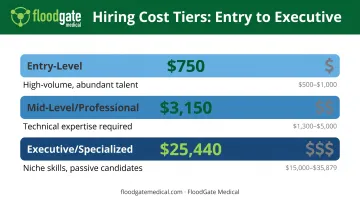
Entry-Level Hiring
What's Typically Included:
- Job board postings and inbound application management
- Basic resume screening and phone interviews
- Minimal interview rounds (often one hiring manager conversation)
Best For: High-volume, low-complexity roles where talent is abundant and speed matters more than fit nuance. Cost-per-hire tends to fall below the nonexecutive median because fixed recruiting costs spread across many hires.
Mid-Level/Professional Hiring
What's Typically Included:
- Skills assessments and work-sample tests
- Multiple interview rounds with cross-functional stakeholders
- Competitive offer negotiation and market-rate benchmarking
Best For: Roles requiring specific technical or functional expertise but drawing from a reasonably broad talent pool. Expect costs near or slightly above the nonexecutive median, depending on sourcing method.
Specialized/Executive Hiring
What's Typically Included:
- Retained or contingency search fees (detailed below)
- Proactive outreach to passive candidates
- Credential and compliance verification (especially critical in MedTech and clinical roles)
- Behavioral assessments and customized scorecards
- Relocation negotiation and support
Best For: Niche technical roles (R&D, regulatory affairs, quality), leadership positions, and regulated-industry hiring where talent scarcity and compliance stakes are high. For example, FloodGate Medical's retained searches for MedTech executive, commercial, clinical, and corporate roles typically include candidate market mapping, proactive pipeline development, and structured fit assessments—work that pushes cost above the executive median but lowers mis-hire risk.
Key Factors That Affect the Cost of Recruiting and Hiring
Role Seniority and Specialization
Entry-level hiring can cost under $1,000 when managed in-house with strong employer branding; executive searches routinely exceed $15,000 and can approach $35,879 for C-suite placements. That's up to a 12x cost gap driven by:
- Longer search cycles and deeper vetting
- Passive-candidate engagement (executives rarely browse job boards)
- Behavioral and leadership assessments
- Relocation and retention negotiations
Niche MedTech roles command premium recruiting investments because the talent pool is scarce and credentialed. R&D engineers, regulatory specialists, and clinical affairs leaders need deep technical expertise and compliance fluency that generalist job boards rarely surface.
Specialized firms fill that gap with focused networks. FloodGate Medical, for example, places 450+ MedTech professionals a year across executive, commercial, clinical, regulatory, and R&D roles from a 200,000+ candidate network built for these specializations.
Industry
Recruiting costs vary dramatically by sector, though apples-to-apples industry comparisons are scarce:
- Healthcare and MedTech face higher costs due to credential verification, licensing requirements, and intense competition for clinical and technical talent
- Technology saw rising cost-per-hire in 2025, with Appcast reporting a 7.14% apply rate and year-over-year CPH increases
- Retail traditionally runs lower per-hire costs due to higher-volume, lower-complexity roles
MedTech adds unique cost layers. Joint Commission standards require primary-source verification of licenses, certifications, and registrations at hire and renewal. The American Hospital Association reports a $61,110 average cost to replace a single bedside nurse.
Those figures are not only recruiting expenses. They are compliance mandates and replacement risks baked into every hire.
Company Size and Recruiting Maturity
Smaller companies without dedicated recruiting teams pay more per hire because:
- Fixed costs (ATS subscriptions, job board licenses) aren't spread across many hires
- Hiring managers handle sourcing and screening, pulling them from revenue-generating work
- Lack of employer brand means higher ad spend to generate the same candidate flow
Enterprise organizations amortize recruiting infrastructure across hundreds of hires annually, driving down unit cost. They also maintain talent pipelines and referral programs that reduce external sourcing expense.
Sourcing Method
| Method | Fee Structure | When to Use |
|---|---|---|
| In-house recruiting | Salary + overhead + tools | High-volume hiring, strong employer brand, sufficient internal capacity |
| Contingency agency | ~20-30% of first-year base salary, paid at hire | Mid-level roles, moderate urgency, broader talent pools |
| Retained search | ~25-35% of first-year guaranteed cash, paid upfront in stages | Executive, scarce, and mission-critical roles where mis-hire risk is unacceptable |
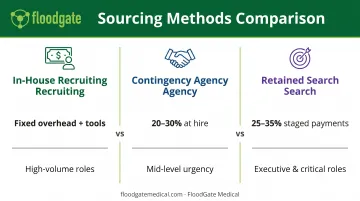
Important distinction: The American Staffing Association defines contingency fees as payable only when the client hires the candidate, while retained search uses staged payments regardless of outcome. Retained engagements cost more upfront but deliver deeper market mapping and rigorous vetting.
For hard-to-fill MedTech roles (regulatory leaders, commercial VPs, clinical R&D directors), a specialized partner who understands credentialing, compliance, and device innovation can cut mis-hire risk even when fees run higher.
FloodGate Medical's 89% one-year retention rate shows what industry-specific screening and culture alignment can protect on the back end of that investment.
Diversity and Quality of Candidate Pool
Building genuinely diverse candidate slates requires more sourcing effort and time upfront:
- Proactive outreach beyond existing networks
- Partnerships with diversity-focused organizations and communities
- Structured interviews and scorecards that reduce unconscious bias
The payoff shows up later in lower turnover and stronger decision-making, which reduces repeat hiring cost. Diverse MedTech teams also tend to drive better innovation and patient-related outcomes. Firms that build DEI into sourcing (FloodGate Medical among them) treat that upfront effort as a retention investment, not just a compliance checkbox.
Cost Breakdown of Recruiting and Hiring
Total hiring cost extends well beyond the recruiter fee or job ad. Here's what adds up:
| Cost Category | One-Time or Recurring | Description |
|---|---|---|
| Recruiter/agency fees or internal salary | One-time per hire (agency) or ongoing (internal team) | Sourcing, screening, interviews, and placement. Contingency: 20–30%; retained: 25–35% |
| Job board & advertising | Recurring | Indeed sponsored jobs from $5/day or $150/month; SHRM postings $299–$499 per 30 days; programmatic spend varies |
| Background checks, assessments & credential verification | One-time per hire | Higher in MedTech/healthcare roles that need primary-source license checks and compliance screening |
| Vacancy costs | Recurring (daily accrual) | Lost productivity, overtime, delayed projects. SHRM 2026 median time-to-fill: 39 days (non-executives), 45 days (executives) |
| Bad-hire and turnover costs | Periodic | SHRM (2015): 39% of CFOs cite lower morale; 34% cite lower productivity. FloodGate Medical estimates full cost up to $250,000 (replacement, training, lost revenue) |
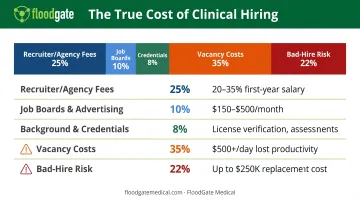
Vacancy costs are often invisible on the P&L but hit hard in practice. An open sales territory loses deals daily; an unfilled R&D seat delays product timelines.
Calculate your role-specific daily cost:
Daily vacancy cost = lost contribution margin + overtime/temp coverage + delay penalties + management time
Low-Cost vs. High-Cost Hiring Approaches
Sticker price alone doesn’t tell you which hiring path costs less. Speed, fit, diversity, and retention decide what you actually spend over the employee lifecycle.
| Dimension | Low-Cost/DIY Approach | High-Cost/Specialized Approach |
|---|---|---|
| Speed to Fill | Slower; depends on inbound applications and internal bandwidth | Faster access to pre-vetted, passive talent pools |
| Candidate Quality & Fit | Higher mismatch and turnover risk; generalist screens miss technical nuances | Industry-specific vetting cuts bad-hire risk (e.g., 89% one-year retention in MedTech searches) |
| Diversity Outcomes | Often defaults to existing networks, limiting pipelines | DEI-focused firms intentionally build diverse candidate slates |
| Long-Term Value | Cheaper upfront; one bad hire can erase savings from many low-cost placements | Higher initial spend offset by better retention, faster ramp, and stronger performance in technical roles |
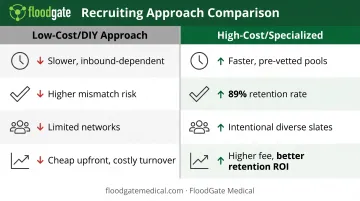
Cheap recruiting isn’t always cost-effective. A $2,000 DIY hire that leaves in six months costs far more than a $12,000 specialized search that delivers a five-year performer. When a reimbursement change forced an urgent MedTech salesforce expansion, FloodGate Medical filled the team in 21 days—speed most inbound-only pipelines can’t match.
How to Estimate the Right Recruiting Budget for 2026
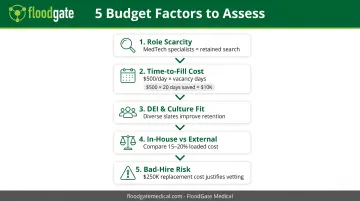
The "right" budget depends on role criticality and risk tolerance, not just minimizing spend. Factor in:
- Role scarcity: MedTech regulatory specialists, clinical R&D leaders, and commercial VPs draw from small, credentialed talent pools. Budget for retained search or specialized partners with warm networks.
- Time-to-fill cost: If an open seat costs $500/day and a faster partner cuts 20 days off fill time, the $10,000 saved justifies higher fees.
- DEI and culture fit: When diversity and retention are strategic goals, invest in firms that build intentionally diverse slates and assess culture alignment, not just resume keywords.
- In-house vs. external: If fully loaded internal cost (salary, benefits, tools, manager time) exceeds 15-20% of first-year salary for specialized roles, external partners often deliver better ROI.
- Bad-hire risk: For a $120,000 role, a mis-hire can cost $250,000+ in replacement, lost productivity, and disruption. An extra $8,000 on rigorous vetting is cheap insurance.
What Most People Miss About the Cost of Recruiting and Hiring
Most teams track recruiter fees and job ads, then miss the costs that actually drive total hiring spend:
- Vacancy cost swamps the agency fee. A $5,000 recruiter fee looks expensive until a 60-day vacancy costs $30,000 in lost contribution margin.
- Hiring-manager time is real labor cost. Five managers at six hours each is $3,000+ in fully loaded cost for a mid-level hire.
- Cheaper generalist recruiting often backfires in MedTech. An 18% fee erases savings when candidates lack regulatory fluency or clinical credibility and turnover forces a re-hire.
- Diverse, well-vetted pipelines cut long-term turnover. DEI-driven recruiting improves retention, innovation, and team performance in ways that compound over years.
Conclusion
The cost of recruiting and hiring in 2026 varies dramatically by role, industry, and sourcing strategy, often far exceeding the sticker price of a job posting or agency fee. Understanding the full cost breakdown—vacancy losses, interviewer time, credential verification, and bad-hire risk—supports smarter budgets and stronger long-term hires.
For specialized, high-stakes MedTech roles, partnering with a firm that knows the technical requirements and values diverse, well-matched candidates delivers the strongest ROI.
Frequently Asked Questions
What is the average cost of recruiting per hire?
SHRM's 2026 benchmarking report shows a median cost-per-hire of $1,300 for nonexecutive roles and $15,000 for executive positions. The 2025 report tracked averages of $5,475 and $35,879 respectively, illustrating wide variation by role complexity and sourcing method.
How much does a $20 an hour employee cost an employer?
Beyond the ~$41,600 annual wage, BLS data shows private employers pay about a 1.43x multiplier for total compensation (taxes, benefits, and paid leave). That brings fully loaded cost to roughly $28.59/hour or $59,465/year, before recruiting and onboarding.
What is a good cost-per-hire benchmark to aim for?
Benchmarks should be compared against your industry and role type rather than the national average alone. High-volume retail hiring may run below $1,000 per hire, while specialized MedTech or executive searches routinely exceed $15,000. Focus on cost-per-quality-hire and retention outcomes, not just the lowest upfront number.
Why does hiring for MedTech and healthcare roles cost more?
Joint Commission rules require primary-source verification of licenses and certifications, which adds screening time and cost. AHA reports 22.3% first-year RN turnover and $61,110 to replace one bedside nurse. Specialized MedTech roles also draw from small, credentialed pools, which raises search and salary costs.
Is it worth paying more for a specialized recruiting firm?
For critical roles, yes. Lower mis-hire risk and faster access to niche talent often offset higher fees. FloodGate Medical's 89% one-year retention rate and week-scale MedTech search timelines show that specialized expertise pays back through better fits and shorter vacancies.
How can companies reduce their cost-per-hire without sacrificing quality?
Use employee referrals, shorten interview cycles, and work with recruiters who keep pre-vetted pipelines instead of starting every search cold. FloodGate Medical's 200,000+ candidate network supports faster placements because relationships and vetting start before a req opens.