Introduction
"Medical trends 2026" describes the specific shifts reshaping how care gets delivered, priced, and staffed as AI, affordability pressure, and workforce disruption collide across healthcare and MedTech.
This isn't a distant forecast. It's already showing up in hospital budgets, cath lab purchasing decisions, and hiring plans right now.
Employers are bracing for a 6.7% increase in health benefit costs next year, the steepest jump in 15 years according to Mercer's 2026 projections. Meanwhile, AI-enabled digital health companies are pulling in a growing share of investor dollars.
Many healthcare organizations struggle to translate that AI momentum into measurable savings while managing thinner margins and shrinking talent pools. Understanding where these forces are headed helps leaders budget accurately and hire strategically ahead of a fast-changing regulatory landscape.
This article breaks down the five trends defining medicine in 2026, what's driving them, how they're reshaping operations and hiring, and what signals to watch next.
TL;DR
- AI adoption deepens across diagnostics, documentation, and revenue cycle work
- Medical cost trend keeps climbing in 2026, squeezing payers and patients alike
- M&A activity reshapes competitive dynamics among providers, insurers, and MedTech vendors
- Precision medicine accelerates as gene editing and AI-discovered therapies reach clinics faster
- DEI-driven talent strategy becomes a key differentiator for MedTech companies
Key Trends Shaping Medicine in 2026
Five forces stand out as the ones most likely to affect budgets, staffing, and strategy this year. Here's what the data shows.
AI Integration Across Clinical and Administrative Workflows
AI has moved well beyond pilot programs. It now touches diagnostics, ambient clinical documentation, administrative automation, and patient-facing chatbots simultaneously.
The capital tells the story. AI-enabled digital health companies captured 54% of 2025 US digital health funding, up from 37% in 2024, according to Rock Health's year-end funding overview. That's a massive shift in investor priorities in just one year.
Adoption is following, at least in documentation:
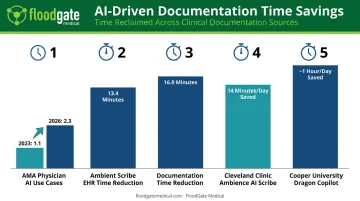
- 81% of physicians surveyed by the American Medical Association reported using AI professionally, with average use cases rising from 1.1 in 2023 to 2.3 in 2026
- Ambient scribe tools cut EHR time by 13.4 minutes and documentation time by 16.0 minutes across five academic medical centers
- Cleveland Clinic's Ambience AI Scribe saved clinicians 14 minutes per day; Cooper University Health Care's Dragon Copilot saved roughly an hour daily per clinician
Not every workflow has caught up equally. Diagnostics and administrative automation are advancing, but documentation remains where the clearest, most measurable gains sit today.
Healthcare Affordability & Cost Pressures Intensify
Medical cost trend is hitting multi-year highs, and 2026 is shaping up to be one of the toughest years in recent memory for budget planning.
Mercer projects employer health benefit costs will rise 6.7% in 2026, pushing average per-employee costs above $18,500. That's the sharpest single-year jump in 15 years.
A few forces are compounding the pressure:
- Subsidy changes: KFF estimates that expiring enhanced premium tax credits could raise subsidized enrollees' annual premium payments by an average 114%, or $1,016, in 2026
- Cost-shifting: The average 2025 family premium reached $26,993, with workers covering $6,850 of that themselves
- Deductible growth: Average single-coverage deductibles now sit around $1,886 among workers in plans that carry one
Employers can't absorb these increases indefinitely, which means more of the burden lands on employees and patients through higher premiums, deductibles, and narrower networks.
Continued Industry Consolidation & M&A Activity
Consolidation is reshaping who controls patient access, pricing power, and technology adoption across the industry, though the picture is more nuanced than "everything is merging."
| Metric | 2025 Data |
|---|---|
| Hospital/health system transactions | 46 deals announced, fewer than 2024 |
| Global healthcare private equity value | $190 billion, a record |
| MedTech PE deal value | Nearly doubled to $33 billion |
| MedTech PE deal count | Rose ~20% to roughly 88 deals |
| Highly concentrated insurance markets | 97%, or 372 of 384 metro areas |
According to Bain & Company, that record private equity value, paired with fewer hospital transactions, shows deal count and deal value moving in opposite directions. One notable example: BD's $4.2 billion acquisition of Edwards Lifesciences' Critical Care unit, a deal that expanded BD's footprint in advanced patient monitoring.
For MedTech vendors like device manufacturers supplying cath labs and interventional cardiology teams, consolidation at the hospital and payer level means fewer, larger buyers with more negotiating leverage. That reality is pushing suppliers toward deeper clinical partnerships rather than transactional sales relationships.
Breakthroughs in Life Sciences & Precision Medicine
Gene editing, mRNA platforms, and AI-accelerated drug discovery are moving from experimental territory into approved, real-world treatment options faster than they used to.
A few milestones define the pace:
- The FDA approved Casgevy in December 2023, the first therapy using CRISPR/Cas9 genome editing, for sickle cell disease
- mRESVIA, an mRNA RSV vaccine, won FDA approval in May 2024 for adults 60 and older
- Rentosertib, a generative AI-discovered candidate, advanced into a randomized Phase 2a trial involving 71 patients with idiopathic pulmonary fibrosis
Funding hasn't kept pace with the science, though. Venture investment in life sciences cooled through H1 2025, with transaction counts hitting a decade low in Q2. Regulatory approvals are outpacing capital enthusiasm, which creates real uncertainty about which breakthroughs actually reach patients at scale.
Workforce & Talent Shifts Reshape MedTech Hiring
Demand for specialized skills, AI and data science, regulatory affairs, and digital health expertise, is climbing just as staffing shortages persist across the industry.
The financial stakes are real. Deloitte estimates that MedTech generative AI adoption could create cost efficiencies equal to 6% to 12% of revenue over two to three years. Companies without the right talent to execute on that opportunity risk falling behind competitors who move faster.
Some organizations are responding with intentional, inclusion-focused hiring. BD hired 6,500 external candidates with diverse backgrounds and perspectives in FY2024, while MedTechVets, a veteran talent pipeline program, reports a 95% job placement rate.
Specialized recruiting partners fill this gap. Firms like FloodGate Medical match MedTech companies with hard-to-find technical and regulatory talent, while embedding equity, diversity, and inclusion practices into the search process itself.

That combination matters more now than it did five years ago. Generic staffing approaches can't keep pace with how specialized MedTech hiring has become.
What's Driving These Medical Trends
Several interconnected forces are pushing these shifts forward heading into 2026. None of them operate in isolation.
- Technology advances: AI and life sciences venture funding reached $10.5 billion across 511 deals in 2024, per PitchBook, fueling continued investment in automation and clinical AI tools
- Market demand and regulatory pressure: 76.4% (194 million) of US adults reported at least one chronic condition in 2023, while 250 health AI bills emerged across 34 states in 2025 amid a fragmenting compliance landscape
- Cost and efficiency pressures: Providers and payers are chasing new cost-of-care strategies as reimbursement pressure mounts alongside rising utilization
- Competitive dynamics: Non-traditional entrants are shaking up the market, though not always successfully. Walmart closed all 51 health centers across five states in 2024, calling the model unsustainable
- Retail retreats, consolidation continues: Walgreens shuttered more than 160 VillageMD clinics after a $6 billion loss, while CVS, Amazon, UnitedHealth, and private equity firms keep acquiring physician practices
These forces feed each other. Rising chronic disease drives utilization, utilization drives cost pressure, and cost pressure drives both consolidation and AI adoption as organizations look for efficiency wherever they can find it.
How These Trends Are Impacting the Industry
These five trends carry measurable consequences across operations, business strategy, and workforce planning. Here's how each area is being reshaped.
Operational Impact
Clinical and administrative workflows now lean heavily on AI tools for documentation, diagnostics support, and virtual care access. With staffing shortages showing no signs of easing, AI adoption is becoming the only way many providers can keep pace with patient volume.
Business Impact
Strategic investment is redirecting toward cost-of-care initiatives, value-based contracts, and technology partnerships designed to protect shrinking margins. Companies that once competed purely on product features now compete on total cost of ownership and integration capability. For device manufacturers supplying cath labs and other high-cost settings, that means proving long-term value through outcomes data, not just product specs.
Workforce Impact
The need for niche technical and regulatory expertise, plus diverse leadership teams, keeps growing. Partnering with specialized, DEI-focused recruiters like FloodGate Medical helps MedTech companies close skills gaps while building leadership teams that reflect the patients they serve. Generic hiring pipelines aren't built for this level of specialization.
Future Signals for Medical Trends Beyond 2026
These trends will keep evolving. Here are the signals worth watching over the next one to three years.
Early indicators include cellular and gene therapies expanding into broader patient populations beyond initial approval indications, alongside AI regulation maturing at both state and federal levels as the current patchwork of laws consolidates.
Technologies to watch:
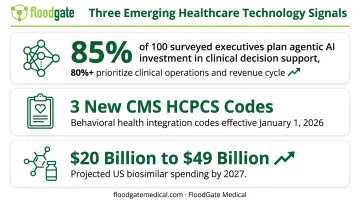
- Agentic AI in clinical decision support: 85% of 100 surveyed health care executives already plan agentic AI investment, with more than 80% prioritizing clinical operations and revenue cycle use cases
- Deeper behavioral health integration, backed by CMS's three new optional HCPCS codes effective January 1, 2026
- Accelerated biosimilar adoption, with IQVIA projecting $20 billion to $49 billion in US biosimilar spending by 2027
Scenario to prepare for: Continued cost-shifting to consumers, paired with rising demand for specialized talent capable of managing growing regulatory and technical complexity. Organizations that don't plan for both will likely struggle on two fronts at once.
Conclusion
AI adoption, affordability pressure, consolidation, life sciences breakthroughs, and workforce shifts are jointly shaping medicine's near-term future. None of these trends are slowing down in 2026.
Organizations that adapt early, particularly by building skilled and diverse teams, gain a real edge over competitors still relying on outdated hiring and operational models. That's not a small advantage in a market this competitive.
Strategic foresight backed by trusted data and the right talent partners will define who thrives in this market and who gets left managing yesterday's playbook.
Frequently Asked Questions
What is the current medical trend?
Medical trend refers to the projected year-over-year cost increase for treating patients, covering factors like utilization, pricing, and treatment mix. Recent trends have been running well above historical norms, driven largely by inflation and rising chronic disease management costs.
What are the top 3 trends in healthcare?
AI adoption across clinical and administrative work, rising costs and affordability pressure, and continued industry consolidation stand out as three of the most significant ongoing trends. Each is reshaping how organizations budget, staff, and compete.
What is the medical trend for 2026?
Medical cost trend is projected to stay elevated in 2026, driven by inflation, higher utilization, and technology-enabled billing changes. Mercer projects employer health benefit costs will climb 6.7%, the steepest increase in 15 years.
What is driving the rise in healthcare costs in 2026?
Inflation, chronic disease utilization, specialty pharmacy costs, and provider consolidation are the primary drivers. Subsidy changes and shrinking insurer competition in concentrated markets are adding further pressure on premiums.
How is AI transforming healthcare delivery in 2026?
AI's expanding role spans diagnostics support, clinical documentation through ambient scribes, and patient engagement tools like chatbots. Documentation shows the clearest measurable gains so far, with some clinicians saving up to an hour daily.
What skills and roles are in highest demand for MedTech companies in 2026?
AI and data science expertise, regulatory affairs specialists, and diverse leadership talent top the list. Specialized recruitment partners such as FloodGate Medical help companies identify and place candidates for these niche, hard-to-source roles.