
Introduction
A MedTech board chair with 15 years of regulatory expertise announces retirement just as the company prepares for FDA review. Without a succession plan, the board faces a knowledge vacuum at the worst possible time. Regulatory continuity vanishes, investor confidence wavers, and the approval timeline becomes uncertain.
Board succession planning is the strategic, ongoing process of identifying, developing, and transitioning board members to maintain effective governance and institutional knowledge. This guide focuses specifically on board-level succession, not CEO or executive transitions.
Effective succession planning covers planned departures such as term limits and retirement, plus emergencies like unexpected resignations. For MedTech organizations facing regulatory complexity and rapid technology change, proactive board succession is a competitive necessity.
This guide walks through how to assess board composition, build a candidate pipeline, and execute transitions that protect governance continuity.
Key Takeaways
- Planned succession protects governance continuity, institutional knowledge, and strategic direction during transitions
- Structured governance committee processes cover both planned departures and emergency scenarios
- MedTech boards need skills-gap analysis across regulatory, clinical, and technology domains
- Diversity in gender, ethnicity, and professional background strengthens decision-making
- Begin 12–18 months before expected departures and maintain continuous candidate pipelines
What Is Board Succession Planning?
Board succession planning is a strategic, ongoing process to identify, develop, and transition board members while maintaining effective governance. Unlike CEO or executive succession, which addresses operational and strategic leadership, board succession focuses on governance-level oversight, fiduciary responsibility, and institutional continuity.
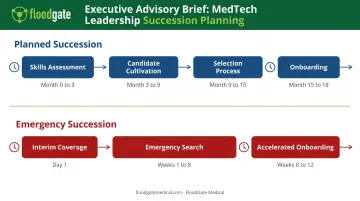
The process covers two scenarios:
- Planned succession: Anticipated departures driven by term limits, retirement timelines, or announced transitions
- Emergency succession: Unexpected vacancies caused by sudden resignation, health issues, or removal
Both require proactive preparation. Emergency succession demands interim coverage plans already in place, while planned succession allows 12-18 months for candidate identification, vetting, and structured onboarding.
Why Board Succession Planning Is Critical in MedTech
MedTech boards face regulatory complexity, rapid technology shifts, and clinical expertise requirements that general boards rarely encounter. FDA compliance demands directors who understand Quality Management System Regulation (QMSR), Premarket Approval processes, and Investigational Device Exemptions. International expansion requires CE Mark expertise and knowledge of global regulatory frameworks.
Research from the American Hospital Association found that more than 75% of healthcare boards either did not replace directors during their terms or reappointed eligible directors over a three-year period. That low turnover can stifle fresh perspectives and leave expertise gaps unaddressed.
Poor succession planning creates real operational risk:
- Strategic initiatives stall when key directors leave mid-cycle
- Stakeholder confidence drops without clear continuity plans
- Compliance exposure rises if regulatory expertise walks out the door
When a board loses a director with deep regulatory knowledge during a critical approval cycle, delayed timelines and costly missteps follow.
The Diversity Advantage in MedTech Governance
Diverse boards deliver measurable performance gains. McKinsey's 2023 global study of 1,265 companies found that organizations in the top quartile for board gender diversity were 27% more likely to outperform financially than bottom-quartile peers. Ethnically diverse boards in the top quartile were 13% more likely to outperform.
For MedTech companies serving diverse patient populations, board composition matters beyond the balance sheet. Gender, ethnicity, professional background, and expertise diversity strengthen decision-making and help products meet varied clinical needs. DEI-focused succession planning also helps attract top talent and build stakeholder trust.
How Board Succession Planning Works
Effective board succession runs as an ongoing cycle. The governance or nominating committee continuously assesses composition, cultivates candidates, and manages transitions in a structured way.
NACD's governance framework recommends a composition horizon of at least three years, and ideally five or more. Revisit succession plans annually, or every two to three years, during strategy discussions.
Step 1: Conduct a Board Skills and Composition Assessment
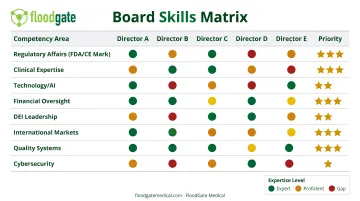
Use a board skills matrix to map current members' expertise against strategic needs:
- Regulatory affairs: FDA, CE Mark, international compliance
- Clinical expertise: Device validation, clinical trials, safety monitoring
- Technology: AI/ML, digital health platforms, cybersecurity
- Financial: Capital raising, M&A, audit oversight
- DEI leadership: Experience building diverse teams and inclusive cultures
Identify gaps in skills, diversity, and experience. Prioritize them against strategy: entering new markets calls for international regulatory expertise; launching AI-enabled devices calls for tech-savvy directors.
Step 2: Assess Upcoming and Potential Vacancies
Review term limits, retirement timelines, and any signals of early departure. Build scenarios for emergency vacancies and define interim coverage plans.
Ask:
- Which directors are approaching term limits in the next 12-24 months?
- Do any committee chairs plan to rotate off within two years?
- What skills would we lose if a director departed unexpectedly tomorrow?
Step 3: Identify and Cultivate Candidates
Internal candidates offer institutional knowledge, trusted relationships, and cultural fluency. External candidates add new networks, independent judgment, and skills the current board lacks.
Use the gaps from your skills matrix to guide outreach. Build the pipeline through industry networks, former executives, clinical leaders, and specialized search partners who understand MedTech governance.
Start cultivation before seats open:
- Maintain a living shortlist tied to priority skill gaps
- Hold informal conversations years ahead of expected transitions
- Track DEI goals alongside expertise so the slate stays broad
- Revisit the pipeline when strategy shifts (new markets, M&A, digital products)
Waiting until a seat is empty forces reactive, narrow searches that perpetuate homogeneity.
Step 4: Formalize Selection and Onboarding
The governance committee recommends candidates; the full board approves appointments. Selection criteria should balance skills gaps, diversity goals, and cultural fit without prioritizing comfort over fresh perspectives.
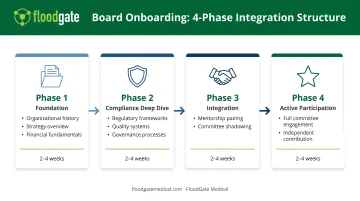
Structured onboarding accelerates effectiveness:
- Organization history, strategy, and financials
- Compliance frameworks, regulatory obligations, and quality systems
- Committee structures and governance processes
- Mentorship pairing with an experienced director
- Shadowing opportunities at key meetings
With structured onboarding, new directors contribute in early meetings instead of spending their first months catching up.
Key Factors That Affect Board Succession in Healthcare Organizations
Strategic Priorities
Board composition must align with organizational direction. International expansion demands global regulatory expertise; AI integration requires technology-savvy directors who understand algorithmic validation and cybersecurity. Boards that fail to anticipate strategic needs find themselves scrambling for expertise when it's already too late.
Regulatory and Compliance Landscape
MedTech boards need directors who understand FDA device classifications, Quality Management System Regulation, Medical Device Reporting, and international standards. The FDA's updated QMSR—effective February 2026—incorporates ISO 13485:2016 by reference and governs design, manufacture, packaging, and labeling controls. Directors unfamiliar with these frameworks cannot provide effective oversight.
Diversity and Inclusion Goals
DEI is a governance imperative. Research tracking US hospital boards from 2011 to 2021 found that mean ethnic-minority representation rose from 1.2 to 1.6 directors. Boards with no ethnic-minority directors declined from 49.5% to 38.4%. Female representation showed slower progress, highlighting the need for intentional diversity goals in succession planning.
Diverse boards better reflect patient populations, challenge groupthink, and drive innovation. Organizations that treat diversity as a checkbox rather than a strategic priority miss the governance and performance benefits diversity delivers.
Access to Qualified Talent
MedTech board candidates with regulatory, clinical, or digital-health expertise are in high demand. Building relationships before vacancies occur strengthens pipelines. Partnering with specialized recruiters who understand healthcare technology and prioritize DEI can expand access to qualified, diverse candidates. Firms such as FloodGate Medical bring deep MedTech expertise and a values-driven approach to that search.
Common Mistakes and How to Avoid Them
Waiting Until a Vacancy Opens
Waiting until a seat opens to start planning is the most common failure. NACD's 2024 survey found that only 29% of public-company boards had developed or reviewed a formal board-leadership succession plan in the preceding 12 months. Reactive succession forces rushed decisions and shrinks the candidate pool.
Begin succession conversations 12–18 months before expected departures, and keep a live candidate pipeline through steady networking—not a scramble when someone resigns.
Prioritizing "Culture Fit" Over Fresh Perspectives
Planning early only helps if the criteria are right. Prioritizing "culture fit" over diversity and fresh perspectives keeps boards hiring in their own image. Replicating existing director profiles narrows debate and weakens decision-making when markets or strategy shift.
Define "fit" as shared commitment to mission and governance standards—not matching backgrounds or thinking styles. Score candidates against skills gaps and diversity goals first, then test cultural alignment.
Neglecting Onboarding and Integration
Selection is only half the job. Neglecting onboarding and integration leaves new directors slow to contribute. Without structured orientation, mentorship, and shadowing, even seasoned directors spend months learning what they should have absorbed in weeks.
Build a formal onboarding path that covers organizational history, strategy, financials, compliance, and governance processes. Pair each new director with an experienced mentor and schedule shadowing at committee meetings before they take a full vote.
When to Seek External Support
External recruitment expertise adds value when:
- Internal networks lack access to specialized skills (AI, regulatory, digital health)
- Diversity goals require expanding beyond familiar candidate pools
- Urgent vacancies demand rapid identification of qualified candidates
- Governance committees lack bandwidth to conduct comprehensive searches
In those cases, specialized MedTech recruiters can surface qualified candidates who already understand healthcare technology governance. FloodGate Medical focuses exclusively on MedTech and expands board pipelines through DEI-centered search practices that reach beyond traditional networks.
Frequently Asked Questions
What are the 5 steps of board succession planning?
Five core steps: (1) assess composition and skills gaps with a board matrix, (2) forecast vacancies from term limits, (3) cultivate diverse candidates early, (4) formalize selection via the governance committee and full board, and (5) onboard with orientation and mentorship.
Who should be involved in board succession planning?
The governance or nominating committee leads the process with input from the board chair and CEO. The full board approves final appointments. External advisors or specialized recruiters may support candidate identification, particularly when diversity or specialized expertise is a priority.
What is the most common mistake in board succession planning?
Waiting until a vacancy occurs rather than planning proactively. Successful boards maintain ongoing candidate pipelines, revisit succession plans annually, and begin formal succession conversations 12-18 months before anticipated departures.
Can family members be included in board succession planning?
Yes, in family-led or closely held organizations. However, family members should meet the same skills, governance, and independence criteria as non-family candidates to ensure board effectiveness and avoid conflicts of interest.
How far in advance should we start board succession planning?
For planned departures, begin 12-18 months in advance. For emergency succession, maintain interim coverage plans at all times so the board can respond immediately to unexpected vacancies without disrupting governance continuity.
How does board succession planning differ from CEO succession planning?
Board succession focuses on governance-level leadership, fiduciary oversight, and institutional continuity. CEO succession focuses on operational and strategic executive leadership. Both are critical, but they require different processes, timelines, and candidate profiles.