Introduction
Ask any seasoned physician how they land on a diagnosis, and most won't point first to a lab report or an imaging scan. They'll point to the conversation.
A classic study of 80 outpatients found that the medical history alone led to the correct diagnosis in 76% of cases, compared with just 12% for the physical exam and 11% for lab work, according to research published in the American Journal of Medicine. That's not a fluke. It's a pattern that's held up across decades of clinical education.
The medical interview is a structured, purposeful exchange that does two things at once: it gathers the facts needed for diagnosis, and it builds the relationship that makes patients trust and follow through on care.
This guide breaks down what the medical interview actually involves, the frameworks physicians use to run it well, and why these same skills matter far beyond the exam room, including for professionals working in MedTech.
Key Takeaways
- Patient history, not imaging or labs, drives most outpatient diagnoses
- Effective interviews balance analytical questioning with genuine connection
- OPQRST and ICE frameworks prevent missed information and misread concerns
- Most interview breakdowns trace back to interviewer habits, not "difficult" patients
- Clinical communication skills now factor into hiring for physician-facing MedTech roles
What Is the Medical Interview?
The medical interview is the physician's most versatile tool. It costs nothing, requires no equipment, and yet outperforms most diagnostic technology in terms of raw information yield. But running one well demands two very different skill sets working together at the same time.
Analytical skills help a clinician organize scattered symptoms into a coherent clinical picture. Interpersonal skills help that same clinician read the emotion behind a patient's hesitation, or notice when someone's downplaying pain out of fear.
Content vs. Process
Clinicians talk about two layers running through every interview:
- Content — the factual information: symptoms, timing, medications, family history
- Process — how that information gets delivered: tone, body language, pauses, what's left unsaid
A patient might report mild chest discomfort (content) while gripping the exam table and avoiding eye contact (process). Miss the process, and you miss half the story.
The History Is Co-Created, Not Extracted
Here's a common misconception worth correcting: physicians don't "take" a history like pulling a file off a shelf. They build it together with the patient. Research analyzing physician-patient conversations describes this as a co-construction of the illness narrative: the account emerges through back-and-forth dialogue, not passive extraction.
This matters because how a question gets asked shapes what answer comes back. A rushed "any pain?" gets a different response than "tell me more about what that felt like."
It's Diagnostic and Therapeutic
Every interview does double duty. It collects the clinical data needed to solve today's problem, while also:
- Building rapport that makes future visits more productive
- Reducing the sense of helplessness that often accompanies illness
- Reinforcing a relationship that supports long-term health management
Most real encounters blend an immediate concern with a longer-term wellness conversation, even when the visit is framed as "just a check-up."
Types of Medical Interviews
Not every visit serves the same purpose. Physicians generally run one of two interview styles, though most visits end up being a mix of both.
The Problem-Oriented Interview
This type centers on the patient's specific complaint and immediate request for help. The presenting problem dictates the depth and direction of every follow-up question. Someone comes in with knee pain; the interview stays focused on that knee, its history, and what's making it worse.
The Health Promotion Interview
This type looks past the immediate complaint to build a full picture of risk. It covers:
- Smoking, alcohol use, and diet
- Family history of chronic disease
- Screening needs based on age and risk factors
- Early signs of conditions the patient hasn't noticed yet
The American Academy of Family Physicians describes this preventive-style visit as non-problem-oriented — it doesn't center on a chief complaint at all.
In practice, these two types blend constantly. A "routine physical" often surfaces a concern the patient wasn't planning to mention, and a problem-focused visit almost always touches on risk factors relevant to the presenting issue.
Key Components of a Clinical Interview
A well-run interview follows a predictable sequence. Skipping steps or running them out of order is one of the fastest ways to miss something important.
The Standard Sections
- Chief Complaint — the reason for today's visit, in the patient's own words
- History of Present Illness (HPI) — a detailed exploration of the current problem
- Past Medical History — prior diagnoses, surgeries, medications, and allergies
- Family History — hereditary risk factors and patterns
- Social History — lifestyle, occupation, substance use, living situation
- Review of Systems (ROS) — a final symptom-by-symptom checklist
Chief Complaint: More Than "What Brings You In?"
The opening question sets the tone for everything after it. Physicians are trained to follow up with "anything else?" before diving deeper, because patients often lead with a lesser concern and save the real issue for later, or never mention it at all.
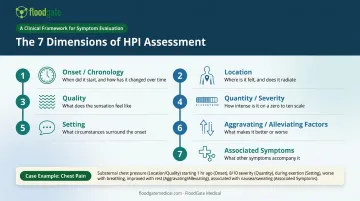
HPI: The Seven Dimensions
Once the chief complaint is identified, the HPI digs into specifics using what's often taught as the seven symptom dimensions (sometimes shortened to OPQRST-AAA):
- Onset/chronology — when did it start, and how has it changed?
- Location — where exactly is the symptom?
- Quality — sharp, dull, burning, pressure?
- Quantity/severity — how bad, on what scale?
- Setting — what was happening when it started?
- Aggravating/alleviating factors — what makes it better or worse?
- Associated symptoms — what else is happening alongside it?
For a patient presenting with chest pain, a structured pass might sound like this:
- Onset: pain started two hours ago
- Location: centered under the breastbone
- Quality: pressure rather than sharp
- Severity: rated 7 out of 10
- Setting: began while climbing stairs
- Aggravating/alleviating: worsens with exertion, eases with rest
- Associated symptoms: accompanied by shortness of breath
That single structured pass gives a cardiologist most of what they need before ever touching a stethoscope.
Building Context: PMH, Family, and Social History
These three sections don't just add background. They tell the physician how much weight to give the current complaint. A patient with a family history of early heart disease reporting chest pain gets a very different level of urgency than one with no cardiac risk factors at all.
Review of Systems: The Final Sweep
The ROS catches anything the earlier sections missed. Done well, it starts with an open question ("Any other symptoms I should know about?") before moving into a focused checklist by body system. A complete ROS should take under five minutes. Any longer usually signals the interviewer is over-probing areas already covered.
Before moving to the physical exam, sharp clinicians summarize the HPI back to the patient: "So this pain started two hours ago, feels like pressure, and gets worse with activity, correct?" That thirty-second check catches errors before they become diagnostic mistakes.
Best Practices for Conducting an Effective Interview
Technique matters as much as content. Two clinicians can ask the same questions and get wildly different information depending on how they run the conversation.
Open-Ended Questions and Active Listening
Every effective interview begins with an open-ended question like "What brings you in today?" Jumping straight to closed, yes/no questions too early is one of the most common and costly interviewing mistakes.
Why? Closed questions filter information through the interviewer's assumptions. Ask "Is the pain sharp?" and you'll never learn the patient actually meant to describe a dull ache that comes and goes. The Calgary-Cambridge framework, widely used in medical education, explicitly directs clinicians to move from open to closed questioning, never the reverse.
Once the door is open, keeping a patient talking productively takes deliberate technique, not just staying quiet:
- Silence — giving space instead of filling every pause
- Nodding and verbal encouragement — signaling "keep going" without interrupting
- Reflecting — repeating the patient's own words back to confirm understanding
- Summarizing — periodically recapping to check accuracy
The ICE Framework
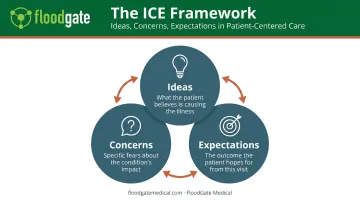
Understanding the facts of an illness is only half the job. Physicians also need to understand how the patient experiences it. The ICE framework captures this:
- Ideas — what does the patient think is causing this?
- Concerns — what specifically worries them about it?
- Expectations — what do they want from this visit?
This isn't just soft-skills theory. A study across 613 consultations in 36 Belgian primary care practices found that when physicians identified patient concerns and expectations, medication was prescribed less often — suggesting that understanding a patient's actual worry, rather than just their symptoms, changes clinical decisions.
Empathy and Trust-Building Basics
Acknowledging emotion is different from promising an outcome. "That sounds frightening" validates a patient's experience. "I'm sure it's nothing" doesn't, and it can backfire if the diagnosis turns out serious.
Building trust also depends on structural habits established early in the visit:
- Introduce yourself and explain the visit's purpose
- Protect privacy before discussing sensitive topics
- Use plain language instead of clinical jargon
- Signal transitions ("Now I'd like to ask about your family's health history")
Common Interviewing Challenges and How to Solve Them
Most interview breakdowns fall into three categories, and it's worth knowing which one you're dealing with before trying to fix it.
| Category | Common Issues | Fix |
|---|---|---|
| Patient-related | Anxiety, confusion, memory gaps | Slow down, simplify language, use open prompts |
| Interviewer-related | Over-directing, poor listening, premature closed questions | Start open, resist interrupting |
| Relationship-related | Language barriers, unclear goals | Use interpreters, clarify agenda early |
The "Poor Historian" Myth
Clinicians sometimes label a disorganized account a "poor history," blaming the patient. Research pushes back hard on this: the clinician is the historian, not the patient. A jumbled history usually reflects interviewing technique, not patient failure.
This label can be especially harmful with patients facing language barriers, where the real issue is inadequate interpretation, not the patient's ability to communicate.
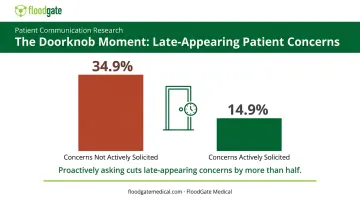
The Doorknob Problem
Ever had a patient mention their real concern just as they're reaching for the door? It's common enough to have a name. One study found late-appearing concerns in 34.9% of encounters where the physician hadn't actively solicited concerns, compared to just 14.9% when they had, according to research on patient agenda-setting.
The fix is simple: ask "what else?" early, more than once, before assuming the agenda is complete.
Time Pressure
With limited minutes per visit, the temptation is to cut the open-ended portion short. Resist it. A few extra seconds of uninterrupted patient talk upfront almost always saves time later by preventing missed information that requires a follow-up visit.
Why Strong Interview Skills Matter in Healthcare and MedTech Careers
Clinical interview skills don't stay confined to the exam room. They show up as core competencies in a growing set of MedTech careers.
Medical science liaisons, clinical specialists, and physician-facing sales professionals spend their days in conversations that mirror the clinical interview. They ask open questions, read nonverbal cues, and adjust communication style based on what the other person actually needs, not just what they say first.
Roles where these skills matter most:
- Medical science liaisons, who exchange scientific information with physicians and need to read what a clinician is really asking
- Field clinical specialists, who support procedures and must communicate clearly under pressure
- Clinical liaisons, who translate between care teams and patients
- MedTech sales professionals, whose credibility with physicians hinges on listening skills, not just product knowledge
Companies hiring for these positions increasingly screen for the same active-listening and rapport-building qualities this guide has covered. That's a large part of what FloodGate Medical looks for when matching candidates with MedTech companies. Beyond technical credentials, it means finding professionals who can build genuine trust with physicians and patients alike.
Frequently Asked Questions
What is the medical interview?
The medical interview is the structured, purposeful conversation between a physician and patient, used to gather diagnostic information while building the relationship that supports ongoing care. Unlike casual conversation, it follows a defined sequence and purpose.
What do they ask in a medical interview?
Physicians typically ask about the chief complaint, details of the current illness (HPI), past medical and family history, social factors, and a final review of systems checklist. Each section serves a distinct diagnostic purpose.
What are the main components of a medical interview?
The six standard sections are Chief Complaint, History of Present Illness, Past Medical History, Family History, Social History, and Review of Systems. Together, they build a complete clinical picture.
How long does a typical medical interview take?
Duration varies by setting and complexity, typically running 15 to 30 minutes for a standard visit. As a benchmark, the review of systems portion alone should take under five minutes when it opens with a broad question before narrowing.
What is the difference between the medical interview and the physical exam?
The interview gathers subjective history through conversation, meaning it relies on what the patient reports. The physical exam involves objective, hands-on assessment of the body itself.
What skills are needed to conduct an effective medical interview?
Active listening, genuine empathy, structured questioning technique, and clear, jargon-free communication. Technical knowledge alone isn't enough without these interpersonal skills.