
MedTech recruiting faces a perfect storm: 69% of organizations report difficulty recruiting for full-time roles, with low applicant volume and intense employer competition leading the challenges. When you layer in niche skill requirements—FDA regulatory expertise, biomedical engineering credentials, clinical trial management—the need for market intelligence becomes urgent. This guide covers what market mapping is, how to build one step-by-step, and how firms like FloodGate Medical use proactive mapping to unite great MedTech talent with great companies before a requisition ever opens.
Key Takeaways
- Market mapping researches talent, companies, and organizational structures within a niche before a role opens
- Distinct from talent mapping (workforce planning) and process mapping (workflow optimization)
- A structured six-step process converts scattered research into a repeatable recruitment asset
- DEI-driven mapping helps MedTech firms build diverse, innovative teams that improve healthcare outcomes
- Pre-mapped pipelines reduce time-to-fill by identifying and warming passive candidates before roles open
What is Market Mapping in Recruitment?
Market mapping is a structured process of researching and organizing the talent, companies, and organizational charts within a target industry or niche. Unlike reactive recruiting, where you start sourcing after a requisition opens, market mapping is proactive intelligence work done in advance. You identify who works where, which companies are growing, who holds critical roles, and which professionals might be open to a move.
In MedTech specifically, this means tracking device manufacturers, regulatory affairs teams, R&D pipelines, clinical specialists, and commercial leadership across subsectors like diagnostics, cardiovascular devices, and digital health.
FloodGate Medical applies this approach exclusively within MedTech, building maps that reflect the industry's unique talent pools: regulatory professionals navigating FDA pathways, biomedical engineers developing advanced devices, and clinical teams managing trial protocols.
Market Mapping vs. Talent Mapping vs. Recruitment Process Mapping
These three terms are often confused, but they serve different purposes:
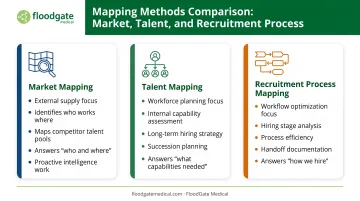
Market mapping examines the external supply market—who the competitors are, which companies employ target talent, what skills are concentrated where, and how roles are structured across organizations.
Talent mapping is a broader workforce-planning activity. It helps businesses anticipate long-term hiring goals, assess internal capability gaps, and align hiring with strategic growth. Talent mapping may include internal succession planning alongside external candidate identification.
Recruitment process mapping focuses on workflow—the stages, handoffs, and controls that move a requisition from approval through offer acceptance. It answers "how does our hiring work move," not "where is the talent."
In short: market mapping answers who and where, talent mapping answers what capabilities we'll need, and process mapping answers how we hire.
Why Market Mapping Matters for MedTech Recruitment in 2026
The MedTech talent landscape is defined by scarcity, competition, and specialization. Gallup found that 40% of US employees are watching for opportunities, but they aren't applying to job postings. They're waiting to be found. SHRM's 2025 survey reported that 69% of organizations struggle to recruit full-time roles, citing too few applicants, heavy employer competition, and candidate ghosting.
MedTech amplifies these challenges. Specialized roles demand narrow expertise:
- Regulatory affairs professionals who understand FDA 510(k) and PMA pathways
- Biomedical engineers with hands-on device development experience
- Clinical specialists fluent in trial protocols and patient-safety requirements
The BLS projects just 1,300 biomedical engineering openings annually through 2034, while RAPS identified 31,133 regulatory professionals in the US, with 21% in medical devices. That is a small, specialized pool.
FloodGate Medical's exclusive MedTech focus is built for this reality. By maintaining maps of healthcare device companies, org structures, and niche talent across regulatory, clinical, R&D, and commercial functions, FloodGate skips the learning curve generalist recruiters face. Deep market maps speed identification and sharpen targeting—critical when top talent may stay available for just 10 days.
Types of Market Mapping in Recruitment
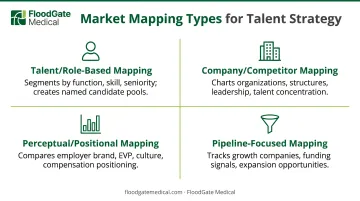
Market mapping takes different forms depending on the hire. Strong recruiters pick the model that matches the problem.
Talent/Role-Based Mapping
Segments professionals by function, skill set, and seniority. In MedTech, that might mean Director-level regulatory affairs talent with FDA submission experience, or R&D engineers with Class II device backgrounds. You get a named, segmented candidate pool.
Company/Competitor Landscape Mapping
Charts MedTech organizations: who they are, where they operate, how they're structured, and who leads each function. The map shows where talent concentrates and which employers are realistic sources for passive candidates.
Perceptual/Positional Mapping
Compares employer brand, employee value proposition (EVP), and reputation across competitors. It clarifies why someone might leave Company A for Company B, and how your client stacks up on culture, compensation, growth, and mission.
Pipeline-Focused Mapping
Flags high-growth MedTech companies announcing funding rounds, launching devices, or expanding into new regions. Those orgs become future clients or rich candidate pools, so the same map fuels recruiting and business development.
How to Do Market Mapping in Recruitment (Step-by-Step)
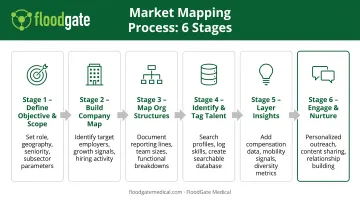
Step 1: Define Objective and Scope
Start with clarity. What role, geography, seniority, and MedTech subsector are you mapping? A cardiovascular device company hiring a VP of Regulatory Affairs in the Midwest requires a different map than a digital-health startup sourcing junior clinical specialists in California.
Define your parameters:
- Role/function: Regulatory affairs, R&D, clinical, quality, commercial
- Seniority: IC, manager, director, VP, C-suite
- Geography: Regional, national, or specific metro areas
- Subsector: Diagnostics, cardiovascular devices, orthopedics, digital health, imaging
- Company type: Startups, mid-market, enterprise, PE-backed
Clear scope prevents wasted effort and ensures your map delivers actionable intelligence.
Step 2: Build the Company Map
Identify target employers: competitors, adjacent companies, and high-growth MedTech firms. Use LinkedIn to search by industry, company size, and location. Layer in Crunchbase or PitchBook for funding data, growth signals, and leadership changes.
Industry-specific sources such as FDA device databases, clinical trial registries, and MedTech news reveal companies launching products, winning approvals, or expanding teams.
Log each company with key details:
- Headquarters and employee count
- Subsector and recent milestones (funding, FDA clearance, acquisitions)
- Known hiring activity
This becomes your target-employer list.
Step 3: Map Org Structures and Key Roles
For each target company, identify how teams are structured. Who leads regulatory? How many R&D engineers report to the VP of Engineering? Is clinical operations centralized or distributed?
Use LinkedIn to view employee lists by function and seniority. Cross-reference press releases, conference speaker lists, and FDA submissions to confirm leadership.
Document org charts with reporting lines, team sizes, and functional breakdowns. That shows who holds roles today and which companies have deep benches versus thin teams, which is useful for candidate availability and client benchmarking.
Step 4: Identify and Tag Talent
Now populate your map with individuals. Search LinkedIn by title, skills, and company. Tag each profile with:
- Current employer and role
- Years in role and total experience
- Key skills (such as "FDA 510(k)," "Class III devices," "clinical trial design")
- Domain expertise (cardiovascular, orthopedic, diagnostic)
- Location and mobility signals (recent moves, geographic preferences)
- Seniority and likely comp band
Log profiles into your CRM or ATS with consistent tagging. The goal is a searchable, segmented database you can query instantly when a req opens.
Step 5: Layer in Compensation, Mobility, and Diversity Insights
Enhance your map with context that predicts candidate responsiveness and fit. Use salary surveys, Glassdoor, Payscale, or proprietary benchmarks to estimate each candidate's current and target compensation.
Mobility signals include tenure (professionals in role under 18 months are less likely to move; those at 3+ years may be ready), recent company changes, and geographic ties.
Diversity insights support inclusive hiring. Track gender, underrepresented groups (where visible or self-identified), and career pathways that signal nontraditional entry points.
FloodGate Medical's DEI-first methodology prioritizes diverse slates that drive innovation and better healthcare outcomes. That means proactively sourcing from HBCUs, professional diversity organizations, and companies with strong inclusion reputations.
Step 6: Engage and Nurture Mapped Talent
A market map only pays off if candidates know you exist. Consistent, personalized outreach keeps you top-of-mind when they're ready to move.
FloodGate Medical nurtures its network of 150,000+ MedTech professionals through monthly newsletters covering industry insights, career opportunities, compensation trends, and hiring updates. The content is built for passive talent who aren't actively job searching.
Engagement tactics include:
- Personalized InMail or email introducing your firm and the types of roles you fill
- Sharing relevant content (FDA updates, MedTech hiring trends, career advice)
- Inviting candidates to join your talent network or newsletter
- Checking in quarterly to maintain relationships without being transactional
When a requisition opens, you're reaching out to warm contacts who already recognize your firm and value your insights.
Benefits & KPIs of Market Mapping in Recruitment
Pre-built market maps deliver measurable recruiting advantages:
Faster time-to-fill and time-to-submit. SHRM's 2026 benchmarks show a 39-day median time-to-fill for nonexecutive roles and 45 days for executive roles. With a mapped pipeline, you shortlist in days, not weeks, because the talent pool is already identified, vetted, and warmed.
One FloodGate case study filled six nationwide sales roles in 21 business days through proactive pipeline development.
Better quality-of-hire and retention. Passive candidates (those not actively job hunting) are more selective and more likely to stay. SHRM reports that only 20% of organizations measure quality of hire, but retention is a top proxy metric.
FloodGate achieves an 89% one-year retention rate by targeting well-matched passive talent rather than relying on active applicants.
Enhanced advisory power. Market maps give recruiters real data to share with clients: comp benchmarks, hiring velocity, org-structure comparisons, and talent availability by geography.
You shift from "here are three resumes" to "here's what the market looks like, here's competitive comp, and here's why these candidates fit your team and culture."
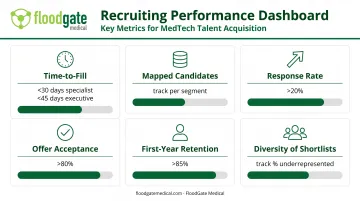
Track these core KPIs:
- Time-to-fill (target <30 days for specialist roles, <45 days for executive)
- Number of mapped candidates and companies per segment
- Response rate to outreach (target >20% for warm contacts)
- Offer-acceptance rate (target >80%)
- First-year retention (target >85%)
- Diversity of shortlists (% underrepresented candidates advanced)
Measure baseline performance, then track improvements quarter-over-quarter. As your maps mature, those gains compound.
Frequently Asked Questions
What is talent mapping?
Talent mapping is a strategic workforce-planning approach that helps businesses anticipate and meet long-term hiring goals. It covers internal capability, skill gaps, and external hiring, and is broader than market mapping, which focuses on external candidate and company intelligence.
How do you do market mapping?
Define your scope (role, geography, seniority, subsector), then map target companies and org structures. Identify and tag talent, add compensation and diversity insights, and nurture relationships with personalized outreach before a role opens.
What are the tools used for mapping?
LinkedIn is the primary platform for candidate and org research; Crunchbase and PitchBook track funding and growth signals. ATS and CRM systems (Bullhorn, Greenhouse, Lever) log profiles, while tools like HireEZ or SeekOut add talent intelligence and contact enrichment.
What is a talent mapping test?
The term usually means assessments used in talent evaluation (skills tests, behavioral profiles, or cognitive evaluations), not a formal industry-standard "mapping test." SHRM reports that 56% of employers use pre-employment assessments to measure candidate fit.
Is TA part of HR?
Yes. Talent Acquisition is a specialized function within HR focused on sourcing, recruiting, and hiring talent. It may operate as a dedicated team, but identifying and onboarding the people the organization needs remains an HR responsibility.
What are some talent strategy examples?
Common examples include leadership pipelines through succession planning, DEI-driven sourcing to diversify teams, and proactive market mapping for hard-to-fill roles. FloodGate Medical combines all three to support sustainable MedTech hiring.
Market mapping helps recruiting stay ahead of open reqs instead of scrambling after them. In MedTech, regulatory expertise, clinical knowledge, and device-development skills are scarce, and competition for them is fierce.
A maintained map can shorten a search from months to weeks and improve the odds of hiring the right person. FloodGate Medical's MedTech focus and DEI-first methodology show how deep market intelligence supports that outcome.
Start mapping now, nurture the pipeline consistently, and measure results. The strongest candidates are rarely sitting on job boards; they are already on a well-built map.