
Introduction
Today's insulin pump combines a sensor, dosing algorithm, mobile app, battery system, and patient interface, all working in concert.
Surgical robots, connected diagnostics, and drug-delivery systems follow the same pattern: no single engineering discipline builds these products alone.
That creates a problem. Without a dedicated function managing how these pieces fit together, MedTech companies face costly redesigns, missed regulatory requirements, launch delays, and shrinking market windows.
This guide breaks down what systems engineering is and what systems engineers do day to day.
It also covers why the discipline matters for patient safety and business outcomes, and how to build the right team around it.
Key Takeaways
- Systems engineering translates clinical, regulatory, and business needs into one compliant device.
- INCOSE research links strong systems engineering capability to better project performance.
- Requirements, risk, integration, and verification management anchor the systems engineer's role across the device lifecycle.
- Sourcing skilled systems engineering talent is as critical as the process itself, especially in software-driven devices.
What Is Systems Engineering in Medical Devices?
Systems engineering is a management and technical discipline that holistically manages stakeholder needs, requirements, and risk to deliver a product meeting user, regulatory, and business objectives. NASA describes it as a methodical, multidisciplinary approach spanning design through retirement, while INCOSE calls it a transdisciplinary, integrative approach to realizing and retiring engineered systems.
The discipline isn't new. It was formalized in the 1950s around complex aerospace and defense programs, and it has since spread into electronics, automotive, and now medical devices. INCOSE even maintains a dedicated Healthcare Working Group focused on medical device development and education.
Where systems engineering differs from mechanical, electrical, or software engineering is scope. A mechanical engineer owns the housing. A software engineer owns the firmware. The systems engineer owns none of those components directly. Instead, they own how the housing, firmware, sensors, and user interface function together as one device.
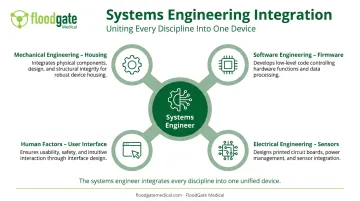
In practice, this means systematically transforming clinical inputs, marketing requirements, regulatory expectations, and business constraints into a single validated product solution.
The Multidisciplinary Nature of the Role
Effective systems engineers typically combine a broad engineering background with a specialty area. That might mean:
- A foundation across mechanical, electrical, software, biology, or materials engineering
- Deep expertise in one niche, such as human factors, microfluidics, or optics
- Enough clinical fluency to understand how a device will actually be used at the bedside or in the cath lab
This blend lets them see the big picture of a device program while still understanding the technical depth needed to make sound trade-off decisions. Consider a microcatheter designed to navigate tortuous coronary anatomy — getting that right requires balancing materials science, torque transmission, and physician usability simultaneously, not sequentially.
What Does a Systems Engineer Do? Key Responsibilities in Medical Device Development
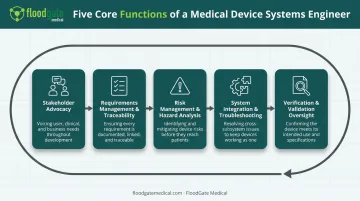
A systems engineer's job runs through five interconnected functions, and none of them work in isolation.
Stakeholder advocacy. They collect, consolidate, and prioritize input from clinicians, patients, regulators, and business teams, then translate competing needs into verifiable requirements. A cardiologist wants faster deployment; regulatory wants documented risk controls; marketing wants a specific price point. Someone has to reconcile all three.
Requirements management and traceability. Every functional, safety, and performance requirement must link to design elements and verification tests. Without this thread, teams can't prove the device does what it's supposed to do, or that they tested for what could go wrong.
Risk management and hazard analysis. Systems engineers identify potential failure modes early, such as sensor malfunction in an automated drug-delivery system, and mitigate them in line with ISO 14971. This standard specifies a lifecycle process for identifying hazards, estimating and evaluating risks, and monitoring how well controls actually work.
System integration and troubleshooting. Individual subsystems can each pass their own tests and still fail together. Firmware works. The UI works. But when they're combined, timing conflicts emerge. Resolving those conflicts before they reach patients is core systems engineering work.
Verification and validation oversight. Through testing, simulation, and clinical evaluation, systems engineers confirm the device meets its intended use and regulatory requirements. FDA guidance describes software verification as objective evidence that design outputs meet design inputs, drawn from unit, integration, and system-level test protocols.
Unlike most engineering roles that peak during design or testing phases, a systems engineer's involvement spans the entire lifecycle: concept, design, integration, verification and validation, and post-market surveillance.
Why Systems Engineering Matters: Benefits and Business Impact
The case for systems engineering isn't just theoretical. It shows up in project performance data, cost curves, and recall statistics.
Performance Gains and the Cost of Late Fixes
A 2012 survey of 148 engineering projects found that 57% of projects with high systems engineering capability achieved high performance, compared to just 15% among projects with lower SE capability, according to a systems engineering effectiveness study conducted for INCOSE. Among the most challenging projects in the sample, the gap widened further, from 8% to 62%.
That performance gap connects directly to timing. Decisions made early in development carry outsized downstream cost.
A NASA aerospace cost-escalation model found that correcting an error during integration and testing costs 21 to 78 times more than fixing it during the requirements phase, based on NASA's error cost escalation research. Requirements gaps or interface conflicts caught in month two are cheap. The same issues found during system integration in month eighteen are not.
Regulatory Traceability and Patient Safety Impact
Regulatory traceability is where this really matters for MedTech specifically. FDA's device-software guidance expects a clear chain linking requirements, design specifications, identified hazards, risk controls, and verification tests. Without a systems engineering function actively maintaining that thread, building this evidence chain after the fact during a submission crunch is painful, and auditors notice the gaps.
Patient safety sits at the end of this chain. The GAO reported 3,934 FDA-overseen medical device recalls between FY2020 and FY2024, with 88% classified as Class II, according to GAO's medical device recall report. GAO also flagged growing hardware-software integration complexity as a contributing factor in device risk. Strong systems engineering practices, focused on catching integration and risk issues early, directly reduce this exposure.
Systems Engineering vs. Project Management and Other Engineering Roles
Teams sometimes conflate systems engineering with project management, or assume it's just another engineering specialty. Neither is accurate.
| Role | Owns | Does Not Own |
|---|---|---|
| Project management | Budget, schedule, resourcing, delivery timelines | Technical architecture and design trade-offs |
| Systems engineering | Requirements, risk, integration, technical trade-offs across the device | Day-to-day budget and staffing decisions |
| Discipline engineering (mechanical, electrical, software) | Deep expertise within one technical domain | Cross-domain integration and system-level requirements |
Project management owns budget, schedule, and resourcing, while systems engineering owns technical and product decisions. The two must collaborate closely, particularly when trade-offs (like deferring a feature to hit a launch date) affect patient safety or regulatory strategy.
The distinction shows up in daily decisions:
- A project manager can push a deadline.
- Only a systems engineer can confirm whether pushing it compromises the device.
Discipline-specific engineers go deep into one domain. Systems engineers integrate across all of them, acting as the primary interface among management, specialty engineers, and outside stakeholders.
The strongest systems engineers often bring project management experience to the table, and vice versa. The two roles stay intertwined throughout a device program.
Building the Right Systems Engineering Talent for Your MedTech Team
Demand for this skill set keeps climbing. Devices are more software-driven and connected than they were five years ago, and regulatory expectations around traceability and risk documentation have grown alongside them. That combination makes the systems engineer's job harder to fill and more critical to get right.
When evaluating candidates, look for:
- Breadth across multiple engineering disciplines (mechanical, electrical, software)
- Depth in one specialty area relevant to your device category
- Strong communication skills, since the role requires translating between clinicians, regulators, and engineers
- Demonstrated experience with risk management frameworks and regulatory submissions
The problem is finding candidates who genuinely combine deep technical expertise with big-picture, cross-functional thinking. These people are rare, and generic hiring channels rarely surface them well. A job posting attracts people who match keywords, not necessarily people who've actually reconciled a firmware conflict during integration testing.
This is where a MedTech-focused recruitment partner earns its keep. FloodGate Medical works specifically within the medical device and biotech space. It understands both the technical requirements of systems engineering roles and the softer skills, like communication and judgment under ambiguity, that rarely show up on a resume.

The firm also emphasizes building diverse engineering teams, since varied perspectives strengthen risk identification and catch failure modes a homogenous team might miss.
If your device is getting more complex and your development team is starting to feel the strain of unfilled technical roles, don't wait. Connect with a specialized recruiter before the talent gap becomes a project bottleneck.
Frequently Asked Questions
What does a systems engineer do in medical devices?
A systems engineer manages requirements, risk, and integration across a device's full lifecycle. They ensure every discipline and stakeholder need comes together into one safe, compliant product.
What is the difference between systems engineering and quality/regulatory engineering in medical devices?
Systems engineering focuses on technical integration and requirements traceability. Quality and regulatory engineering focus on compliance processes and formal submissions. The two roles collaborate closely but own different pieces of the puzzle.
Do all medical device companies need a dedicated systems engineer?
Need grows with device complexity and team size. Small teams building simple, single-function devices may share the role, but complex or software-driven devices benefit from a dedicated systems engineer.
What qualifications should a medical device systems engineer have?
Look for a broad technical background, depth in one specialty area, strong communication skills, and familiarity with medical device risk and regulatory frameworks like ISO 14971 and IEC 62304.
How does systems engineering support FDA and regulatory compliance?
Systems engineering creates traceability between requirements, design, risk analysis, and verification testing. This evidence chain is essential during regulatory audits and premarket submissions.
When should a MedTech company hire its first systems engineer?
Bring in systems engineering expertise as soon as a device involves multiple interacting subsystems or disciplines, ideally before conflicts and rework start surfacing between teams.