Introduction
A patient logs into a video call, describes chest tightness, and within minutes an AI algorithm flags an irregular heartbeat pattern for her cardiologist to review.
Compare that to a 17th-century physician drilling a hole into a patient's skull to "release evil spirits," or bleeding a fever patient with leeches.
That gap didn't close overnight. It took centuries of trial, error, and breakthrough.
Understanding this arc matters for anyone building products, careers, or companies in the MedTech space today. The pace of change hasn't slowed.
If anything, it's accelerating, and companies that understand where this industry came from are better equipped to hire for where it's going.
This article traces medical technology from ancient tools to today's AI-driven devices, and closes with what this history means for building the MedTech workforce of tomorrow.
Key Takeaways
- Medical technology evolved from hand tools to sensory instruments to decision-support systems
- Antibiotics, imaging, and genomics each created entirely new professional specialties
- Modern MedTech blends hardware, software, data science, and regulatory expertise
- Building tomorrow's devices requires cross-disciplinary talent, not just traditional engineers
Ancient & Early Medical Practices: The Roots of Medical Technology
Medical technology didn't begin with electricity or microchips. It began with survival.
Archaeological evidence shows trepanation, the practice of removing or opening a section of skull bone, dates back to the Neolithic period, making it one of the oldest documented surgical procedures on record. Ancient healers also relied on herbal remedies long before anyone understood pharmacology. Sumerian and Egyptian practitioners used willow bark, a natural precursor to aspirin, as an analgesic more than 3,500 years ago.
The Greek Shift Toward Technique and Ethics
The Hippocratic tradition added something new: reasoning alongside tools. Greek physicians paired simple instruments, such as bandages, scalpels, forceps, and probes, with an early code of professional conduct. This distinction matters:
- Technique relied on the practitioner's senses and judgment
- Technology relied on physical objects designed to extend what the hand or eye could do
- Together they formed a model of care that blended human skill with tool-based intervention
That split between skill and tool would define medicine for the next two thousand years.
Vesalius and the Break from Tradition
In 1543, Andreas Vesalius published De Humani Corporis Fabrica, an anatomical text based on actual human dissection rather than centuries-old assumptions inherited from Galen's animal studies. The work corrected numerous long-standing anatomical errors and pushed medicine toward evidence gathered from direct observation. This marked a genuine turning point: medicine started trusting what could be verified, not just what had always been assumed.
The 19th Century Revolution: From Stethoscopes to X-Rays
Diagnostic Breakthroughs
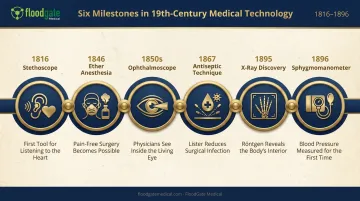
Before 1816, doctors diagnosed largely by listening to a patient's story and pressing an ear directly to the chest. René Laennec changed that when he rolled a sheet of paper into a tube and used it to listen to a patient's heart, inventing the first stethoscope. It shifted diagnosis from narrative to physical, measurable evidence.
The rest of the century built on that shift fast:
- Ophthalmoscope (1850–51) – allowed physicians to examine the interior of the eye directly
- Clinical thermometer (1866–67) – made body temperature a standard, portable measurement
- Sphygmomanometer (1896) – introduced blood pressure as a quantifiable vital sign
Each device extended a physician's senses beyond what the human body alone could detect.
Surgical and Infection Control Advances
Surgery before 1846 was brutal, fast, and often fatal from shock alone. William Morton's public demonstration of ether anesthesia that year made painless, longer surgeries possible for the first time.
Two decades later, Joseph Lister introduced antiseptic technique in 1867, applying carbolic acid to wounds and surgical instruments. Surgical mortality, previously devastating, dropped sharply as infection control became standard practice.
Then, almost by accident, Wilhelm Röntgen discovered X-rays on November 8, 1895, while experimenting with cathode rays. Physicians could now see inside a living body without cutting it open.
This growing toolkit reshaped the hospital system itself. In 1873, the U.S. had counted just 178 hospitals nationwide, a number that climbed steadily as new diagnostic and surgical technology gave hospitals more to offer patients.
Underneath all of this sat germ theory. Louis Pasteur and Robert Koch established that microorganisms caused disease, giving Lister's antisepsis a scientific foundation and reshaping hospital design, hygiene standards, and sterilization practices for generations.
The 20th Century: Antibiotics, Imaging, and the Rise of Modern MedTech
The Antibiotic and Vaccine Era
Alexander Fleming discovered penicillin in 1928, but it took World War II urgency to scale it. U.S. penicillin production rocketed from 21 billion units in 1943 to 1.66 trillion units in 1944, according to the American Chemical Society's account of Fleming's discovery.
That scale-up turned a lab curiosity into mass-produced medicine. Bacterial infections that once carried grim survival odds became treatable almost overnight.
Vaccines followed the same pattern of preventive impact:
- Polio vaccine (1955) – Jonas Salk's breakthrough ended decades of paralysis fears
- Measles vaccine (1963) – first U.S. licensure, dramatically cutting infection rates
- MMR vaccine (1971) – combined measles, mumps, and rubella protection into a single shot
The Rise of Diagnostic and Life-Support Machines
Electricity opened an entirely new diagnostic frontier, with four breakthroughs defining the era:
- ECG (1903) – Willem Einthoven's string galvanometer produced the first detailed clinical readings
- EEG (1924) – Hans Berger recorded the first human brainwave activity
- Defibrillation (1947) – Claude Beck performed the first successful cardiac defibrillation
- Pacemaker (1958) – Åke Senning implanted the first self-contained device
Imaging made its next major leap between 1971 and 1978. Godfrey Hounsfield scanned the first CT patient in 1971, building on Allan Cormack's mathematical groundwork. Around the same time, Raymond Damadian's tissue research, combined with imaging techniques from Paul Lauterbur and Peter Mansfield, led to the first human MRI head image by 1978.
Organ Support and Transplant Technology
Willem Kolff's 1943 rotating-drum artificial kidney made dialysis possible; the Scribner shunt in 1960 made it repeatable for chronic patients. Physician Lewis Thomas described devices like this as "halfway technologies," meaning they support a failing body without curing the underlying disease.
Christiaan Barnard's team performed the first human-to-human heart transplant on December 3, 1967, another halfway solution that opened the door to modern transplant medicine.
During this same era, Bjørn Ibsen's work during Copenhagen's 1952 polio epidemic laid the groundwork for the modern ICU, consolidating ventilators, continuous monitoring, and drug therapy into one coordinated system of critical care.
The Digital Revolution: 21st Century Medical Technology
The 2000s opened with a genetic milestone: the Human Genome Project's working draft, announced in June 2000. It launched the era of genomic and personalized medicine, giving physicians a molecular map to work from instead of guesswork alone.
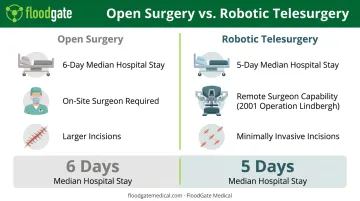
Surgery went remote next. On September 7, 2001, surgeons in New York performed a robot-assisted gallbladder removal on a patient in Strasbourg, France, the first transatlantic telesurgery, known as Operation Lindbergh.
Minimally invasive techniques like this have measurably shortened recovery. One randomized study of liver resections found patients went home in a median of 5 days after laparoscopic surgery versus 6 days after open surgery, a meaningful difference for patient comfort and hospital capacity.
Wearables became mainstream next. A 2022 Deloitte study found roughly six in ten U.S. consumer households owned a smartwatch or fitness tracker, turning everyday people into passive data collectors for their own health.
Then COVID-19 hit, and telehealth exploded almost overnight:
Medicare fee-for-service audio-only telehealth visits jumped from fewer than 200,000 in 2019 to 14 million in 2021, according to an HHS report on Medicare telehealth trends.
Regenerative medicine advanced in parallel. In April 2019, researchers at Tel Aviv University 3D-printed a small, vascularized human heart complete with cells and chambers, not yet transplant-ready, but a real signal of where organ replacement is heading.
The Future of MedTech: Emerging Trends Shaping Healthcare
Artificial intelligence has moved from research papers into real clinical tools. In 2018, the FDA authorized IDx-DR, the first autonomous AI diagnostic system cleared to detect diabetic retinopathy without a specialist reviewing the image first. That approval opened the door for a wave of AI-cleared diagnostic tools now working their way through FDA review.
Precision medicine is following a similar trajectory. According to the Personalized Medicine Coalition, 18 personalized medicines represented roughly 38% of newly approved therapeutic molecular entities in 2024, driven by genetic testing and biomarker-based treatment selection rather than one-size-fits-all prescribing.
What's driving both trends is convergence:
- Hardware, software, and data science now sit inside the same device
- Devices increasingly connect, communicate, and update remotely
- Regulatory frameworks are expanding to cover cybersecurity and data governance alongside traditional safety testing
This convergence is exactly what's reshaping the skill sets MedTech companies need to hire for.
Building Tomorrow's MedTech Workforce: Why This History Matters Today
Look back across this timeline and a pattern emerges. Every major leap in medical technology created a category of professional that didn't exist before.
- Antibiotics demanded microbiologists and mass-manufacturing expertise
- Imaging demanded radiologic technologists and biomedical engineers
- Genomics demanded bioinformatics and computational biology talent
- AI-driven devices now demand data scientists, ML validation specialists, and cybersecurity experts working alongside traditional device engineers
Today's MedTech companies aren't just competing for engineers. They're competing for regulatory affairs specialists who understand software-as-a-medical-device rules. Clinical research professionals who can run trials for connected devices matter just as much, alongside data scientists who validate an algorithm's clinical safety before it ever reaches a patient.
This is where FloodGate Medical operates. As a recruitment partner focused exclusively on the MedTech industry, FloodGate Medical helps companies build the diverse, cross-disciplinary teams this next era demands.
Its DEI-driven recruitment approach has earned a 4.9-star rating across 72 client reviews, built on placing candidates who fit both the technical requirements and the culture of a MedTech team.

Beyond placement, FloodGate Medical supports the talent pipeline from both directions:
- Permanent placement and contract/interim staffing for MedTech companies across commercial, clinical, regulatory, and R&D functions
- Career coaching through FloodGate Futures, including a four-week BootCamp, résumé and LinkedIn review, and a dedicated track for veterans entering MedTech
- Complimentary hiring-manager training through its Talent Excellence Education program
Medical technology has always advanced through people willing to build the next tool, run the next trial, or write the next line of validated code. Only the level of specialization, and how tightly those roles now intertwine, has changed.
Frequently Asked Questions
What does MedTech stand for?
"MedTech" is shorthand for "medical technology." It covers devices, software, and diagnostic tools used across patient care and healthcare delivery, from microcatheters to AI diagnostic algorithms.
Who is the founder of MedTech in the Philippines?
MedTech refers to the global industry as a whole, not one specific company. In the Philippines, the Philippine Association of Medical Technologists (PAMET) was organized in 1963, with Crisanto Almario recognized as its founding organizer.
Is MedTech an Indian brand?
No. "MedTech" is a generic industry term, not a specific brand. Companies in many countries, including India, use "Medtech" in their business names, but no single entity owns the term.
What was the first major medical technology invention?
It depends on your definition. Trepanation and basic surgical instruments date back millennia, but many medical historians credit René Laennec's 1816 stethoscope as the first purpose-built modern diagnostic instrument.
How has medical technology changed patient care over time?
Care shifted from relying on a patient's own description of symptoms to objective, instrument-based evidence, and now to data-driven, AI-assisted diagnosis. Each stage added more precision and less guesswork.
What is the next big trend in medical technology?
AI-powered diagnostics, wearable health monitoring, and precision medicine driven by genetic and biomarker testing are shaping MedTech's near-term future.