
The global medical devices market is projected to reach $604.99 billion in 2026, according to Fortune Business Insights, and that scale is creating intense demand for senior leadership with a rare combination of skills. According to McKinsey's MedTech Pulse survey of 192 MedTech leaders, 25% cited R&D capacity and 23% cited skills or talent as their primary constraints — numbers that make the case for specialized hiring support rather than improvising with generalist recruiters.
This article covers the best executive search firms for MedTech companies in 2026, what sets each one apart, and how to evaluate which is the right fit for your search.
Key Takeaways
- MedTech executive roles demand expertise in regulatory pathways, clinical-commercial dynamics, and device-specific reimbursement — gaps generalist recruiters consistently miss
- The global medical devices market hits $604.99B in 2026, intensifying competition for a narrow pool of senior MedTech talent
- Top firms for 2026: FloodGate Medical, Korn Ferry, Spencer Stuart, Heidrick & Struggles, and Russell Reynolds Associates
- Retained executive search firms typically charge around 33% of first-year compensation
- Boutique MedTech-specialist firms frequently outperform larger generalists for domain-specific executive placements
Why MedTech Companies Need Specialized Executive Search Firms
Executive search firms handle the full cycle of senior-level recruitment: defining the role, mapping the candidate landscape, reaching passive candidates, running structured assessments, and managing the offer process. For most industries, a capable generalist firm can do this well. MedTech is different.
The Talent Pool Is Narrow and Relationship-Dependent
Roles like VP of Regulatory Affairs, Chief Medical Officer, and VP of R&D pull from a small, specialized talent pool — many of whom are already employed, not actively searching, and unlikely to respond to a job board posting. Finding them requires existing relationships and genuine sector knowledge, not keyword searches.
Generalist recruiters who occasionally work in "healthcare" often lack the fluency to evaluate these candidates properly. That knowledge gap shows up across every stage of the search:
- Confusing a 510(k) clearance pathway with a PMA approval process
- Overlooking reimbursement experience when evaluating a CMO candidate
- Surfacing candidates with the right title but not the right background
- Presenting a shortlist that falls apart under functional scrutiny
The Skill Convergence Problem
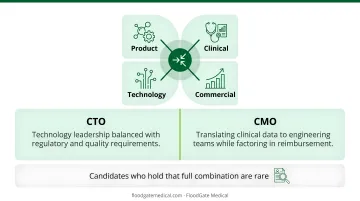
Russell Reynolds Associates describes the challenge clearly: MedTech senior leaders increasingly need a combined skill set spanning product, technology, clinical, and commercial acumen simultaneously. A CTO must balance technology leadership with regulatory and quality requirements. A CMO must translate clinical data to engineering teams while factoring in reimbursement.
Candidates who hold that full combination are rare — and distinguishing the ones who do from those who merely claim to requires a search partner with hands-on industry knowledge, not a generalist working from a competency checklist.
Best Executive Search Firms for MedTech Companies in 2026
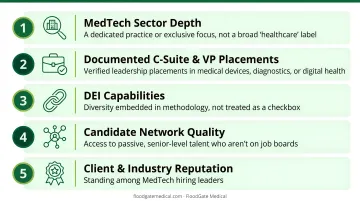
Firms on this list were evaluated based on MedTech and life sciences sector depth, documented executive-level placements, DEI commitment, candidate network quality, and reputation among MedTech hiring leaders.
FloodGate Medical
FloodGate Medical is a recruitment firm built exclusively for the MedTech industry — not a life sciences practice within a larger platform, but a firm whose entire business operates in this single sector. Its mission: "Recruiting Done Differently. Improving lives by uniting great people with great companies."
The firm recruits across commercial, clinical, marketing, operations, and leadership functions, serving companies at every stage from early-stage startups to established medical device manufacturers. FloodGate draws from a network of over 150,000 MedTech professionals and reaches over 4 million people annually through industry presence and engagement initiatives.
FloodGate integrates DEI principles directly into its recruitment methodology — building diverse candidate slates and helping companies construct teams where varied perspectives drive better clinical and commercial outcomes. The firm holds a 9.4 Net Promoter Score from candidates and has been recognized as MedTech Recruitment Company of the Year 2025 – USA. Executive Talent Director Heidi Herrick, for example, reports an 89% one-year retention rate for her placements — a meaningful signal of candidate-role fit.
| Attribute | Details |
|---|---|
| Specialty/Focus | Exclusively MedTech talent acquisition across commercial, clinical, operations, and leadership functions |
| Best For | MedTech companies at any stage seeking specialized executive and professional-level hires with a DEI-forward approach |
| Key Differentiator | 100% MedTech-dedicated firm with DEI-centered recruitment methodology and a 150,000+ professional network |

Korn Ferry
Korn Ferry is one of the world's largest organizational consulting and executive search firms, with a dedicated Medical Devices and Diagnostics sector led by Global Sector Leader David Vied. The practice covers CEO, board, general management, regulatory affairs, quality systems, R&D, and medical direction searches across MedTech clients from emerging growth companies to Fortune 500 manufacturers.
Korn Ferry's differentiation sits in its assessment infrastructure. The Four Dimensions of Leadership and Talent framework — covering competencies, experiences, traits, and drivers — gives clients a structured view of candidate readiness beyond resume credentials. Its Korn Ferry Assessment of Leadership Potential (KFALP) evaluates learning agility, leadership traits, and derailment risks.
Combined with on-the-ground recruitment experience in 130 countries, this makes Korn Ferry a strong option for large enterprise searches requiring both global reach and rigorous candidate evaluation.
| Attribute | Details |
|---|---|
| Specialty/Focus | Life sciences, medical devices, and healthcare within a broad multi-industry global platform |
| Best For | Large MedTech enterprises and multinationals needing integrated executive search and organizational consulting |
| Key Differentiator | Proprietary four-dimensional assessment tools and global candidate intelligence infrastructure across 130 countries |
Spencer Stuart
Spencer Stuart is a privately owned executive search and leadership consulting firm with a dedicated Medical Technology practice covering medical devices, in-vitro and molecular diagnostics, medical imaging, healthcare IT, and genomics. Its track record in this space is the most publicly documented of any firm on this list: more than 400 CEO, senior-level executive, and board-director assignments for medical-device companies over the past three years.
The firm's board advisory capabilities are particularly strong. Spencer Stuart's 2025 U.S. Board Index — now in its 40th year — reflects deep governance expertise, and its Healthcare and Life Sciences offering explicitly includes Board and CEO Advisory services. For public MedTech companies managing CEO succession or confidential board-level searches, Spencer Stuart brings both the relationships and the discretion that these processes require.
| Attribute | Details |
|---|---|
| Specialty/Focus | Healthcare, life sciences, and medical technology at board and C-suite level |
| Best For | Public MedTech companies needing board director placements, CEO succession, or governance-sensitive searches |
| Key Differentiator | 400+ documented medical-device company assignments in three years; industry-leading board advisory capabilities |
Heidrick & Struggles
Heidrick & Struggles is a global executive search and leadership advisory firm whose Healthcare and Life Sciences practice lists Medical Technology, Health Tech, and Disruptive Healthcare as distinct focus areas. The firm's engagement with the sector includes documented work with executives like Abbott's EVP of Medical Devices Lisa Earnhardt on health tech talent strategy.
Two capabilities stand out for MedTech companies specifically. First, Heidrick's On-Demand Talent service offers interim executives and consultants to fill leadership gaps during transitions — useful for MedTech companies mid-search or navigating a sudden vacancy. Second, Heidrick's culture-shaping practice runs alongside its core search work, which is relevant for organizations rebuilding leadership teams or integrating acquisitions. For MedTech companies undergoing digital transformation — particularly those building connected device or AI-driven diagnostics divisions — Heidrick's technology leadership expertise provides direct support for these technically complex hires.
| Attribute | Details |
|---|---|
| Specialty/Focus | Healthcare, life sciences, and technology leadership within a global executive search platform |
| Best For | MedTech companies undergoing leadership transition, digital transformation, or scaling connected device and digital health divisions |
| Key Differentiator | Culture shaping practice integrated with executive search; explicit interim executive capability through On-Demand Talent |
Russell Reynolds Associates
Russell Reynolds Associates operates a global MedTech, Devices and Diagnostics practice led by David Krahe. The firm publishes original research on MedTech leadership — including a 2025 study with McKinsey focused on R&D talent, digital capabilities, and the challenge of retaining technology-sector hires who struggle with MedTech's regulatory pace.
RRA's Leadership Portrait framework evaluates senior candidates across current readiness (experience and competencies) and future potential (growth factors including systems thinking, curiosity, and social intelligence), benchmarked against thousands of senior leaders.
Its DEI advisory and Sustainability Leadership Advisory capabilities are formally documented, and the firm explicitly incorporates equitable search and succession practices into client work — making it a strong fit for PE-backed or publicly traded MedTech companies where board-endorsed process rigor matters.
| Attribute | Details |
|---|---|
| Specialty/Focus | Healthcare, life sciences, and board/senior executive level across a global platform |
| Best For | Public or PE-backed MedTech companies requiring data-driven, board-endorsed executive and director-level searches |
| Key Differentiator | Leadership Portrait assessment framework benchmarked against thousands of senior leaders; integrated ESG and DEI advisory |
How We Chose the Best MedTech Executive Search Firms
Firms were assessed on five criteria:
- MedTech sector depth — a dedicated practice or exclusive focus, not a broad "healthcare" label
- Documented C-suite and VP-level placements in medical devices, diagnostics, or digital health
- DEI capabilities — whether diversity is embedded in methodology or treated as a checkbox
- Candidate network quality — ability to access passive, senior-level talent who aren't on job boards
- Client and industry reputation among MedTech hiring leaders
The Most Common Selection Mistake
Many MedTech companies default to well-known generalist firms with broad healthcare practices, assuming brand recognition equals domain expertise. It rarely does.A recruiter who places hospital administrators and pharmaceutical sales reps is not equipped to evaluate a VP of Regulatory Affairs candidate. They don't know which regulatory pathways matter, what questions to ask, or how to distinguish someone who has navigated a 510(k) clearance from someone who merely claims familiarity with the process.
The result: misaligned shortlists, slower searches, and candidates who look credible on paper but don't understand device-specific commercial or clinical dynamics.
Why Boutique Specialists Often Win
Boutique firms with 100% MedTech focus often outperform large generalists for specialized placements because their consultants are embedded in the industry — attending device conferences, maintaining active networks, and tracking talent movement within specific sub-sectors like interventional cardiology, diagnostics, or digital health. FloodGate Medical's Talent Directors, for example, specialize within MedTech sub-sectors and attend relevant industry events to stay current on market dynamics — the kind of granular engagement that produces faster, more accurate shortlists.
Conclusion
The right executive search partner for a MedTech company isn't the one with the biggest brand — it's the one whose consultants understand FDA pathways, can evaluate a CMO candidate's reimbursement background, and have genuine relationships with senior MedTech professionals who aren't actively job searching.
When evaluating search partners, focus on three things: the specificity of their MedTech experience, the diversity and quality of their candidate pipeline, and their ability to reach passive talent. General "life sciences" experience signals familiarity — not the depth MedTech placements actually demand.
If those are your benchmarks, FloodGate Medical is worth a direct conversation. Built exclusively for MedTech, they recruit across commercial, clinical, leadership, and operations functions for companies at every stage — from early commercialization through scale. Connect with their team at floodgatemedical.com to discuss your next executive search and see how a sector-specific firm approaches the brief differently.
Frequently Asked Questions
How do executive search firms charge?
Most retained executive search firms charge approximately 33% of the placed executive's first-year compensation — including salary, bonus, and signing bonus — billed in installments across the search. Contingency firms, paid only upon a successful hire, typically charge 20–25% and are used more commonly for non-executive roles.
How do I choose an executive search firm for a MedTech role?
Prioritize firms with verified, sector-specific experience in medical devices or life sciences — not just a general healthcare label. Ask for documented examples of C-suite or VP-level placements in your specific area, and confirm the firm has a clear methodology for sourcing passive candidates rather than relying on active job seekers.
Are executive search firms worth the cost for senior MedTech hires?
For VP and C-suite roles, yes. The cost of a misaligned hire — in delayed timelines, team disruption, and re-search expense — typically exceeds the search fee. Specialized firms also reduce time-to-hire and access candidates who won't respond to job postings.
What roles do MedTech executive search firms typically fill?
Specialized MedTech search firms commonly recruit for CEO, CFO, Chief Medical Officer, VP of Regulatory Affairs, VP of R&D, VP of Sales and Marketing, and General Manager roles across medical device, diagnostic, and digital health companies.
How long does a MedTech executive search take?
Most retained searches run 6–12 weeks from kickoff to offer acceptance. SHRM's 2026 benchmarking data puts the median time-to-fill for executive roles at 45 days — firms with deep MedTech networks tend to reach a qualified shortlist faster than generalists.