
Introduction
Imagine a MedTech company racing to launch a breakthrough medical device. The FDA submission deadline looms, but critical gaps remain.
There's no regulatory affairs specialist to navigate 510(k) requirements, no clinical research coordinator for trial data, and no QA expert to validate ISO 13485 compliance. Hiring permanent staff would take months—time the project doesn't have.
MedTech teams hit this wall whenever niche skills and hard deadlines collide. Project staffing connects organizations with specialized professionals for temporary or defined-term assignments. You get the right expertise when you need it, without a permanent hire.
In this guide, you'll learn what project staffing is and how it helps MedTech organizations facing tight deadlines and niche skill gaps. We'll also walk through how to implement it and how to handle common integration and quality challenges.
Key Takeaways
- Project staffing delivers specialized MedTech professionals on temporary or contract terms for defined project needs
- Organizations gain rare skills such as regulatory affairs and clinical trials coordination without permanent hiring costs
- Pre-vetted professionals can start in 10-24 days (median 14 days) compared to months-long permanent recruitment cycles
- Success depends on clear scope, standards-specific qualification checks, and onboarding that treats temps as full team members
- The model works best for milestone-bound initiatives with clear endpoints; core institutional roles still require permanent talent
What Is Project Staffing?
Project staffing brings specialized professionals in on a temporary or contract basis to hit specific project requirements and deliverables. Unlike permanent hires, these relationships are time-bound and tied to a defined outcome: a completed FDA submission, a finished clinical trial, or a validated quality system.
The American Staffing Association describes it as using a staffing firm to supply special expertise, staff projects, cover busy periods, or fill temporary vacancies. The key distinction is simple: the assignment ends when the project ends, not when a standing org-chart role does.
Scope and Structure
In MedTech, project staffing scales from one specialist to a full team:
- Individual contributors: A RAC-certified regulatory consultant leading a 510(k) submission
- Functional teams: A quality group standing up an ISO 13485 system or running post-market surveillance
- Interim leadership: A fractional VP of Quality or Director of Regulatory Affairs for a launch or leadership gap
Typical MedTech Applications
MedTech teams lean on project staffing when the work has a clear deliverable, needs scarce skills, and has a finite end date:
- FDA submissions: 510(k), PMA, IDE, and de novo filings
- Clinical trial management: Protocol development, site selection, data collection, and analysis
- Device development: IEC 62304 software validation, design controls, and V&V testing
- Quality systems: ISO 13485 prep, CAPA design, and DHF remediation
- Post-market surveillance: Complaint handling setup, MDR/MAUDE reporting, field corrective actions
Market Context
The broader US staffing industry placed 12.7 million temporary and contract employees in 2023, according to the American Staffing Association (down from 14.6 million in 2022 after a post-pandemic correction).
In life sciences, Staffing Industry Analysts tracked 27 firms generating $2.7 billion in 2023 US revenue, about 86% of that specialized segment. Project staffing is a mature channel in this market; published figures still rarely break out MedTech on its own.
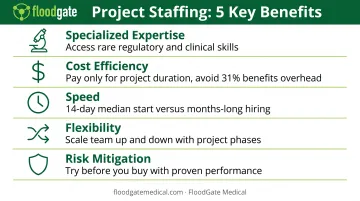
Benefits of Project Staffing for MedTech Companies
Access to Specialized, Hard-to-Find Expertise
MedTech projects demand niche skills that few full-time teams maintain in-house:
- Regulatory specialists with current FDA and international submission experience
- Standards experts versed in IEC 62304 software life-cycle processes, ISO 10993 biocompatibility testing, or ISO 13485:2016 quality management
- Clinical operations professionals who can design protocols, manage CROs, and coordinate multi-site device trials
The FDA recognizes IEC 62304 as the consensus standard for medical device software, and the Quality Management System Regulation (QMSR) incorporates ISO 13485:2016 as of February 2026. Finding professionals fluent in these frameworks on short notice is difficult. Project staffing provides immediate access to pre-vetted specialists who have already navigated these requirements on prior assignments.
Specialized MedTech recruiters such as FloodGate Medical maintain networks of these professionals and use DEI-focused sourcing to reach qualified candidates beyond traditional hiring channels.
Cost Efficiency and Budget Control
Project staffing creates a pay-as-you-go model that aligns costs with project phases:
- No long-term salary commitments: You engage talent only for the required duration—three months for a submission sprint, six months for a clinical trial, or one year for a quality system build
- Avoided benefits overhead: The Bureau of Labor Statistics reports that benefits represented 31.1% of total compensation for private-industry management and professional employees in December 2024. With project staffing, those costs remain with the staffing firm
- Predictable budgeting: Fixed bill rates and defined engagement periods make project budgets more accurate
However, cost discipline requires scrutiny. Deloitte research warns that long-running staffing-agency premiums can exceed the avoided benefit costs, particularly when engagements stretch beyond initial plans. Always compare total engagement cost—bill rate, vendor fees, supervision, knowledge transfer—against employee wages, benefits, recruiting, and vacancy costs.
Faster Project Execution
Pre-vetted, experienced professionals shorten time to delivery:
- Rapid deployment: Staffing Industry Analysts' 2022 benchmark shows professional temporary staffing achieves a median 14-day job start from requisition to day one, compared to months-long permanent searches
- Minimal onboarding: Specialists who have completed similar projects before can hit the ground running with product-specific training only
- Front-loaded productivity: An experienced regulatory consultant begins drafting your 510(k) summary in week one; a clinical coordinator starts site qualification immediately
This speed advantage matters most when project milestones are immovable—an FDA meeting deadline, a clinical trial enrollment window, or a product launch date.
Flexibility and Scalability
Project staffing provides the ability to match headcount to project demand:
- Scale up rapidly: Add three validation engineers for a six-month IEC 62304 sprint, then scale back when verification completes
- Scale down without workforce reductions: Conclude engagements naturally at project end, avoiding layoffs, severance, or reorganizations
- Adjust mid-project: If requirements shift—additional device variants, expanded clinical endpoints—you can bring in supplemental expertise without restructuring permanent teams
Risk Mitigation Through Performance Validation
Project staffing offers a "try before you buy" evaluation period:
- Assess technical competence on real deliverables, not interviews
- Observe cultural fit, communication style, and collaboration over weeks or months
- Convert high performers to permanent roles when long-term needs emerge and mutual fit is confirmed
This reduces hiring mistakes, improves retention, and ensures permanent offers go to candidates whose capabilities have been proven in your environment.
How to Successfully Staff Your MedTech Project
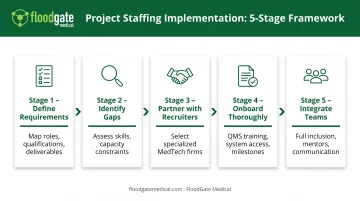
Successful MedTech project staffing follows a clear sequence: define roles, find skill gaps, partner with specialists, onboard tightly, and integrate contractors with your core team.
Define Project Requirements and Roles
Start with thorough project scope analysis:
- Map the full project lifecycle: regulatory strategy, design inputs, verification testing, clinical protocol, submission compilation, post-approval commitments
- Identify all required disciplines: regulatory affairs, clinical operations, quality assurance, biostatistics, technical writing, software validation
- Document the deliverables each role must produce: DHF sections, clinical study reports, validation protocols, submission modules
Create role descriptions with specific qualifications:
- Educational requirements: Bachelor's in life sciences, engineering, or related field; advanced degrees for senior roles
- Certifications: RAC-Devices (Regulatory Affairs Certification for medical devices from RAPS), CQE (Certified Quality Engineer from ASQ), PMP (Project Management Professional from PMI)
- Years of experience: Minimum experience in medical device development, FDA submissions, or clinical trials
- Domain expertise: Therapeutic area knowledge (cardiovascular, orthopedic, neurovascular), device classification (Class II vs. III), regulatory pathway experience (510(k), PMA, IDE)
Example role profile:
Regulatory Affairs Specialist (Contract, 6 months)
- RAC-Devices certification required
- 5+ years medical device regulatory experience
- Minimum 3 successful 510(k) submissions as lead author
- Current knowledge of FDA guidance documents for cardiovascular devices
- Deliverable: Complete 510(k) submission package ready for FDA filing
Identify Skill Gaps and Resource Needs
Assess current team capabilities against project requirements:
- Conduct a skills inventory: Which required competencies exist in-house?
- Pinpoint external needs: Which niche skills (biocompatibility testing, IEC 62304 validation, clinical data management) must be sourced?
- Identify capacity constraints: Do internal experts have bandwidth, or are they committed to other initiatives?
Prioritize roles based on project timeline:
- Immediate needs: Positions on the critical path: regulatory lead before design freeze, clinical coordinator before site selection
- Phased needs: Roles required later: technical writers during submission compilation, post-market surveillance specialists after launch
Partner with Specialized Recruitment Firms
Generic staffing agencies lack the MedTech context needed to evaluate technical qualifications. Specialized recruitment partners understand:
- Regulatory pathways and FDA submission requirements
- Quality system standards (ISO 13485, ISO 14971, IEC 62304)
- Clinical trial phases and Good Clinical Practice (GCP)
- Medical device design controls and risk management
Look for firms that keep pre-vetted talent pools ready for fast deployment. FloodGate Medical, for example, maintains a network of more than 200,000 MedTech candidates and places credentialed specialists for contract and project-based work.
Evaluate potential partners on:
- MedTech client portfolio: Do they serve device manufacturers, not just pharma or general healthcare?
- Candidate screening rigor: How do they verify certifications, validate submission experience, and assess technical depth?
- Deployment speed: What is their median time from requisition to candidate start?
- Compliance support: Do they handle payroll, benefits, and regulatory compliance for contract staff?
Establish Clear Expectations and Onboarding
Develop comprehensive onboarding materials specific to your project:
- Project charter: Objectives, scope, deliverables, timeline, success criteria
- Quality system procedures: Document control, design controls, CAPA, risk management
- Regulatory strategy: Chosen pathway (510(k), PMA), predicate devices, FDA feedback to date
- Communication protocols: Meeting cadence, reporting structure, escalation paths, collaboration tools
Set measurable deliverables and milestones from day one:
- Week 1: Complete orientation, review project documents, meet stakeholders
- Month 1: Draft regulatory strategy document, complete gap analysis, submit first deliverable
- Ongoing: Biweekly progress reviews against defined milestones
SHRM recommends preboarding information, facility familiarization, and a buddy assignment before day one. For MedTech projects, also cover:
- Documented scope and QMS training
- System access, confidentiality, and IP terms
- Planned knowledge transfer
Integrate Project Staff with Core Teams
Create communication structures that fully integrate temporary staff:
- Include project staff in all relevant team meetings: design reviews, regulatory strategy sessions, and clinical operations calls
- Grant appropriate access to project management systems, document repositories, and communication platforms
- Avoid "us vs. them" dynamics by treating deliverables and accountability equally across permanent and temporary team members
Assign dedicated mentors or liaisons:
- Pair each project staff member with a permanent employee who can explain organizational culture, navigate internal systems, and facilitate stakeholder introductions
- Schedule regular check-ins to address questions, remove barriers, and ensure alignment
Deloitte's 2023 global survey found that 84% of business leaders considered inclusive leadership of all workers important, but only 16% felt their organizations were very ready. That readiness gap is why deliberate integration still separates smooth project teams from stalled ones.
Project Staffing vs. Traditional Hiring
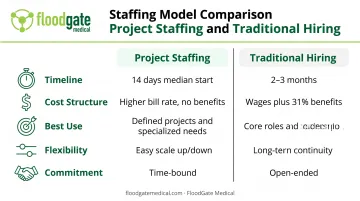
Project staffing and permanent hiring solve different workforce problems. Use the comparison below to match the model to role criticality, timeline, and how long you need the capacity.
| Dimension | Project/Contract Staffing | Traditional Permanent Hiring |
|---|---|---|
| Relationship | Staffing firm assigns its employee to client project work | Direct, permanent employment with the organization |
| Best Use | Defined projects, specialized expertise, demand spikes, temporary vacancies | Core competencies, long-term strategic roles, leadership positions requiring institutional knowledge |
| Speed | Professional-temp median: 9 days to offer acceptance, 14 days to start (SIA benchmark) | Typically 2–3 months for specialized MedTech roles |
| Cost Structure | Higher bill rate covers pay, burden, and firm margin; very long assignments can cost more than a benefits-eligible hire | Wages plus benefits (31.1% of total compensation for professional employees) |
| Flexibility | Defined assignment aligns capacity with milestones; easy scale-up and scale-down | Lower short-term reversibility; stronger long-term continuity |
| Commitment | Time-bound, ends naturally at project completion | Open-ended, requires termination process if needs change |
| Risk | Integration, IP, quality oversight, knowledge transfer at engagement end | Longer commitment, higher vacancy exposure during search |
When Traditional Hiring Makes More Sense
Permanent hiring remains the right choice for:
- Core capabilities that need deep institutional knowledge (regulatory strategy, quality leadership, clinical operations)
- Strategic roles that shape company direction over years, not months
- Directors, VPs, and executives who build teams, set culture, and lead multi-year initiatives
- Work where turnover would disrupt quality, compliance, or customer relationships
The "Try Before You Buy" Advantage
Even when a permanent seat is the end state, you do not always have to start there. Successful project engagements often convert when:
- You have validated technical skill and cultural fit over months of real work
- Longer-term needs emerge that match the professional’s strengths
- Both sides see clear value in a permanent relationship
This temp-to-perm path gives you an extended, lower-risk evaluation window before you extend a permanent offer—and it usually improves hire quality and retention.
Common Project Staffing Challenges and Solutions
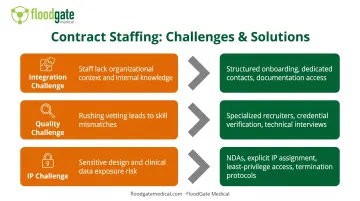
Challenge: Integration and Knowledge Transfer
Problem: Project staff lack organizational context: your quality system nuances, stakeholder preferences, historical design decisions, and informal communication norms. Without this context, they may duplicate work, miss stakeholder expectations, or struggle to navigate internal processes.
Solution:
- Build structured onboarding that documents procedures and the "why" behind key decisions
- Assign dedicated points of contact from your core team who can answer questions, provide context, and facilitate introductions
- Create accessible documentation repositories with project history, design rationale, regulatory correspondence, and lessons learned
- Schedule early stakeholder meetings to build relationships and clarify expectations before deliverables are due
Challenge: Quality Concerns When Vetting External Talent Quickly
Problem: Speed is a project staffing advantage, but rushing candidate evaluation can lead to mismatches: professionals who lack the specific regulatory pathway experience, don't understand your device type, or have certifications but limited hands-on expertise.
Solution:
- Partner with specialized recruitment firms that pre-screen candidates for technical competencies, regulatory knowledge, and cultural fit within MedTech environments
- Verify credentials directly with issuing organizations (RAPS, ASQ, PMI) for RAC, CQE, or PMP certifications
- Request submission samples or work products (redacted for confidentiality) that demonstrate writing quality and regulatory thinking
- Run technical interviews with internal experts, not only HR. Ask candidates to walk through a recent 510(k) or explain an IEC 62304 Class B vs. Class C decision
- Check references rigorously, focusing on deliverable quality, deadline performance, and collaboration
The FDA recognizes specific consensus standards (IEC 62304 for software, ISO 13485:2016 for quality management), so verify standards-specific experience, not just general device background.
Challenge: Managing Intellectual Property and Confidentiality
Problem: Project staff access sensitive design files, proprietary manufacturing processes, clinical data, and regulatory strategies. Without clear IP and confidentiality controls, you risk inadvertent disclosure or ownership disputes.
Solution:
- Execute NDAs before any project access, and ensure confidentiality obligations survive engagement termination
- Define IP ownership explicitly in contracts, including written IP assignment clauses rather than relying on assumptions about work-made-for-hire status
- Use least-privilege access: only the systems and documents each person needs, with separate credentials and access logs
- Mark confidential information clearly and limit physical or digital distribution
- Record return/destruction obligations at engagement end and verify compliance
- Terminate access immediately when the project concludes
Under US Copyright Office guidance, commissioned work qualifies as "work made for hire" only if it falls within specific statutory categories and the parties sign a written agreement stating that status. If either requirement is missing, add explicit IP assignment language.
WIPO identifies reasonable trade-secret measures such as marking information confidential and limiting access as key protection steps. The FDA also reminds that the finished-device manufacturer remains responsible for device safety and effectiveness, including contractor activities. Outsourcing labor does not outsource regulatory accountability.
Frequently Asked Questions
What does staffing mean in simple terms?
Staffing means finding and assigning the right people to fill specific job roles in an organization, whether permanently or temporarily, ensuring the right skills are available when and where they're needed.
What types of MedTech projects typically require project staffing?
Common examples include FDA submissions (510(k), PMA, IDE), clinical trial management, ISO 13485 quality system implementations, post-market surveillance setup, and new device development that needs regulatory, clinical, or quality expertise.
How long do project staffing engagements typically last?
Most MedTech project staffing engagements last 3 to 18 months. Shorter work such as regulatory gap analyses may take a few weeks; complex multi-year initiatives often use extended or phased support.
How quickly can project staff be onboarded?
With pre-vetted talent pools, specialists can often start within 10–24 days (median 14 days, per Staffing Industry Analysts). MedTech credentialing, QMS training, and system access may add time. Permanent hiring for specialized roles typically takes 2–3 months.
What should I include in a project staffing contract?
Include these essentials in a project staffing contract:
- Scope of work, deliverables, duration, and payment terms
- Confidentiality, NDA, and IP ownership (work-made-for-hire or assignment)
- Termination conditions, notice periods, and quality/regulatory oversight
Can project staff transition to permanent roles?
Yes. A temp-to-perm path lets strong project engagements convert to permanent roles when fit and long-term need are clear. That longer evaluation period lowers hiring risk and often improves retention versus traditional hires.
Project staffing gives you specialized MedTech expertise when you need it, without a permanent headcount commitment. Define requirements clearly, work with specialized recruiters, integrate temporary staff fully, and manage risk up front. Done well, you move critical projects faster, control cost, and reach scarce skills that support regulatory success and product innovation.