That's the healthcare project manager's job. Yet hiring managers often can't articulate how this role differs from a generic PM position, and candidates aren't sure which certifications actually move the needle.
This guide breaks down what a healthcare project manager does, the core responsibilities, the skills that matter most, current salary data, and the certification path to get there.
Key Takeaways
- Healthcare project managers bridge clinical, technical, and regulatory teams to hit deadlines and budgets
- Core duties span task management, staff coordination, resource/budget oversight, and change/compliance management
- US salaries average $112,022, with certification and subsector driving the biggest swings
- PMP, CAPM, and PRINCE2 credentials are increasingly non-negotiable for competitive candidates
What Does a Healthcare Project Manager Do?
A healthcare project manager oversees healthcare-specific initiatives from kickoff to close. Think EHR rollouts, new service line launches, telemedicine programs, or compliance overhauls tied to a new regulation.
This isn't a standard PM gig with a healthcare label slapped on it. The environment is heavily regulated, and stakeholders range from clinicians and insurers to patients and vendors, all with different priorities and none of them fully aligned.
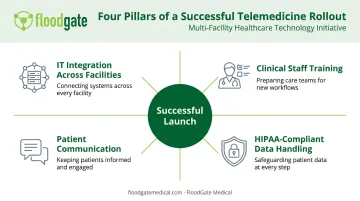
Example: Rolling out a telemedicine program across a multi-facility health network means juggling several moving pieces at once:
- Coordinating IT integration across facilities running different existing systems
- Training clinical staff on new workflows
- Verifying HIPAA-compliant data handling
- Managing patient communication throughout the rollout
On day one of any project, the PM builds a detailed plan and tries to anticipate problems before they surface. Waiting for issues to show up is how timelines slip and budgets balloon.
Demand Is Real, Even Without a Healthcare-Specific Number
There's no BLS series that isolates growth specifically for healthcare project managers. But the broader occupation, project management specialists, is projected to grow 6% from 2024 to 2034, adding roughly 78,200 openings annually across all industries, per the Bureau of Labor Statistics.
Pair that with the sustained pace of digital-health adoption, and it's clear healthcare systems need this skill set to keep pace.
What sets successful candidates apart: they combine formal project management methodology with working knowledge of healthcare regulations and clinical workflows. One without the other doesn't cut it in this space.
Key Roles & Responsibilities of a Healthcare Project Manager
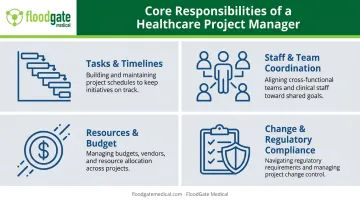
Responsibilities generally break into four categories: tasks, staff, resources, and change/compliance. Here's how each plays out day to day.
Managing Tasks & Project Timelines
Healthcare projects rarely move in a straight line. A PM sequences interdependent tasks across departments (radiology, IT, nursing, finance) using Gantt charts or PM software to keep milestones visible and on track.
Miss a dependency, and a go-live date for a new EHR module can slip by weeks.
Managing Staff & Team Coordination
Building staff and shift schedules for care providers and administrators is a constant balancing act. The PM has to ensure the right personnel are available at the right time, which means:
- Regular check-ins with department heads
- Contingency planning for callouts or emergencies
- Clear communication when schedules shift mid-project
Managing Resources & Budget
Budget oversight covers more than a project line item. It includes:
- Patient billing and fee structure adjustments tied to new services
- Overhead cost tracking across departments
- Vendor and equipment procurement for new systems or devices
A single equipment delay can derail a launch date, so vendor management matters as much as internal coordination.
Managing Change & Regulatory Compliance
This is where healthcare PMs earn their keep. They drive change management to reduce staff resistance when new systems or workflows roll out, while monitoring evolving regulations like HIPAA and FDA requirements to keep the project compliant from start to finish.
This role demands a broad mix of clinical fluency, regulatory awareness, and traditional PM skill. That's why many MedTech and healthcare companies turn to specialized recruiters like FloodGate Medical, who source candidates already fluent in industry regulations and operations instead of starting from scratch with generalist PM talent.
Essential Skills for a Healthcare Project Manager
The top skills employers look for:
- Problem-solving – clinical and technical roadblocks appear constantly, and there's rarely a manual for them
- Interpersonal communication – translating between clinicians, IT, and finance requires more than technical vocabulary
- Leadership – teams need direction, especially when a project disrupts established clinical routines
- Flexibility – regulations and priorities shift mid-project more often than in other industries
- Multitasking – most PMs run several workstreams at once, not one clean sequential project
Beyond individual skills, a healthcare PM needs a nuanced read on the market itself. That means navigating insurance-driven buying dynamics, juggling stakeholder groups with competing incentives, and carrying a regulatory load heavier than almost any other sector.
What Is the Most Important Skill for a Healthcare Project Manager?
Leadership combined with adaptability. That's the answer, and it's not close.
Here's the reasoning: technical PM skills, such as Gantt charts, budgeting software, and scheduling tools, can be trained in a matter of weeks. Adaptive leadership under pressure cannot.
Healthcare projects face regulatory shifts, clinical emergencies, and stakeholder pushback on a rolling basis. A PM who can hold a team together and pivot a plan mid-stream, without losing stakeholder trust, is far harder to develop than one who simply knows the software.
Healthcare Project Manager Salary in the US
Current national data puts the average and median Healthcare Project Manager salary at $112,022, while medical device-specific PM roles average $102,682 based on separate industry data. Here's how the two sources compare:
| Data Source | Average/Median | 25th Percentile | Top Percentile |
|---|---|---|---|
| Salary.com (Healthcare PM) | $112,022 | $103,851 | $122,973 (75th) |
| ZipRecruiter (Medical Device PM) | $102,682 | $78,500 | $146,000 (90th) |
Salary.com's full range runs from $96,412 to $132,943.
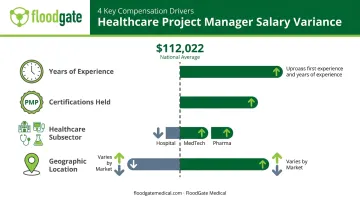
What drives the variance:
- Years of experience – the role typically requires 4-7 years minimum, and pay climbs steadily beyond that
- Certifications held – PMI's 2025 survey found certified PMP holders earn a median of $135,000 versus $109,157 for non-certified peers, a nearly 24% gap (cross-industry data, not healthcare-specific)
- Healthcare subsector – hospital systems, MedTech, and pharma each have different pay ceilings
- Geographic location – metro markets with dense hospital systems or MedTech clusters tend to pay more
Salary.com notes that experience affects compensation but doesn't publish precise figures for a 5-10 year bracket versus a 10-15 year bracket. Treat the direction as reliable and the exact numbers as unconfirmed.
Education, Certifications & How to Become a Healthcare Project Manager
Most healthcare PMs start with a bachelor's degree in health administration, business administration, nursing, or a related field. An advanced degree, like an MHA or MBA, can differentiate a candidate for senior roles, though it's not always required.
Certifications That Matter Most
| Certification | Best For | Prerequisite |
|---|---|---|
| PMP | Experienced PMs seeking the top credential | 3-5 years of PM experience depending on education level |
| CAPM | Entry-level candidates building a foundation | No experience required; 23 hours of PM education |
| PRINCE2 Foundation | Structured, process-driven environments | None |
| AgilePM | Teams running agile delivery models | Varies by level |
Employers increasingly ask for formal certification over experience alone. Mayo Clinic's own project manager postings list PMP as preferred, and MedTech employers like Boston Scientific name it explicitly in job listings for senior PM roles.
Certification matters, but it isn't the only way in. Many healthcare project managers start in adjacent clinical or operations roles instead. Clinical staff, nurses, lab managers, and operations coordinators often transition into the position through targeted certification plus hands-on project experience, a common and realistic path into the field.
If you're mapping out that transition, resources matter. FloodGate Medical's monthly newsletter shares MedTech industry insights and career resources for professionals building toward roles like this, alongside broader career coaching support for candidates moving into the sector.
Frequently Asked Questions
How much do healthcare project managers make in the US?
The national average and median sit at $112,022, with most professionals earning between $96,412 and $132,943. Experience level, certifications, and location are the biggest drivers of where you land in that range.
What is the most important skill for a healthcare project manager?
Adaptive leadership. Regulatory shifts, clinical emergencies, and stakeholder pushback are constant in this field, and that's harder to teach than technical PM knowledge.
What are the core "C's" of project management for a healthcare project manager?
A practical framework: Communication across stakeholders, Coordination of interdependent tasks, Cost control on budgets, and Compliance with regulations like HIPAA. It's not an official standard, but it captures the job well.
What certifications are best for a healthcare project manager?
PMP carries the most weight for experienced candidates, while CAPM works for entry-level professionals. PRINCE2 is also widely recognized, particularly in structured healthcare environments.
Is healthcare project management a good career choice?
Digital health adoption is holding steady, with CMS reporting that a quarter of Medicare beneficiaries used telehealth in 2024, and salaries average six figures nationally.
How is a healthcare project manager different from a general project manager?
Healthcare PMs need working knowledge of regulations like HIPAA and FDA requirements, plus the ability to manage clinical stakeholders alongside insurers and vendors. That regulatory and clinical layer doesn't exist in most general PM roles.