
Introduction
MedTech companies face a critical challenge when scaling commercial teams to launch new devices or expand into new markets. One wrong hire can delay a product launch by months and cost hundreds of thousands in lost revenue.
Unlike general hiring, go-to-market (GTM) recruiting directly impacts revenue velocity and market adoption. A territory sales rep who lacks catheterization lab relationships or a clinical specialist without procedure-support experience can stall physician adoption, even when the device itself is excellent.
This article covers what GTM recruiting means in MedTech, how to build a strategy aligned with product launch and reimbursement timelines, which roles matter most, common hiring mistakes, and when to bring in a specialized recruiting partner.
Key Takeaways
- GTM recruiting targets revenue-generating, market-facing roles with direct commercial accountability
- Align GTM hiring with launch timeline, hospital segment, reimbursement pathway, and distribution model
- MedTech GTM roles differ from SaaS—clinical credibility, procedure support, and regulatory fluency are required
- Diverse commercial teams drive innovation gains and stronger patient-population understanding
- Specialized recruiting partners deliver pre-vetted pipelines, market intelligence, and faster passive-candidate reach
What Is Go-to-Market (GTM) Recruiting?
Go-to-market recruiting means sourcing and hiring the cross-functional talent needed to execute a company's market entry or expansion plan. In MedTech, this includes revenue-generating and market-facing roles such as territory sales representatives, clinical specialists, marketing and product managers, reimbursement specialists, and sales trainers.
How GTM Recruiting Differs From General Hiring
GTM recruiting operates under tighter timelines and higher accountability than traditional HR hiring. Every open territory represents delayed revenue. Every unfilled clinical specialist role limits physician training and case coverage. Unlike back-office or R&D hiring, GTM roles get judged on speed to productivity, market fit, and revenue impact.
Key differences:
- GTM hires are measured on quota attainment, territory growth, and case volume, not competency checklists alone
- Strong candidates bring therapy-area knowledge, hospital networks, and physician relationships—not generic selling skills
- Field personnel must finish credentialing (hospital safety training, immunizations, HIPAA, facility orientation) before they enter procedure environments
- Hiring timelines have to line up with FDA clearance, reimbursement coverage, and channel readiness
Example: MedTech GTM Strategy in Action
A cardiovascular device company launching a new interventional catheter for chronic total occlusions (CTO) might hire:
- Three regional sales managers to establish hospital accounts and drive case volume
- Two clinical specialists to provide in-procedure support and physician education
- One reimbursement specialist to secure favorable coding and payer coverage
- One product trainer to certify the field team on safe device use and clinical evidence
That mix lets the company cover physician training, in-room case support, hospital purchasing, and reimbursement questions at the same time. Adoption and revenue ramp faster as a result.
Building a Go-to-Market Recruiting Strategy for MedTech Companies
A successful MedTech GTM recruiting strategy starts with alignment across three dimensions: product launch timeline, target customer segment, and reimbursement pathway. Deloitte's MedTech commercialization framework spans marketing, sales-force design, market access, reimbursement, pricing, contracting, channel strategy, and evidence-driven product development. Recruiting must staff this entire system, not just sales.
Step 1: Define Target Roles Based on Commercial Motion
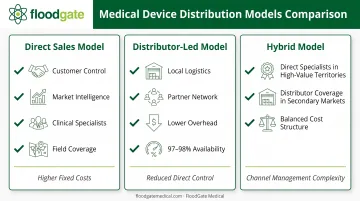
Your distribution model determines headcount and role mix.
Direct sales model:
- Manufacturer owns customer relationships, clinical support, and territory coverage
- Requires more field sales reps, clinical specialists, sales operations, and market-access support
- Delivers maximum customer control and market intelligence but adds fixed costs
Distributor-led model:
- Partner network handles local logistics, customer access, and inventory
- Requires channel managers, partner trainers, and governance capability instead of large direct teams
- HIDA research: distributors can lift an 80% manufacturer fill rate to 97–98% customer availability
Hybrid model:
- Combine direct clinical specialists in high-value territories with distributor coverage in secondary markets
- Example: Haemonetics runs its own teams plus independent distributors across most of its 95-country footprint (AtriCure uses a similar international mix)
- Requires clear account and case-coverage rules to avoid channel conflict
Hiring implication: Lock in your distribution model before finalizing headcount plans. A shift from distributor to direct coverage mid-launch can add 12-18 months of recruiting and training delays.
Step 2: Build Candidate Personas Around Clinical Credibility and Market Fit
MedTech GTM candidates need more than quota achievement. They need clinical fluency, hospital stakeholder relationships, and therapy-area depth.
Territory/Field Sales Rep persona:
- 3-5 years selling interventional devices in target specialty (e.g., CTO, structural heart, vascular closure)
- Existing relationships with key opinion leaders (KOLs) and hospital purchasing committees
- Proven ability to support in-room procedures and manage case logistics
- Willingness to travel 50-75% and maintain flexible procedure-coverage hours
Clinical Specialist persona:
- Clinical background (e.g., cath lab nurse, surgical tech, perfusionist) or deep device-education experience
- Experience providing in-procedure technical support and physician training
- Strong understanding of safe device use, complications management, and escalation protocols
- Current or ability to obtain hospital credentialing and facility access
Reimbursement/Market Access Specialist persona:
- Knowledge of CPT coding, Medicare coverage, and payer policy development
- Experience building health-economic evidence and communicating product value to payers
- Ability to work with R&D and clinical teams early enough to shape evidence strategy
Step 3: Create an Outreach Plan Targeting Passive Candidates
The best device sales reps and clinical specialists are rarely unemployed. SHRM data shows median time-to-fill of roughly 1.5 months across industries, but MedTech GTM roles often take longer due to smaller talent pools and credentialing requirements.
Effective passive-candidate strategies:
- Map competitor sales teams – Identify top performers at competitor organizations in your therapy area
- Leverage LinkedIn and clinical networks – Engage candidates through specialty groups, clinical conferences, and physician referrals
- Offer compelling territory opportunities – Highlight new technology, competitive compensation, protected territories, and KOL relationships
- Use contract-to-hire models – Test fit through short-term projects or product-launch assignments before permanent offers
FloodGate Medical reports that 70% of candidates hired are passive—so proactive outreach outperforms posted job ads for these roles.
Step 4: Incorporate DEI-Driven Sourcing
Building diverse commercial teams improves customer relationships and innovation outcomes. BCG research across 1,700+ companies found that organizations with more diverse management teams reported 45% of revenue from recently launched products versus 26% for less-diverse teams, a 19-point gap.
In healthcare specifically, physician-patient racial concordance increases preventive care uptake: Black patients seeing Black physicians showed an 11-percentage-point increase in blood-pressure measurement and 16-point increase in BMI screening. While this evidence is not MedTech-sales-specific, it supports the principle that diverse teams better understand and serve diverse patient populations.
DEI sourcing tactics:
- Partner with professional organizations serving underrepresented groups in medical sales and clinical roles
- Review candidate pipelines for demographic diversity before final slates
- Train hiring managers on structured interviews and scorecards to reduce bias
- Track diversity metrics at each stage of the hiring funnel
Step 5: Build a 30/60/90-Day Onboarding Plan
MedTech GTM hires face longer ramps than SaaS counterparts due to hospital credentialing, device training, and procedure-support certification.
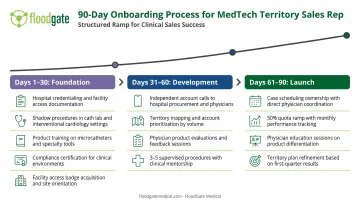
Sample 30/60/90-day plan for a territory sales rep:
Days 1-30:
- Complete hospital credentialing and facility-access requirements
- Shadow experienced reps in live procedures
- Complete product, clinical-evidence, and compliance training
- Attend initial physician and hospital meetings with manager
Days 31-60:
- Begin independent account calls and case coverage
- Develop territory account map and target physician list
- Complete first product evaluations with new physicians
- Support 3-5 procedures independently under remote supervision
Days 61-90:
- Take ownership of case scheduling and physician education
- Begin quota ramp (often 50% of full territory quota)
- Conduct first lunch-and-learn or in-service training session
- Review territory plan and adjust targeting based on early wins
Critical success factor: Align ramp expectations with hospital credentialing timelines. While hospital credentialing requirements vary, most facilities require safety training, immunization verification, background checks, and policy acknowledgments before granting procedure-room access.
Key GTM Roles Every MedTech Company Should Hire For
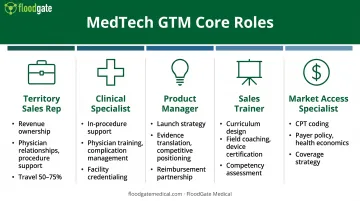
MedTech GTM roles differ from SaaS counterparts due to clinical, regulatory, and reimbursement complexity. Use the five core roles below—and the hiring screen under each—to decide who to hire and what to assess before you extend an offer.
1. Territory/Field Sales Representative
Primary responsibilities:
- Own revenue and case volume in assigned geography
- Develop relationships with physicians, administrators, and purchasing decision-makers
- Provide in-procedure product support and technical troubleshooting
- Manage inventory, case logistics, and hospital compliance requirements
Boston Scientific's interventional cardiology territory managers combine revenue ownership with procedure support, product-use education, hospital stakeholder management, and clinical aptitude.
Hiring screen:
- Clinical and technical aptitude
- Cath lab stakeholder fluency
- Account development
- Procedural availability
- Travel flexibility
2. Clinical Specialist
Primary responsibilities:
- Provide in-procedure technical support during device use
- Train physicians, nurses, and cath lab teams on safe device handling
- Troubleshoot complications and escalate issues to medical affairs
- Maintain hospital credentialing and facility access
Abbott's structural-heart clinical specialists provide clinical and sales support through customer education and procedure coverage. AdvaMed defines healthcare industry representatives (HCIRs) as company specialists who train and technically support hospital teams.
Hiring screen:
- Therapy/device depth
- Case coverage
- Safe-use education
- Escalation judgment
- Facility credentials
3. Product Manager
Primary responsibilities:
- Develop go-to-market strategy and launch plans
- Translate clinical evidence into sales enablement tools
- Monitor therapy adoption, referral patterns, and competitive positioning
- Partner with sales, medical affairs, and market access on reimbursement strategy
Boston Scientific's interventional cardiology product managers partner with sales and medical affairs on reimbursement, clinical-evidence dissemination, therapy adoption, and referral monitoring.
Hiring screen:
- Voice-of-customer work
- Launch/portfolio strategy
- Evidence translation
- Reimbursement literacy
- Compliant sales enablement
4. Sales Trainer
Primary responsibilities:
- Design and deliver product, procedure, evidence, and compliance curriculum
- Conduct field coaching and competency assessments
- Certify new hires on device use and clinical positioning
- Update training materials based on new evidence and competitive intelligence
Hire trainers who can build field competency, not only slide decks.
Hiring screen:
- Instructional design
- Field coaching
- Clinical and selling fluency
- Measurement/certification capability
5. Reimbursement/Market Access Specialist
Primary responsibilities:
- Secure favorable CPT coding, Medicare coverage, and commercial payer policy
- Build health-economic evidence and value dossiers
- Monitor policy trends and communicate implications to field teams
- Support product development and pricing strategy with reimbursement insights
MDIC identifies favorable coding, coverage, and payment as prerequisites for commercial success and emphasizes continuing reassessment. Abbott's market-access roles cover policy trends, value communication, product development, pricing, and securing reimbursement for cardiac technologies.
Hiring screen:
- Coding, coverage, and payment
- Health economics
- Payer/provider policy
- Evidence strategy
- Field issue resolution
How MedTech Roles Differ From SaaS GTM Roles
SaaS GTM teams focus on lead generation, demo delivery, contract negotiation, and customer onboarding. MedTech GTM teams add:
- Procedure-room presence: Providing in-case technical support and troubleshooting
- Clinical education: Training physicians and hospital teams on safe device use
- Regulatory compliance: Navigating FDA, hospital, and HIPAA requirements
- Reimbursement complexity: Understanding coding, coverage, and payment pathways
Hiring Order Should Match Launch Stage
Early-stage device companies often need clinical specialists and market-access expertise before large sales teams. A common sequence:
- Pre-launch: Market access specialist to shape reimbursement strategy
- Limited market release: Clinical specialists to support initial physician training
- Commercial launch: Territory sales reps to scale case volume
- Post-launch expansion: Product managers, trainers, and additional field personnel
Common Mistakes in MedTech GTM Recruiting
MedTech GTM plans often stall after the offer letter. The usual cause is hiring that ignores how device sales, hospital access, and clinical credibility actually work.
Mistake 1: Hiring Generalist Sales Reps Without Device or Clinical Experience
A strong pharma or SaaS rep is not automatically ready for interventional device sales. Cath lab work rewards clinical fluency, not just close rates.
Boston Scientific's interventional roles expect clinical excellence, procedure support, proper-use education, technical aptitude, and extensive training. AMA guidelines add clear limits: reps must stay within their training, work under supervision, refrain from practicing medicine, and never replace physician education.
Hiring a pharmaceutical rep or SaaS seller into a device role risks:
- Lack of credibility with physicians and cath lab teams
- Inability to provide technical support during procedures
- Failure to recognize device complications or escalation needs
- Slower ramp from unfamiliar hospital purchasing and credentialing
Mistake 2: Underestimating Time-to-Productivity
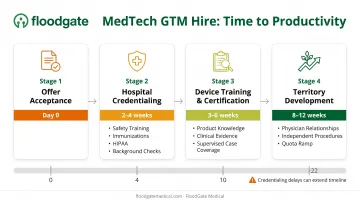
Offer accepted is not the same as revenue-ready. Hospital credentialing alone can stall field activity for weeks.
Requirements vary by facility, but usually include safety and HIPAA training, immunization verification, policy acknowledgments, and sanctions checks. GHX warns that noncompliance can lead to access denial. AORN also expects credentialing, identification, orientation, ongoing education, and background verification.
Time-to-productivity factors:
- Hospital credentialing and facility access (varies by site)
- Device training and clinical-evidence certification
- Supervised case coverage before independent procedure support
- Territory development and physician relationship building
SHRM's time-to-fill benchmark of roughly 1.5 months ends at offer acceptance. It does not cover onboarding, training, credentialing, or case competency.
Mistake 3: Ignoring Diversity in Candidate Pipelines
Homogeneous commercial teams struggle to reach diverse physician networks and patient populations. A 2020 healthcare-workforce review argues that workforce composition should reflect patients across race, ethnicity, gender, sexual orientation, immigration status, disability, and socioeconomic level.
Narrow referral networks and look-alike hiring create commercial gaps:
- Weaker access across varied health-system and physician communities
- Flatter messaging and support for different care settings
- Fewer perspectives when shaping territory strategy and account coverage
Broaden the pipeline on purpose, or you limit who you can hire and who you can sell to.
When to Bring In a Specialized MedTech Recruiting Partner
Internal HR teams often lack the networks, market intelligence, and speed required for MedTech GTM hiring. A 2024 SHRM survey of 2,366 HR professionals found that 77% reported difficulty recruiting full-time roles.
Leading challenges included:
- Too few applicants (60%)
- Employer competition (55%)
- Candidate ghosting (46%)
When to Consider a Specialist Partner
Trigger scenarios:
- You need to hire 5+ GTM roles within 3 months for a product launch
- Your internal team lacks relationships with passive device sales and clinical talent
- You're entering a new therapy area and need candidates with specific clinical networks
- You require market intelligence on competitor movement, compensation benchmarks, and territory strategy
- You want to build diverse candidate pipelines but lack sourcing channels
What Specialized Recruiters Provide
Pre-vetted candidate pipelines:
- Access to passive, high-performing device sales and clinical professionals
- Candidates with therapy-specific experience and hospital relationships
- Faster time-to-slate and reduced screening burden
Market intelligence:
- Compensation benchmarks by role, therapy area, and geography
- Competitive hiring activity and territory coverage changes
- Candidate availability and offer-acceptance trends
DEI-driven sourcing:
- Diverse candidate pipelines across race, ethnicity, gender, and background
- Structured interview processes and bias-reduction training
- Hiring metrics and accountability for inclusive outcomes
FloodGate Medical combines deep MedTech sourcing expertise with a DEI-driven methodology to help companies build diverse, high-performing commercial teams. The firm provides permanent placement, contract staffing, executive search, and workforce planning tailored to device companies. Its monthly newsletter offers hiring trends, compensation insights, and career opportunities for candidates and hiring teams navigating the MedTech market.
Frequently Asked Questions
What does go-to-market (GTM) mean in recruiting?
GTM recruiting is hiring for revenue-facing roles that execute a company's market entry or expansion plan. In MedTech, this includes territory sales reps, clinical specialists, product managers, sales trainers, and reimbursement specialists who drive device adoption and revenue growth.
What is an example of a go-to-market (GTM) strategy in recruiting?
A cardiovascular device company launching a new CTO catheter might hire regional sales managers to open hospital accounts, clinical specialists for in-procedure support, and a reimbursement specialist to secure payer coverage. That mix keeps physician training, case coverage, and market access in sync.
How is GTM recruiting different from traditional recruiting?
GTM recruiting emphasizes revenue accountability, speed to productivity, and specialized evaluation criteria. Candidates are assessed on clinical credibility, hospital networks, therapy-area knowledge, and ability to support procedures, not just selling skills or culture fit.
What roles are typically included in a MedTech GTM team?
Core roles include territory/field sales representatives, clinical specialists, product managers, sales trainers, and reimbursement/market access specialists. Early-stage companies often prioritize clinical specialists and market access before scaling sales teams.
When should a MedTech company hire a GTM recruiting specialist?
Consider a specialist when launching a new product, hiring 5+ roles within three months, lacking internal networks in passive MedTech talent, or needing market intelligence on compensation and competitor activity. Specialists deliver faster slates, pre-vetted candidates, and DEI-driven sourcing.
How does diversity impact GTM team performance in MedTech?
Diverse teams better reflect patient populations and tend to drive more innovation revenue. In MedTech, diverse commercial teams also expand clinical networks and bring sharper patient-population insight.