
The trouble is, job titles rarely match up. "Clinical Assistant," "Clinical Medical Assistant," and "Clinic Assistant" get used interchangeably in job postings, leaving employers unsure how to write the listing and candidates unsure what they're even applying for.
This guide breaks down the core duties, the skills employers actually want, a ready-to-use job description template, and current salary data, whether you're hiring for the role or pursuing it.
Key Takeaways
- Clinical assistants blend patient care with administrative duties; CNAs focus solely on custodial tasks
- Median pay sits at $44,200 annually ($21.25/hour), with 12% job growth through 2034
- Certification (CCMA or CMA) measurably improves interview and hire odds with employers
- Scope of practice, including injections and phlebotomy, depends entirely on state regulation
What Is a Clinical Assistant?
A clinical assistant is a cross-trained healthcare support professional who handles both clinical tasks and office administration under a physician's or nurse's direction. You'll find them in physician offices, outpatient clinics, urgent care centers, and hospital departments.
Here's the catch: there's no single federal job classification called "Clinical Assistant." The Department of Labor's O*NET database lists Clinical Medical Assistant as a reported title under the broader Medical Assistant occupation code (31-9092.00). So when employers post a "Clinical Assistant" role, they're typically describing Medical Assistant-level work, just under a different name.
What that means practically: tasks like giving injections or performing phlebotomy aren't universal. Each state's Medical Practice Act and employer-specific delegation policies govern these tasks. A clinical assistant in California, for example, needs documented training hours before performing injections, while other states set different thresholds.
Where Clinical Assistants Actually Work
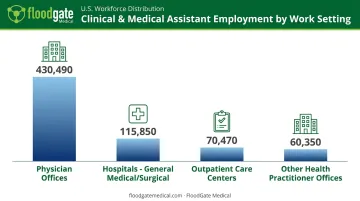
Employment concentrates heavily in outpatient settings, based on national data for the Medical Assistant occupation:
| Work Setting | Employment Count |
|---|---|
| Physician offices | 430,490 |
| Hospitals (general medical/surgical) | 115,850 |
| Outpatient care centers | 70,470 |
| Other health practitioner offices | 60,350 |
Physician offices alone account for well over half of all positions, according to BLS occupational employment data.
Clinical Assistant vs. Medical Assistant vs. CNA
The confusion doesn't stop at "Clinical Assistant" versus "Clinical Medical Assistant" — those two get used interchangeably in nearly every job posting you'll find. The real distinction employers and candidates need is between this hybrid role and a CNA.
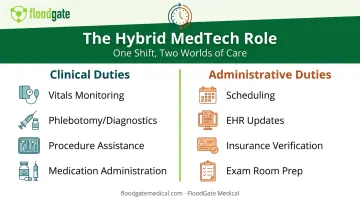
- Clinical Assistant / Medical Assistant: Splits time between clinical procedures (vitals, specimen collection, exam prep) and administrative tasks (scheduling, EHR updates, insurance forms)
- Medical Assistant (specialized track): Some MAs train into clinical-only or administrative-only roles, narrowing their day-to-day focus
- CNA (Certified Nursing Assistant): Focuses on long-term daily care such as bathing, feeding, and mobility support in nursing facilities, not diagnostic procedures
If a job posting emphasizes lab work, EKGs, or injections alongside scheduling duties, it's describing a clinical assistant. If it centers on daily patient hygiene and comfort care, that's CNA territory.
Clinical Assistant Duties and Responsibilities
Daily responsibilities blend hands-on patient care with essential administrative support. No two shifts look identical, which is part of what makes the role demanding and, for many, genuinely rewarding.
Core Clinical Duties
Clinical assistants are often the first clinical contact a patient has during a visit:
- Measure and record vital signs, including blood pressure, temperature, pulse, and oxygen saturation, plus patient history documentation
- Support diagnostics through phlebotomy, EKG administration, point-of-care testing (urinalysis, glucose checks), and specimen collection and labeling
- Assist during physician procedures, including instrument handling, wound care, dressing changes, and maintaining sterile fields
- Administer medications and injections under physician order, with exact scope varying by state regulation and employer protocol
Core Administrative Duties
The administrative half of the job keeps the clinic functioning between patient visits:
- Scheduling appointments and maintaining electronic health records (EHR)
- Coordinating with outside labs and communicating results back to patients
- Verifying insurance and assisting with billing and coding tasks
- Restocking and sterilizing exam rooms between patients
A clinical assistant who spends the morning drawing blood might spend the afternoon reconciling insurance claims. That variety is simply part of the job.
Essential Skills and Qualifications for Clinical Assistants
Employers look for a mix of technical competency and interpersonal skill. Job postings for this occupation frequently name specific software: Microsoft Office and Epic Systems each appear in roughly 6% of listings, with EHR platforms like eClinicalWorks and MEDITECH showing up as well.
Technical/Hard Skills
- Phlebotomy technique and blood draw protocols
- EKG operation and basic diagnostic equipment use
- Infection control and sterile field maintenance
- EHR software navigation (Epic, eClinicalWorks, MEDITECH)
Soft Skills
- Communication: explaining procedures clearly so patients aren't left guessing
- Organization and multitasking: juggling a full patient schedule without dropping a step
- Empathy: especially with anxious or first-time patients
- Attention to detail: critical for accurate documentation and correct dosing
Most positions require only a high school diploma plus on-the-job training or a certificate program. But certification changes the hiring math.
A recent employer survey found **72% of employers require Medical Assistant certification**, and 85% said they're more likely to interview and hire a nationally certified candidate over one without credentials, according to NHA's 2025 Industry Outlook report.
Credentials like CCMA (Certified Clinical Medical Assistant) or CMA (Certified Medical Assistant) give candidates a real edge over uncertified applicants.
Sample Clinical Assistant Job Description Template
A strong job posting covers five elements: a job summary, clinical responsibilities, administrative responsibilities, required qualifications, and preferred certifications. Structure it like this:
- Job Summary: one paragraph describing the setting (specialty clinic, urgent care, hospital department) and the physician/nurse supervision structure
- Clinical Responsibilities: vitals, phlebotomy, EKGs, assisting procedures, medication administration under order
- Administrative Responsibilities: scheduling, EHR updates, insurance verification, billing support
- Required Qualifications: high school diploma, relevant training or on-the-job experience
- Preferred Certifications: CCMA, CMA, or state-specific credentials
Don't skip the practical details. Note physical requirements (standing for long periods, occasional lifting) and work environment specifics (specialty clinic versus outpatient center). Vague postings attract mismatched applicants; specific ones don't.
For healthcare organizations hiring multiple clinical assistants at once, a specialized recruitment partner can shortcut a lot of this legwork. FloodGate Medical's DEI-driven sourcing approach, built specifically for the MedTech and healthcare space, helps employers reach a broader, more qualified candidate pool than a standalone job posting typically manages alone.
Salary and Career Outlook
Clinical assistants (tracked federally under the Medical Assistant occupation) earned a median $44,200 annually, or $21.25 per hour, as of May 2024. The Bureau of Labor Statistics projects 12% employment growth through 2034, faster than average for all occupations.
Pay ranges by experience level, based on AAMA's 2025 compensation survey of certified medical assistants:
| Experience Level | Hourly | Annual |
|---|---|---|
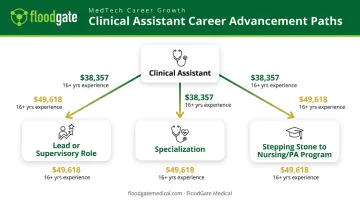
| 0-2 years | $20.60 | $38,357 |
| 16+ years | $25.21 | $49,618 |
Top-paying states by mean annual wage include Washington ($53,780), Alaska ($52,530), and California ($50,900). Certification correlates with higher pay too: current CMA holders averaged $23.55/hour versus $22.61/hour for those without the credential.
Career growth typically flows in one of three directions:
- Lead or supervisory roles within a clinic or department
- Specialization in a particular practice area, such as cardiology or dermatology
- A stepping stone toward nursing or physician assistant programs, though no formal transition pipeline is guaranteed
Finding or Filling Clinical Assistant Roles
For job seekers: Build your resume around the clinical and administrative skills employers actually screen for, not a generic list of duties. Pursue CCMA or CMA certification if you haven't already. It's one of the few credentials known to move you up the interview stack.
For employers: Filling a clinical support role slowly costs you more than the vacancy itself. Every week a seat sits open, existing staff absorb the overflow, patient wait times stretch, and care quality can slip. Finding the right cultural and skills fit quickly matters as much as filling the seat at all.
This is where a MedTech-focused recruitment network earns its keep. FloodGate Medical connects MedTech companies with pre-vetted candidates for clinical-facing and industry roles, drawing on an active talent pipeline built well before a specific opening exists rather than a cold job board search. Job seekers, including clinical assistants looking to grow into MedTech careers, get access to the same network, plus a monthly newsletter covering open roles and industry insight.
Frequently Asked Questions
How much do clinical assistants make in the US?
The median is $44,200 annually, or $21.25 per hour, as of May 2024 BLS data. Entry-level workers typically earn closer to $38,000, while experienced, certified professionals can exceed $49,000.
What are the duties of a clinical assistant?
Clinical assistants take vitals, perform phlebotomy, assist with procedures, and administer medications under physician order. They also handle scheduling, EHR updates, and insurance verification.
What qualifications do you need to become a clinical assistant?
Most roles require just a high school diploma plus on-the-job training or a certificate program. Certifications like CCMA or CMA give candidates a real edge, and a growing share of employers now require them outright.
Is a clinical assistant the same as a medical assistant?
The terms are largely interchangeable in job postings, and "Clinical Medical Assistant" is actually the federally recognized title. Specific duties still vary by employer and state regulation.
Where do clinical assistants typically work?
Physician offices employ the largest share, followed by hospitals, outpatient care centers, and other health practitioner offices. Urgent care centers are common too, though not separately tracked in federal data.
What is the career growth path for a clinical assistant?
Common paths include moving into lead or supervisory positions, specializing within a clinical department, or using the role as a foundation for nursing or physician assistant programs. Building hands-on experience and adding certifications along the way strengthens your odds with any of these paths.