
Job postings make this role harder to pin down than it should be. "Medical technician" and "medical technologist" get used interchangeably by employers, recruiters, and even job boards, despite requiring different degrees and different scopes of practice. That mismatch confuses job seekers comparing openings and trips up hiring managers writing requisitions.
This guide breaks down what medical technicians actually do, the skills and credentials employers expect, how the career ladder works, and what the role pays. If you're weighing this path or building a hiring plan around it, you'll find the specifics here.
Key Takeaways
- Medical technicians test blood, tissue, and fluid samples that directly shape diagnoses and treatment plans
- Associate degrees or certificates land entry-level roles; bachelor's degrees unlock the technologist track
- Specializations like phlebotomy, histotechnology, and blood bank technology each carry distinct certification paths
- ASCP or AMT certification isn't always required, but it boosts hiring odds and pay
What Is a Medical Technician?
A medical technician (often called a medical laboratory technician or MLT) performs routine, frequently automated lab testing, usually under a technologist's oversight. Medical technologists, by contrast, handle more complex manual testing and quality-assurance work, and they typically hold a bachelor's degree rather than an associate degree or certificate.
The federal government groups both roles together under one classification, SOC 29-2010, which makes technician-specific data harder to isolate. Still, the distinction in daily responsibilities and education is real, even if the paperwork blurs the lines.
Where Medical Technicians Work
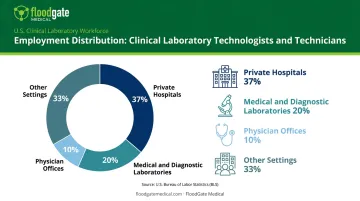
Hospitals dominate the employment picture for this combined occupational category. According to the Bureau of Labor Statistics, private hospitals employ 37% of clinical laboratory technologists and technicians, followed by medical and diagnostic laboratories at 20% and physician offices at 10%.
That hospital concentration matters for job seekers. It means:
- Larger labs with more specialized equipment and rotating shifts
- Greater exposure to varied case types, from routine chemistry panels to urgent trauma work
- More structured advancement ladders compared to smaller physician-office labs
This role sits at the foundation of the diagnostic process, where speed and accuracy directly affect how quickly a patient gets treated.
Medical Technician Responsibilities & Duties
Core duties stay consistent across most employers, though specialization narrows the day-to-day focus. A histotechnician spends most of the day with tissue sections; a phlebotomist spends it drawing blood. Below are the responsibilities that show up across nearly every job description.
Sample Collection & Laboratory Testing
Technicians collect and prepare specimens, then run the tests that turn raw samples into usable data. This includes:
- Drawing blood via venipuncture or capillary methods
- Collecting and labeling tissue, urine, and other fluid samples
- Preparing specimens for testing, including centrifuging, staining, or diluting as needed
- Running assays and flagging abnormal results for pathologist or physician review
Accuracy here isn't optional. A mislabeled sample or missed abnormality can send a diagnosis down the wrong path entirely.
Equipment Operation & Quality Control
Technicians spend a large share of their shift operating and maintaining lab instruments, including microscopes, automated cell counters, and chemical analyzers. Daily quality control checks confirm that equipment is calibrated correctly before patient samples ever touch the machine.
Why this matters: a miscalibrated analyzer can produce results that look normal but aren't. Catching that before it reaches a physician is part of the job, not an occasional task.
Documentation, Compliance & Communication
Once testing wraps up, technicians log results into laboratory information systems or electronic health records, then communicate findings to physicians and care teams. This step also includes:
- Following infection control and biohazard safety protocols
- Maintaining chain-of-custody documentation for regulated specimens
- Staying current with CLIA and other regulatory compliance standards
None of this is glamorous work. It's also the reason lab results carry the weight they do in clinical decision-making.
Skills, Qualifications & Certifications Needed
Hiring managers consistently ask the same question: what actually makes someone good at this job? It comes down to a mix of hands-on technical skill and the composure to work accurately under pressure.
Core Skills & Competencies
The strongest technicians share a specific skill set:
- Attention to detail — a single mislabeled tube can compromise an entire test result
- Analytical thinking — interpreting results that fall outside expected ranges
- Technical proficiency — comfort operating and troubleshooting complex lab equipment
- Physical stamina — long shifts often spent standing or moving between stations
- Clear communication — relaying findings to physicians without ambiguity
- Composure under pressure — STAT orders and critical values don't wait
Soft skills get overlooked in job postings, but they separate technicians who thrive from those who burn out. A lab moving through hundreds of samples a day needs people who stay level-headed when volume spikes.
Education & Certification Pathways
Most technician roles require an associate degree in clinical laboratory science, though some employers accept a postsecondary certificate program instead. The bachelor's degree route is reserved for the technologist track, which carries broader scope and typically higher pay.
Major certifying bodies and their credentials include:
| Certifying Body | Common Credential | Focus Area |
|---|---|---|
| ASCP | MLT(ASCP) | General medical lab technician |
| AMT | MLT(AMT) | General medical lab technician |
| NCCT | NCPT | Phlebotomy technician |
| NBSTSA | CST | Surgical technologist |
The ASCP's MLT credential typically requires an associate degree or 60 semester hours, completion of an accredited MLT program, and a passing exam score. CPR or Basic Life Support certification is common in surgical settings but isn't a universal requirement for lab-bench roles.
Licensure requirements vary widely by state, with some states, like New York, requiring separate registration regardless of national certification. Always verify state-specific rules before assuming a national credential is enough on its own. Sorting through which credential fits your career goals can be confusing, and that's where guidance helps — FloodGate Medical's career coaching works with MedTech job seekers to map out the right certification path and next career move.
Career Path: Growth Opportunities & Specializations
Most technicians enter the field through an entry-level bench role in a hospital or diagnostic lab. From there, experience opens two general directions: deeper specialization or a move into supervisory work.
Common Specialization Tracks
- Phlebotomy — focused entirely on specimen collection, often the fastest entry point into healthcare
- Histotechnology — preparing tissue samples for microscopic examination, typically inside pathology departments
- Blood bank technology — handling transfusion-related testing with strict regulatory oversight
- Surgical technology — a related but separate occupation, supporting sterile fields during procedures
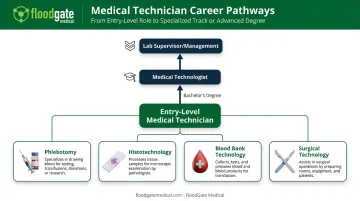
Each track has its own certification path and its own work environment. A histotechnician rarely sees a patient; a surgical technologist works in the OR every shift.
Advancing to Medical Technologist and Beyond
The clearest advancement route is earning a bachelor's degree and transitioning into a medical technologist role, which expands scope into complex manual testing and quality assurance. From there, experienced technologists often move into lab supervisor or laboratory management positions.
The occupation isn't growing fast, but it isn't shrinking either. The BLS projects combined employment for clinical laboratory technologists and technicians to grow 2% from 2024 to 2034, adding roughly 6,000 jobs.
About 22,600 openings are expected annually once retirements and turnover are factored in. Replacement demand, in other words, dwarfs net growth, meaning steady hiring activity even in a slow-growth field.
As MedTech innovation accelerates the need for skilled, diverse lab talent, specialized recruiters like FloodGate Medical step in to help. They connect qualified technicians with leading MedTech and healthcare device companies through a DEI-driven hiring approach built to support long-term career growth, not just a single placement.
Medical Technician Salary Overview
Salary data for this role gets complicated because the BLS reports technicians and technologists together. That combined median landed at $61,890 in May 2024, but that figure skews upward due to higher-paid technologist salaries mixed into the average.
For a more technician-specific number, the 2023 ASCP wage survey found staff-level MLTs averaging $27.74 per hour, roughly $57,700 annually at full-time hours.
What Drives Pay Differences
Several factors move technician pay up or down:
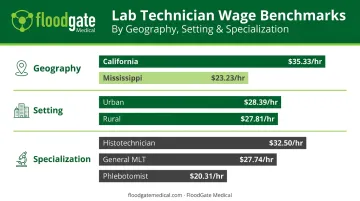
- Geography: the same survey showed California staff MLTs averaging $35.33/hour versus $23.23/hour in Mississippi
- Setting type: urban labs averaged $28.39/hour compared to $27.81/hour in rural settings
- Experience and tenure: pay increased consistently with longer time in the role
- Specialization: histotechnicians averaged $32.50/hour, outpacing general MLTs at $27.74/hour and phlebotomists at $20.31/hour
For context beyond the core MLT role, surgical technologists reported a separate BLS median of $62,830 in 2024 — a related but distinct occupation, not a direct comparison to lab-based technician pay.
Within the lab-specific data, histotechnology continues to command the highest pay among core technician tracks. Certification's wage premium wasn't measurable in the ASCP survey, since too few respondents lacked credentials to make a fair comparison.
If you're weighing an offer against these benchmarks, career coaching through firms like FloodGate Medical can help translate the data into a realistic negotiation strategy.
Frequently Asked Questions
What are the responsibilities of a medical technician?
Medical technicians collect and prepare specimens, run laboratory tests, operate and calibrate lab equipment, and document results in laboratory information systems for physician review.
What skills do you need to be a medical technician?
You need strong attention to detail, analytical thinking, technical comfort with lab instruments, and clear communication skills for relaying results to physicians under time pressure.
Which medical technician role is highest paid?
Among core lab technician tracks, histotechnicians tend to earn the most, averaging $32.50/hour versus $27.74/hour for general medical laboratory technicians (MLTs). Pay still varies by location, employer, and experience.
What is the difference between a medical technician and a medical technologist?
Technicians typically hold an associate degree and perform routine, often automated testing. Technologists hold a bachelor's degree and handle more complex manual testing plus quality-assurance duties.
How long does it take to become a medical technician?
Certificate programs can take under a year, while associate degree programs typically run two years. Add a few months for certification exam prep and scheduling after graduation.
Do medical technicians need certification to work?
Certification isn't universally required by law, but many employers prefer or require it, and some states mandate separate licensure regardless of national certification status.