
Introduction
Becoming a doctor is one of the longest professional commitments in the United States. Most physicians spend 11 to 16 years in training, from the first day of a bachelor's degree to the last day of residency, before they see a patient without supervision.
That timeline confuses a lot of aspiring students. Specialty choice, accelerated programs, gap years, and residency length all shift the finish line in different directions, so "how long does it take" rarely has a one-size-fits-all answer.
This article breaks the path down stage by stage: undergrad, medical school, residency, and fellowship. It also covers what speeds the process up, what slows it down, and which faster healthcare careers are worth a look if the traditional physician track isn't the right fit.
Key Takeaways
- Standard path to becoming a physician: ~11 years (4 undergrad + 4 med school + 3+ residency)
- Combined BS/MD programs can compress that to 6-7 years for highly competitive applicants
- Residency length ranges 3-7 years by specialty; fellowships add 1-3 more
- Starting medical school at 30 or 40 is increasingly common and doesn't extend the training itself
- Physician Assistant and MedTech careers offer faster entry into healthcare for those exploring alternatives
What Does a Doctor Actually Do?
Physicians diagnose illness, order and interpret diagnostic tests, build treatment plans, and prescribe medication. That's the core job description, but it barely scratches the surface of daily practice.
The scope of the role is massive. As of 2024, the United States counted 1,032,365 active physicians, including roughly 866,460 who provide direct patient care, according to AAMC's 2025 workforce report.
Beyond one-on-one patient visits, physicians typically:
- Collaborate with specialists, nurses, and allied health professionals on complex cases
- Deliver preventive care, including vaccinations and patient education
- Coordinate care transitions between hospital, outpatient, and rehab settings
Many doctors also take on research, teaching, or administrative leadership roles later in their careers. That breadth of responsibility is part of why the training pathway runs so long. Physicians need years of supervised practice before they're trusted to make independent, high-stakes decisions.
The Complete Timeline: From High School to Practicing Physician
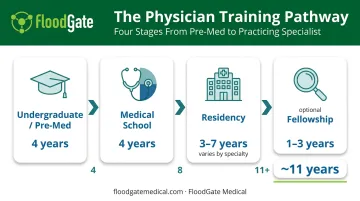
The traditional MD or DO path adds up to roughly 11 years after high school before a physician can practice independently. Here's how that breaks down, stage by stage.
Undergraduate / Pre-Med Education (4 Years)
Any major works for medical school admission, from biology to music. What matters is completing prerequisite coursework: biology, chemistry, physics, and math, typically including a year of organic chemistry.
Most students take the MCAT during junior year, which allows enough runway to apply and enroll immediately after graduation. Admissions committees also look for:
- Clinical volunteering or physician shadowing hours
- Research experience in a lab or clinical setting
- Leadership roles that show sustained commitment, not resume-padding
Medical School (4 Years)
Medical school splits into two phases. The first two years are preclinical, meaning classroom-based instruction in anatomy, physiology, pharmacology, and pathology. Students typically take USMLE Step 1 around the end of this phase.
Years three and four shift to clinical rotations across specialties like internal medicine, surgery, pediatrics, and psychiatry. USMLE Step 2 CK usually falls during this stretch. Most students finish medical school and enter residency in their mid-to-late twenties, depending on when they started college.
Residency (3-7 Years, Depending on Specialty)
Residency length is the single biggest variable in the entire timeline. Here's how it breaks down by specialty, based on current ACGME program requirements:
| Specialty | Residency Length |
|---|---|
| Family Medicine | 3 years |
| Internal Medicine | 3 years |
| Pediatrics | 3 years |
| Emergency Medicine | 3-4 years |
| General Surgery | 5 years |
| Neurological Surgery | 7 years |
Residents earn a salary during training, though it's modest compared to attending physician pay.
The 2025 AAMC survey of resident stipends put the average first-year (PGY-1) stipend at $68,166 nationwide, with small increases each subsequent year plus benefits like health insurance and loan assistance.
Fellowship (Optional, 1-3 Additional Years)
Fellowship isn't required for general practice. It's only necessary for physicians pursuing a narrow subspecialty, such as cardiology, oncology, or sports medicine.
These programs typically run 1 to 3 years after residency and require passing additional board certification exams. A cardiologist, for example, adds about three more years beyond internal medicine residency before practicing independently in that subspecialty.
Factors That Can Shorten or Extend Your Timeline
Not every future physician follows the exact 11-year script. Several factors push the timeline in either direction.
Accelerated BS/MD programs compress undergrad and medical school into 6-7 years total by combining the two into one continuous track. AAMC's current list of combined baccalaureate-MD programs includes options ranging from 6 to 9 years, though seats are extremely limited and competition is fierce. Residency still follows afterward.
Other timeline shifters include:
- Gap years: Common enough that they're now closer to the norm than the exception, often used for research, work, or MCAT preparation
- Part-time or non-traditional study: Balancing work or family responsibilities can stretch undergrad or medical school beyond the standard four years
- Specialty choice: Choosing primary care versus a surgical subspecialty is the biggest lever on total residency plus fellowship length
- Starting age: Training length stays fixed regardless of age, so a 35-year-old follows the same four-year curriculum and residency path as a 22-year-old
Career-changers considering medicine later in life shouldn't view age as a disqualifier. Medical schools increasingly value the maturity, communication skills, and real-world perspective older applicants bring to patient care.
MD vs DO: Two Physician Paths, One Timeline
MD and DO physicians both practice medicine, prescribe treatment, and perform procedures. The difference is philosophical and technical rather than a matter of speed.
MDs practice allopathic medicine, focused on diagnosing and treating disease through conventional clinical methods. DOs receive the same core medical training plus additional coursework in osteopathic manipulative treatment (OMT), a hands-on approach that emphasizes the musculoskeletal system and whole-person care.
| Factor | MD | DO |
|---|---|---|
| Medical school length | 4 years | 4 years |
| Licensing exam | USMLE | COMLEX-USA |
| Distinctive training | Standard allopathic curriculum | Adds OMT training |
| Residency | Required, same Match process | Required, same Match process |
Both paths require licensing exams, four years of medical school, and residency training. The choice between MD and DO affects a physician's philosophy and hands-on techniques rather than the total time required to practice.
Faster Alternatives: Allied Health & MedTech Career Paths
Not everyone wants to spend a decade-plus in training before starting a career. Fortunately, healthcare offers plenty of faster entry points.
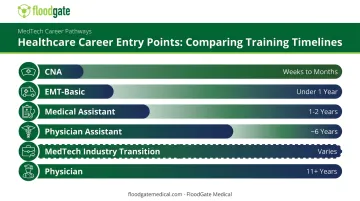
Entry-level clinical roles can start within weeks to months:
- Certified Nursing Assistant (CNA): a few weeks to a few months, depending on the state program
- EMT-Basic: typically under one year
- Medical Assistant: usually 1-2 years via certificate or associate degree
Physician Assistant (PA) is a middle-ground option for those who want serious clinical responsibility without a decade of training. The typical path runs about 6 years total: a bachelor's degree plus roughly 27 months of PA-specific graduate education. PAs diagnose conditions, order tests, and prescribe medication, often working closely alongside physicians.
MedTech industry careers offer a third route for science-minded professionals who want healthcare impact without the clinical training marathon. Roles in clinical affairs, medical science liaison work, R&D, and sales let nurses, PAs, scientists, and other clinicians apply their expertise in a commercial or research setting instead of at the bedside.
This is where FloodGate Medical comes in. The firm connects healthcare and life sciences professionals, including nurses, PAs, and bench scientists exploring a pivot, with MedTech companies through a recruitment approach built around diversity, equity, and inclusion.
For clinicians who've decided the traditional physician path isn't the right fit, resources like a dedicated Breaking Into MedTech guide and career coaching through FloodGate Futures can help map out what a transition looks like.
If the eleven-year physician road doesn't match your goals, allied health and MedTech careers offer equally meaningful ways to shape patient outcomes, just on a faster timeline.
Frequently Asked Questions
What is the typical timeline to become a doctor?
The standard path takes about 11 years after high school: 4 years of undergrad, 4 years of medical school, and a minimum 3-year residency. Surgical specialties extend that further.
What is the quickest medical career to enter?
Entry-level roles like CNA or EMT can be started within weeks to months of training. That's a stark contrast to the decade-long physician pathway.
Is 40 too late to start a medical career?
No. Medical schools increasingly value the maturity and life experience older applicants bring, and training length is the same regardless of starting age.
Can I become a doctor by age 30?
It's possible if you start undergrad at 18 and choose a specialty with a 3-4 year residency, like family medicine. That path makes independent practice by 29-30 realistic.
How long is medical school?
Medical school runs 4 years for both MD and DO students: two preclinical years focused on classroom science, followed by two years of clinical rotations.
Do medical residents get paid during training?
Yes. Residents earn a modest salary that increases slightly each training year, plus benefits like health insurance. First-year stipends averaged $68,166 nationally in 2025.