

This career translates patient records into the codes that keep hospitals paid and healthcare data accurate, and it's one of the most accessible entry points into the industry. No medical degree. No four-year commitment before you can start earning. Just certification, focus, and a willingness to learn a highly specific skill set.
This article covers what medical coders actually do, current job outlook data, realistic salary ranges, and the career paths available once you're certified, including a lesser-known route into the MedTech industry. By the end, you'll know whether this path fits you.
Key Takeaways
- Medical coding jobs are growing faster than average, driven by an aging population.
- Certification, not a medical degree, is the standard entry ticket into this field.
- Pay climbs steadily with credentials, specialization, and years on the job.
- Advancement stretches beyond hospitals into auditing, compliance, and MedTech companies.
What Is Medical Coding? (Role, Setting, and Core Skills)
The Role and Where Coders Work
Medical coding means converting a patient's diagnosis, treatment, and procedures into standardized codes, specifically ICD-10, CPT, and HCPCS. These codes drive insurance billing, reimbursement, and the data that health systems rely on to track outcomes and costs.
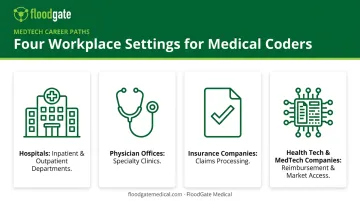
Coders show up in more places than you might expect:
- Hospitals — inpatient and outpatient departments
- Physician offices and specialty clinics
- Insurance companies processing claims
- **Health tech and MedTech companies** that need coding-savvy staff for reimbursement and market access work
That last category is growing. As device makers navigate Medicare coverage rules, they increasingly need people who actually understand how codes work.
Skills and Qualifications Needed
Here's the part that surprises most newcomers: you don't need a medical degree. Entry runs through certification programs like the CPC (Certified Professional Coder), CCA (Certified Coding Associate), or RHIT (Registered Health Information Technician). These cover medical terminology, anatomy, and the coding systems themselves, not clinical practice.
Beyond the certification, successful coders tend to share a few traits:
- Comfort with EHR and coding software platforms
- Sharp attention to detail (a single wrong digit can trigger a claim denial)
- Analytical thinking to interpret physician documentation
- Strong organizational habits for managing caseloads and deadlines
Medical Coding Career Outlook: Growth and Demand
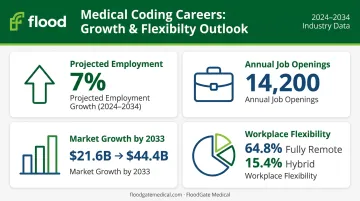
The numbers back up the hype. The Bureau of Labor Statistics projects medical records specialists, the occupational category covering coders, will grow 7% between 2024 and 2034, more than double the 3% average for all U.S. occupations. That translates to roughly 14,200 openings per year once you factor in replacement needs.
What's driving the demand?
- An aging population requiring more medical visits and procedures
- Growing billing and reimbursement complexity across payers
- Continued EHR adoption, which requires accurate, structured data entry
Industry projections tell a similar story. The U.S. medical coding market is valued at roughly $21.6 billion in 2025 and expected to reach $44.4 billion by 2033, a 9.6% compound annual growth rate. That's revenue, not job counts, but it signals long-term investment in this function.
Remote Work Has Widened the Field
Geography used to limit coding jobs to wherever hospitals were hiring locally. That's no longer true. AAPC's 2025 member survey found 64.8% of coders work fully remote, another 15.4% work hybrid, and just under 20% remain fully on-site. That's over 80% of coders with at least some remote flexibility, letting them pursue employers nationwide instead of settling for whatever openings exist nearby.
AI Is Reshaping the Coder's Role
Automation can now suggest codes from clinical notes, but it hasn't replaced the human role. AAPC's own analysis states plainly that AI will not replace medical coders — messy documentation, inconsistent EHR formats, and complex cases still require human judgment. Coders are shifting toward validation, audit, and compliance work rather than disappearing from the workforce, and those who build skills in these areas are best positioned for what comes next.
Salary and Earning Potential in Medical Coding
Let's talk numbers. The BLS reports a median annual salary of $50,250 as of May 2024, with the bottom 10% earning under $35,780 and the top 10% earning over $80,950.
AAPC's own 2025 salary survey, drawn from more than 20,000 coder respondents, puts the average income at $65,007, a helpful reminder that certified, AAPC-affiliated coders often out-earn the broader occupational average.
Income climbs steadily with time in the field:
| Experience Level | Average Salary (2025) |
|---|---|
| 0-1 years | $45,377 |
| 5-9 years | $59,144 |
| 10-15 years | $67,331 |
| 31+ years | $80,479 |
Which Coding Job Pays the Most?
Not all coding roles pay equally. Specialty certifications correlate with noticeably higher pay:
- CPMA (coding audit): $81,287 average
- CIC (inpatient/DRG coding): $77,511 average
- CRC (risk adjustment/HCC coding): $74,943 average
- CPC (general professional coding): $66,415 average
Stacking credentials pays off too. Coders holding three or more AAPC certifications average $81,227, compared to $67,260 for those with just one.
Setting matters as well. Health systems ($68,290 average) and hospital inpatient roles ($66,048) tend to outpace solo practice settings ($57,797). Region plays a role too: Pacific-region coders average $74,409, versus $59,046 in the East South Central states.
Career Advancement and Specialization Opportunities
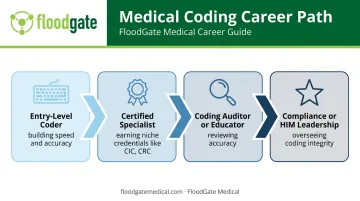
Most coders don't stay in an entry-level seat forever. A typical trajectory looks something like this:
- Entry-level coder — building speed and accuracy on general claims
- Certified specialist — earning niche credentials (CIC, CRC, CCC, COSC)
- Coding auditor or educator — reviewing accuracy and training junior staff
- **Compliance or HIM leadership** — overseeing coding integrity across a department
Specialty certifications open doors that general coding credentials don't. A coder with a CRC (risk adjustment) or CIC (inpatient) credential often qualifies for higher-paying, more specialized roles than someone holding only a foundational CPC.
The MedTech Pathway Most Coders Overlook
Here's a career move fewer coders consider: medical device and health technology companies need coding and reimbursement expertise too. CMS maintains dedicated guidance for MedTech companies on coding, coverage, and payment, and companies bringing new devices to market need people who understand how ICD-10-PCS and HCPCS codes translate into actual reimbursement.
That knowledge is directly transferable to roles supporting market access, provider billing education, and reimbursement strategy inside device manufacturers.
This is where FloodGate Medical comes in. As a recruitment firm focused exclusively on the MedTech industry, FloodGate Medical connects experienced healthcare professionals, including those with coding and reimbursement backgrounds, with growth opportunities inside device and health technology companies. It's a path many coders never realize exists until they're already deep into a hospital-based career.
Staying plugged into industry resources helps here. Professional associations and specialty-focused recruiter newsletters surface these cross-industry openings before they hit mainstream job boards.
Advancement also hinges on continuing education, not just initial certification. AAPC certifications require 36 CEUs every two years (more for multiple credentials), while AHIMA's CCA and RHIT each require 20 CEUs per two-year cycle. Skip this, and coders stay certified in name only, not competitive in the field.
Is Medical Coding the Right Career for You?
The upsides are real: strong job security, remote and flexible work options, faster entry than any clinical role, and a clear certification-based path to higher pay. If you want healthcare industry stability without years of clinical school, this is one of the most direct routes in.
That said, it's not effortless. Consider the trade-offs:
- Repetitive daily tasks: coding claims all day isn't for everyone
- High accuracy demands — one wrong code can trigger a denial or audit flag
- Constant learning curve: CPT updates annually, while ICD-10-CM and HCPCS update quarterly
Quick self-check — this career tends to fit people who:
- Feel comfortable spending most of the day at a computer
- Notice small details others miss
- Can work independently with minimal supervision
- Don't mind following strict rules and documentation standards
If that sounds like you, medical coding offers a solid entry point into healthcare, one that can eventually lead well beyond the billing department.
Frequently Asked Questions
Is medical coding a good career?
Yes, for the right person. It offers strong job stability, flexible and remote work options, and a clear certification-based path to higher pay. It suits detail-oriented people who prefer non-clinical, desk-based work.
Which medical coding job pays the most?
Specialty roles tend to pay best, including coding auditors (CPMA), inpatient/DRG coders (CIC), and risk adjustment coders (CRC). Certification level and years of experience are the biggest pay drivers.
Can I be a medical coder without a medical degree?
No medical degree is required. Entry runs through certification programs like CPC or CCA, which cover medical terminology, anatomy, and coding systems rather than clinical training.
What is the job outlook for medical coders in the coming years?
The BLS projects 7% employment growth for this occupational category through 2034, well above the 3% average across all jobs. Demand is driven by an aging population and expanding billing complexity.
Is medical coding a stressful job?
It can be, mainly due to accuracy pressure and frequent regulatory updates. However, flexible schedules and widespread remote work options help offset that stress for many coders.
Can medical coders work remotely?
Remote work is common, especially for certified and experienced coders. AAPC survey data shows over 80% of coders have at least some remote flexibility, though some employers require initial onsite training.