![Medical Secretary Job Description [Updated for 2026]](https://file-host.link/website/floodgatemedical-yc9tym/assets/blog-images/ffc7c265-22d6-4d39-95d7-59dd45a456e3/1785145414676453_53d552d20c524f7f901d8b062c4fe371/360.webp)
The numbers show why this role matters more than ever. The Bureau of Labor Statistics projects employment for medical secretaries and administrative assistants to climb from 850,000 workers in 2024 to 885,300 by 2034 — a 4.2% increase representing 35,300 new positions nationwide.
Yet many job postings still read like they were written in 2015. They skip EHR proficiency, remote check-in coordination, and updated compliance expectations that define the role today.
This guide covers the role definition, a ready-to-use job description template, core duties, must-have skills, current salary benchmarks, and practical hiring tips for 2026.
Key Takeaways
- Medical secretary employment is projected to grow 4.2% through 2034, adding 35,300 jobs
- The 2025 national median pay sits at $45,930 per year ($22.08/hour)
- A high school diploma is standard, though CMAA certification adds a competitive edge
- Core duties span scheduling, records, patient check-in, billing, and general office support
- Facility type and location affect both pay and job responsibilities
What Is a Medical Secretary?
A medical secretary performs specialized administrative and clerical work using knowledge of medical terminology and office procedures, according to the official O*NET occupational profile. Job postings frequently use interchangeable titles, including:
- Medical Administrative Assistant
- Medical Office Assistant
- Medical Receptionist
- Clinic Office Assistant
- Unit Clerk or Ward Clerk
About 90% of medical secretaries work in health care and social assistance settings, spanning physician offices, hospitals, dental practices, and outpatient centers. Work environment shapes daily duties significantly, based on U.S. Bureau of Labor Statistics wage and employment data:
| Work Setting | Employment | Annual Mean Wage |
|---|---|---|
| Physician offices | 241,900 | $41,440 |
| General medical/surgical hospitals | 173,500 | $44,840 |
| Dental offices | 91,570 | $46,500 |
| Outpatient care centers | 49,990 | $46,930 |
A hospital-based secretary might rotate shifts and coordinate across departments. A private practice hire often wears more hats, handling everything from front-desk check-in to basic bookkeeping.

Medical Secretary vs. Medical Assistant
These titles get confused constantly, but the distinction matters for hiring accuracy.
| Dimension | Medical Secretary | Medical Assistant |
|---|---|---|
| Primary focus | Administrative and clerical work | Administrative + clinical support |
| Patient contact | High (scheduling, check-in, billing) | Limited, task-specific (vitals, prep) |
| Typical duties | Charts, billing, correspondence, calendars | Vitals, specimens, injections where permitted |
If your posting mentions taking vital signs or assisting with exams, you're describing a Medical Assistant role, not a Medical Secretary one. Mixing the two in a job ad is one of the fastest ways to attract mismatched applicants.
Medical Secretary Job Description Template [Ready to Post]
Copy and customize this framework for your job board listing.
Job Summary
We're seeking an organized, detail-oriented Medical Secretary to join our team. In this role, you'll serve as the administrative backbone of our practice, coordinating patient scheduling, managing medical records, and ensuring smooth communication between patients, providers, and insurance companies. As the first point of contact for many patients, a professional, welcoming demeanor is essential.
Key Responsibilities
- Schedule and confirm patient appointments, manage physician calendars, and send reminders
- Maintain and update EHR/EMR systems in compliance with HIPAA privacy standards
- Greet patients, verify insurance and demographic information, and manage check-in
- Process insurance claims, handle pre-authorizations, and collect patient payments
- Answer and route phone calls, manage correspondence, and prepare routine reports
- Order office supplies and coordinate with vendors as needed
Qualifications and Skills
- Proficiency with EHR platforms (Epic, eClinicalWorks, or similar)
- Working knowledge of medical terminology and insurance billing procedures
- Strong organizational skills and ability to multitask in a fast-paced environment
- Excellent written and verbal communication skills
- Discretion in handling sensitive patient information
Education and Experience Requirements
- High school diploma or GED required
- Associate degree or vocational certificate in medical administration preferred
- 1-2 years of prior medical office experience preferred
- CMAA certification a plus
Note: Adjust the work hours and benefits to match your facility, then tailor the call-to-action language to your audience. A hospital posting might emphasize shift flexibility; a small practice might highlight team culture instead.
Core Duties and Responsibilities of a Medical Secretary
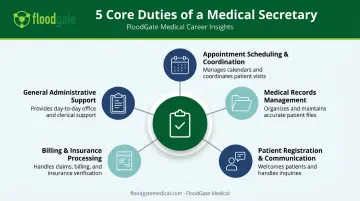
Daily responsibilities generally fall into five categories. Employers should tailor this list based on facility size and specialty.
Appointment scheduling and coordination Booking patient visits, sending reminders, and managing physician calendars to avoid overlaps or gaps often includes coordinating surgical bookings across multiple providers.
Medical records management Maintaining accurate EMR or paper files while following HIPAA guidelines includes updating charts without creating duplicate records, a common compliance pitfall.
Patient registration, check-in, and communication Verifying insurance and demographic details, answering patient questions, and managing the front-desk experience, often the first human interaction a patient has with the practice.
Billing and insurance processing Submitting claims, handling pre-authorizations, and collecting payments overlaps heavily with front-office financial operations.
General administrative support Managing correspondence, ordering supplies, and preparing reports for physicians or office managers.
A small clinic might combine all five categories into one role. A hospital department frequently splits these duties across multiple staff members, so scope the posting to match your actual operational structure.
Skills, Qualifications, and Education Requirements
Education Baseline
A high school diploma or GED remains the standard entry requirement. According to the U.S. Bureau of Labor Statistics, 90.2% of positions require a high school diploma, while 96.1% require on-the-job training. An associate degree or vocational certificate in medical administration is increasingly preferred for 2026 postings, particularly in competitive urban markets.
Skills to Look For
Hard skills employers prioritize include:
- EHR/EMR proficiency (Epic, MEDITECH, Dentrix, or similar platforms)
- Medical terminology knowledge
- Insurance claims and billing familiarity
- Microsoft Office and basic bookkeeping competency
Soft skills that separate strong hires from the rest:
- Organization and multitasking under pressure
- Clear written and verbal communication
- Discretion and patience with patients
- Customer service orientation
Certification and Experience
The NHA's Certified Medical Administrative Assistant (CMAA) credential signals job-readiness to employers. Candidates qualify through either a recent training program completed within five years, or 1-2 years of supervised field experience. The exam covers scheduling, billing, patient encounters, and compliance, giving employers a standardized way to verify competency without running their own assessment.
Entry-level candidates typically need little more than this credential or a training program. Experienced hires commonly bring 1-2 years in a medical office setting, which employers list as a preferred (not universal) requirement in most job postings.
Medical Secretary Salary Expectations for 2026
Pay varies by source, geography, and facility type, but the benchmarks below give employers a reliable starting point.
| Source | Annual | Hourly |
|---|---|---|
| O*NET (2025 BLS data) | $45,930 | $22.08 |
| Indeed (July 2026) | — | $21.44 |
| ZipRecruiter (July 2026) | $42,374 | $20.37 |
Factors that influence pay:
- Geographic location — Indeed's 2026 data shows city ranges from $22.76 to $26.42/hour in high-cost Massachusetts markets alone
- Years of experience — more tenure in medical-office settings commands higher offers
- Certification status — CMAA-credentialed candidates often stand out in salary negotiations
- Facility type — hospitals and outpatient centers ($44,840-$46,930 average) tend to pay more than physician offices ($41,440 average)
These variables compound, so employers who offer competitive pay and clear growth paths, including support for certification, consistently attract stronger applicants in a tightening administrative hiring market. A modest investment in exam fees or study time often pays for itself in reduced turnover.
How to Hire the Right Medical Secretary for Your Team
Structuring your interview process well separates candidates who look good on paper from those who thrive on the job.
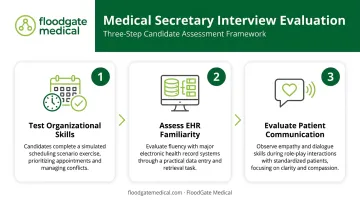
- Test organizational skills directly. Ask candidates to walk through how they'd handle a double-booked schedule or an urgent insurance denial. Their process reveals more than a resume ever will.
- Assess EHR familiarity with specifics. Don't just ask "have you used an EHR?" Ask which platform, how they handled a documentation error, and how they avoided duplicate records.
- Evaluate patient-facing communication. Role-play a difficult check-in scenario, such as a patient upset about a billing surprise, and watch how the candidate balances empathy with policy.
Cultural fit matters just as much as technical skill for a role this patient-facing. FloodGate Medical's DEI-driven recruitment approach helps healthcare and MedTech organizations build administrative and support staff that reflect the patients and communities they serve. That focus goes beyond technical skills alone.
If you're building out broader clinical, commercial, or administrative teams across your MedTech organization, FloodGate Medical can help. Its recruitment expertise spans clinical affairs, regulatory, and operations roles beyond the front desk.
Frequently Asked Questions
Do I need a degree to be a medical secretary?
No. A high school diploma or GED is the minimum requirement. An associate degree or vocational certificate can improve job prospects and starting pay, but it's not mandatory for most entry-level positions.
How long does it take to become a medical secretary?
Most candidates enter the field within a few weeks to a few months through a training or certification program. A multi-year degree isn't necessary for entry-level roles.
What are the duties of a medical secretary?
Core responsibilities include appointment scheduling, medical records management, patient registration and communication, billing and insurance processing, and general administrative support.
What is the difference between a medical secretary and a medical assistant?
Medical secretaries handle administrative and clerical work with heavy patient interaction. Medical assistants provide clinical support, such as taking vitals, with more limited patient-facing time.
What certification should a medical secretary get?
The NHA's Certified Medical Administrative Assistant (CMAA) credential is the most widely recognized option. It validates scheduling, billing, and compliance knowledge, helping candidates stand out in a competitive hiring market.
Is medical secretary a good career choice in 2026?
Yes. The field offers steady projected growth of 4.2% through 2034, accessible entry requirements, and clear paths to advancement through certification and experience in specialized medical settings.
![Medical Scheduler Job Description [Updated for 2026]](https://file-host.link/website/floodgatemedical-yc9tym/assets/blog-images/692cc1a1-aabe-486c-8c34-f627625d633f/1785145458154350_2bcaf2d1c39c43d58f2b1428a008affc/1080.webp)
![Medical Practice Manager Job Description [Updated for 2026]](https://file-host.link/website/floodgatemedical-yc9tym/assets/blog-images/aaa27d1a-a01c-4fb8-b5f3-41b7461ce7f8/1785145357693488_9e5775b277a243ac90b133a686093465/1080.webp)