Introduction
Every time a physician sees a patient and the practice bills insurance for that visit, someone has already done the invisible work of confirming that provider is legally allowed to practice and get paid. That's a medical credentialing specialist.
These professionals rarely get recognition, but hospitals, group practices, telehealth startups, and health tech companies can't scale their provider networks without them. One missed license renewal or incomplete application can delay revenue for months.
Demand for this career is climbing fast: the U.S. Bureau of Labor Statistics projects 8% growth in health information roles through 2032, well above the average for all occupations. As telehealth platforms and MedTech companies build out clinical networks, they need people who understand payer enrollment, primary source verification, and compliance documentation.
This guide covers what the job involves, the education and experience needed, the certifications worth pursuing, and what you can expect to earn.
Key Takeaways
- A high school diploma plus 2+ years of experience can replace a formal degree.
- NAMSS certification (CPCS/CPMSM) isn't required but boosts pay and advancement.
- Attention to detail beats credentials: errors delay claims and privileges.
- CAQH, PECOS, and NPDB fluency is now a baseline job requirement.
What Does a Medical Credentialing Specialist Do?
A medical credentialing specialist verifies that healthcare providers hold the licenses, certifications, education, and clean work history they claim to have. This isn't a formality. It's how hospitals and insurers confirm a provider meets regulatory and payer standards before they ever treat a patient.
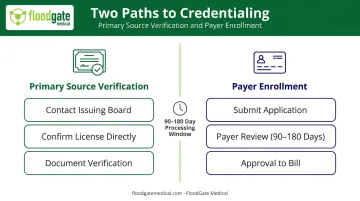
The job splits into two distinct workflows:
- Primary source verification (PSV): Confirming a credential directly with the issuing entity, such as a medical board or residency program, rather than trusting a copy of the document.
- Payer enrollment: Submitting applications so an already-credentialed provider can bill insurance companies as an in-network provider.
Daily Responsibilities
On a typical day, a specialist might process a batch of initial credentialing applications in the morning, then pivot to a recredentialing cycle for providers whose three-year window is closing. Following up with payers is a constant task, since applications sit in queues and rarely move without a nudge.
Other recurring duties include:
- Maintaining accurate, audit-ready provider databases
- Tracking license and certification expiration dates
- Flagging discrepancies between submitted documents and verified sources
- Coordinating with medical staff offices, payers, and providers directly
Who hires for this role? Hospitals and group practices are the traditional employers, but the list has expanded. Credentialing agencies, telehealth companies, and MedTech organizations building clinician networks now recruit for this skill set too.
Here's why proactive follow-up isn't optional: MGMA reports that submission through verification and approval can take 90 to 180 days. Left unmanaged, that timeline stretches further and delays a provider's ability to bill.
How to Become a Medical Credentialing Specialist: Step-by-Step
There's no single accredited path into this career, but a clear pattern shows up across job postings and NAMSS resources. Here's how most people get there.
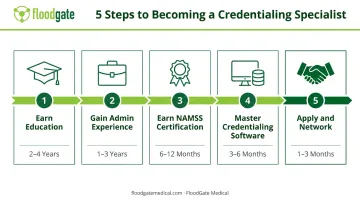
Step 1: Earn the Right Education
A bachelor's degree in healthcare administration, business, or a related field is commonly preferred. That said, employer requirements vary more than you'd expect.
Some hospital systems accept an associate's degree combined with relevant work history. Others, like certain regional health systems, only require a high school diploma plus a couple of years of administrative experience.
Coursework in medical terminology, health information systems, and database management gives you a real head start, regardless of which degree path you choose.
Step 2: Gain Hands-On Healthcare Admin Experience
Most people don't walk straight into a specialist title. They start in a medical office or admin role, often as a credentialing coordinator, and build experience handling documentation, data entry, and provider files.
Expect to spend 1-2 years in this kind of role before employers consider you ready for a specialist position. Some job postings request even more, up to 3-5 years, depending on the complexity of the organization.
Step 3: Earn a Professional Certification
Certification through NAMSS isn't mandatory everywhere, but it's increasingly listed as preferred or required. There are two credentials worth knowing:
| Credential | Employment requirement | Experience requirement | Best for |
|---|---|---|---|
| CPCS | 12 consecutive months within the last 24 months | 3 years within the last 5 years | Hands-on credentialing and PSV work |
| CPMSM | 12 consecutive months within the last 24 months | 5 years within the last 8 years | Medical services management and oversight |
Note that CPCS isn't an entry-level credential. According to NAMSS's 2026 candidate handbook, you need real experience under your belt before you're even eligible to sit for the exam.
Step 4: Master Credentialing Software and Industry Portals
Four systems come up constantly in job postings, and you'll want working familiarity with all of them:
- CAQH ProView: Where providers enter and attest to profile data, which plans then access
- PECOS: CMS's system for Medicare provider and supplier enrollment
- NPPES: The registry through which providers apply for and manage their NPI numbers
- NPDB: The federal repository of malpractice payments and adverse actions
Manual workflows are still surprisingly common. A 2024 Medallion survey of 347 organizations found that 52% reported relying entirely on manual credentialing processes. That's shifting as automation tools handle repetitive data entry, but specialists who understand both the manual process and the software layered on top of it stay more valuable.
Step 5: Apply, Network, and Keep Growing
Once you've built experience and, ideally, a certification, start applying directly for credentialing specialist roles. Joining NAMSS gives you access to continuing education, a career-focused job board, and a network of medical staff services professionals who know where openings exist before they're posted publicly.
Career coaching services, such as those offered through FloodGate Medical, can also help by turning hands-on credentialing experience into a polished resume and interview strategy for specialist-level roles.
There's no fixed timeline that applies to everyone. Some people combine an associate's degree with a few years of coordinator experience and move into a specialist role in under three years. Others take longer, particularly if they're pursuing a bachelor's degree alongside full-time work.
Skills That Set Top Credentialing Specialists Apart
Technical knowledge gets you in the door. These skills determine how far you go.
Attention to detail isn't negotiable. A single typo in a license number or a missed expiration date can lead to a denied claim or, worse, a provider losing admitting privileges mid-shift. This role has zero tolerance for shortcuts.
Precision alone won't carry you, though. Communication and diplomacy matter more than people expect. You'll spend a good chunk of your week on the phone or in email threads with:
- Providers who are frustrated that their application is stuck
- Payer representatives who need clarification on submitted documents
- Healthcare executives who want status updates without the technical jargon
Being able to translate credentialing bureaucracy into plain language for each audience is a skill that develops with time, not something you learn in a course.
Beyond people skills, technology is reshaping the job itself. Tech adaptability is now essential. As AI-powered credentialing platforms automate document extraction and flag inconsistencies, specialists who can work alongside these tools, rather than resist them, move up faster. The role is shifting from pure data entry toward oversight and exception handling.
Essential Tools and Technology to Know
Beyond the core government portals covered in Step 4, day-to-day work runs through a mix of specialized software.
Credentialing management platforms centralize provider documentation, automate expiration reminders, and run exclusion checks against federal databases. These systems are what make recredentialing cycles manageable at scale, especially for organizations tracking hundreds of providers.
Industry portals you'll navigate regularly include:
- CAQH for provider data attestation
- NPDB for malpractice and adverse action history
- Payer-specific enrollment systems, which vary by insurer and rarely talk to each other
EHR and document management systems round out the toolkit. These keep compliance records audit-ready, which matters during accreditation reviews or payer audits. If your documentation isn't organized and retrievable on demand, you're exposed.
Salary Expectations and Career Growth Opportunities
Pay varies widely depending on the source, your certification status, and where you're located.
| Role/Source | Reported Pay |
|---|---|
| Credentialing Specialist (PayScale) | $38,000-$64,000 total pay |
| Credentialing Specialist (Glassdoor) | $59,294 average; up to $86,289 at the 90th percentile |
| Medical Staff Credentialing Specialist III (Salary.com) | $53,239 average |
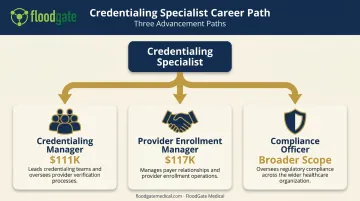
| Credentialing Manager (Salary.com) | $111,457 average |
| Provider Enrollment Manager (Salary.com) | $117,000 average |
| Credentialing Director (NAMSS Gateway) | $163,039 average |
Location matters too. Salary.com data shows a specialist role in Mississippi averaging $41,083, well below the national figure for the same title.
Career advancement typically flows in one of three directions:
- Credentialing Manager – overseeing a team and setting process standards
- Provider Enrollment Manager – focusing specifically on payer relationships and enrollment strategy
- Compliance Officer – broadening scope beyond credentialing into full regulatory compliance
Beyond these traditional paths, MedTech and health tech companies are building out their own provider networks to support telehealth and remote monitoring programs, and credentialing expertise is showing up in job postings outside traditional hospital settings. If you're exploring where that expertise might lead within the broader medical technology industry, FloodGate Medical's 2026 MedTech Compensation Guide breaks down pay benchmarks across adjacent roles. Their monthly newsletter also tracks open positions and industry shifts worth watching.
Frequently Asked Questions
What does a medical credentialing specialist do?
They verify a healthcare provider's licenses, certifications, education, and work history, then manage payer enrollment so the provider can legally practice and bill insurance companies as an in-network provider.
Is certification required to become a credentialing specialist?
No, but it's strongly recommended. NAMSS's CPCS and CPMSM credentials are industry-standard and often listed as preferred, sometimes required, in job postings.
How long does it take to become a credentialing specialist?
There's no fixed timeline. Combining a degree with hands-on experience often takes several years, though an associate's degree plus 2-3 years of relevant admin work can get you there faster.
Can you become a credentialing specialist without a college degree?
Yes, in many cases. Some employers accept a high school diploma paired with relevant medical office or administrative experience instead of a formal degree.
What's the difference between a Credentialing Specialist and a Credentialing Coordinator?
The difference is mostly seniority and scope. Specialists typically bring more years of experience and often hold certification, while coordinators are earlier in the career path.
What is the average salary for a medical credentialing specialist?
Reported averages range from roughly $46,000 to $64,000 depending on the source and experience level. Certification and location are the two biggest factors driving pay differences.