With that many openings, clinics are also fielding stacks of similarly credentialed applicants. A CMA or RMA credential gets you through the door. It doesn't get you the interview.
Here's the common mistake: many applicants either skip the cover letter entirely or send a generic one they've reused a dozen times. Hiring managers notice immediately. This guide covers the exact structure to use, a fill-in-the-blank template, three real-world examples, and the mistakes that quietly sink otherwise strong applications.
Key Takeaways
- Keep your letter to one page and tailor it to the specific clinic and role.
- Pair your certification with one measurable achievement, not a list of duties.
- Mirror job-posting keywords to pass ATS screening and grab a recruiter's attention.
- Address the hiring manager by name whenever possible — it signals genuine interest.
- Skip vague phrases like "hard worker" and let numbers make you memorable.
How to Structure a Winning Medical Assistant Cover Letter
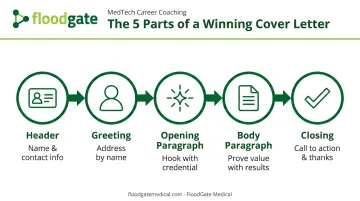
Every strong cover letter follows the same five-part skeleton: header, greeting, opening, body, and closing. Get these right and the content practically writes itself.
Header & Professional Greeting
Your header needs your name, phone number, email, and city/state — no full street address required. Skip "To Whom It May Concern." It reads as lazy and dated.
Instead:
- Check the clinic's "Our Team" or "Staff" page for the office manager or hiring supervisor's name
- Search LinkedIn for the practice and filter by role (office manager, clinical director)
- If you truly can't find a name, use "Dear Hiring Manager," which is still more professional than a generic salutation
Opening Paragraph That Grabs Attention
Your first two sentences should state the position you're applying for, your certification or years of experience, and one standout qualification. That's it. Don't bury the lede.
Don't: "I am writing to apply for the medical assistant position I saw online. I am a hard worker and fast learner."
Do: "As a Certified Medical Assistant (CMA) with two years of cardiology clinic experience, I'm excited to apply for the Medical Assistant role at Lakeview Family Health, where I can bring my EKG and patient intake expertise to your growing team."
The second version names the credential, the specialty, and the clinic. The first says nothing.
Body Paragraphs: Proving Your Clinical & Administrative Value
This is where most letters fall flat: they restate the resume instead of adding context. Use the STAR method (Situation, Task, Action, Result) to walk through one specific achievement rather than listing job duties.
For example: "When our front desk fell behind during flu season, I restructured the intake checklist, cutting average wait times from 22 minutes to 12."
Tailoring pays off. In a large-scale test of over 7,000 job applications, ResumeGo found that tailored cover letters generated 53% more interview invitations than applications with no cover letter at all. Generic letters won't get you that lift. Specificity will.
Also mirror language directly from the posting. If the listing mentions phlebotomy, EKGs, or EHR charting, use those exact terms (only if you actually have the experience).
Closing Paragraph & Call to Action
End with three things:
- Genuine enthusiasm for that specific role or clinic
- Your availability for an interview
- A professional sign-off ("Sincerely" or "Best regards")
Keep it to two or three sentences. This isn't the place to repeat your qualifications again.
Medical Assistant Cover Letter Template
Copy this template and fill in the brackets. Adjust the tone based on your experience level.
[Your Name]
[Phone Number] | [Email Address] | [City, State]

[Date]

[Hiring Manager's Name]
[Clinic/Employer Name]

Dear [Hiring Manager's Name / "Hiring Manager"],

As a [certification, such as CMA (AAMA)] with [X years of experience / recent graduate of X program], I'm excited to apply for the Medical Assistant position at [Clinic Name]. [One sentence on your standout qualification or specialty area.]

In my [previous role / clinical externship] at [Employer/Facility], I [specific achievement using STAR method, with a number if possible, such as "streamlined patient check-in, reducing average wait times by 30%"]. I'm skilled in [2-3 keywords pulled directly from the job posting, such as EKG administration, phlebotomy, EHR charting, or patient scheduling], which aligns directly with what you're looking for in this role.

I'd welcome the chance to bring this same attention to detail and patient care to [Clinic Name]. I'm available for an interview at your convenience and can be reached at [phone/email].

Sincerely,
[Your Name]
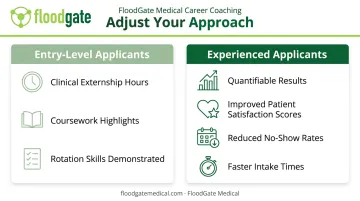
For entry-level applicants: swap the achievement paragraph for clinical externship hours, coursework, and a specific skill demonstrated during rotations.
For experienced applicants: lead with your strongest quantifiable result: improved patient satisfaction scores, reduced no-show rates, or faster intake times.
Whatever you fill in, match the exact phrasing from the job description. CareerOneStop and SHRM both converge on a similar length benchmark: keep the finished letter around 200-400 words across three to four short paragraphs (roughly one page).
Medical Assistant Cover Letter Examples
Three scenarios, three approaches. Use whichever matches your situation as a starting point, then personalize it.
Entry-Level Medical Assistant Cover Letter Example
Dear Ms. Alvarez,
As a newly certified Medical Assistant (CCMA) graduating from Riverside Community College's medical assisting program, I'm eager to apply for the Medical Assistant role at Pinewood Family Clinic. During my 160-hour clinical externship, I rotated through intake, phlebotomy, and EKG administration, gaining hands-on experience with high patient volumes.
At my externship site, I independently managed patient check-in for a physician seeing 25+ patients daily, keeping the schedule on track during two staff absences. My instructors consistently noted my calm demeanor with anxious patients and my accuracy in charting vitals.
I'd love to bring that same reliability to Pinewood Family Clinic. I'm available for an interview anytime this week.
Sincerely, Maria Chen
Experienced Medical Assistant Cover Letter Example
Dear Mr. Okafor,
As a Registered Medical Assistant (RMA) with four years of experience in high-volume family medicine, I'm excited to apply for the Medical Assistant position at Summit Health Partners. Your posting's emphasis on patient flow efficiency matches exactly what I've spent my career improving.
At Cedar Grove Medical Group, I redesigned our patient rooming process, which reduced average intake time from 18 minutes to 9 and helped raise our patient satisfaction scores by 15% over one year. I'm proficient in EKG administration, venipuncture, and Epic EHR charting, all listed in your job description.
I'd welcome the opportunity to bring these same results to Summit Health Partners. I'm available for an interview at your convenience.
Best regards, David Torres
Career-Change Medical Assistant Cover Letter Example
Dear Hiring Manager,
After three years as a Certified Nursing Assistant, I recently completed my Medical Assistant certification (CMA) to expand into a role that combines clinical and administrative work. I'm applying for the Medical Assistant position at Harborview Pediatrics, drawn to your clinic's focus on family-centered care.
As a CNA, I managed vitals, patient documentation, and family communication for a caseload of 12-15 patients per shift, skills that translate directly to medical assisting. My clinical externship added hands-on EKG and injection administration experience, rounding out the transition.
I'm confident my clinical background and administrative training make me a strong fit for Harborview. I'd welcome the chance to discuss this further.
Sincerely, Jasmine Reid
Common Mistakes to Avoid in Your Medical Assistant Cover Letter
Even qualified candidates undermine themselves with these errors:
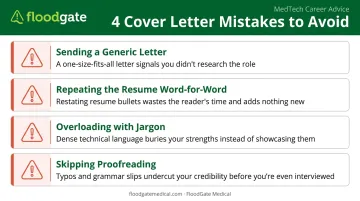
- Sending a generic letter. Reusing the same letter for every application is obvious to hiring managers — they can spot a template that never mentions their clinic by name.
- Repeating the resume word-for-word. Your cover letter should add context and personality, not summarize what's already listed. Explain the story behind one achievement instead.
- Overloading with jargon. Listing every procedure you've ever performed reads as a checklist, not a narrative. Pick the two or three most relevant to this specific posting.
- Skipping proofreading. A single typo can cost you the interview, and hiring managers notice.
This isn't an exaggeration: in a survey of over 300 U.S. senior hiring managers, 63% said one or two resume mistakes were enough to eliminate a candidate. A typo in a healthcare setting also raises quiet doubts about attention to detail with patients.
Read your letter out loud before sending it. Typos hide better on screen than in your own voice.
Take Your Healthcare Career Further with FloodGate Medical
Plenty of medical assistants use the role as a launchpad. After a few years of clinical experience, some pursue additional certifications like CCMA or RMA. Others start eyeing broader healthcare technology roles within MedTech companies, such as:
- Clinical deployment specialist
- Territory or account management
- Quality and regulatory affairs
That's the space FloodGate Medical works in. The firm connects healthcare talent with MedTech companies across commercial, clinical, and operational functions, using a recruitment approach built around equity, diversity, and inclusion.
If you're a medical assistant thinking beyond the clinic long-term, FloodGate Medical's monthly newsletter covers industry insights and career opportunities worth following as your experience grows. Their career resources and job-search guides are also worth exploring as you map out that transition.
Frequently Asked Questions
What is a good cover letter for a medical assistant?
A good letter is tailored to the specific employer, fits on one page, and pairs your certification with one specific, measurable achievement. It closes with clear enthusiasm for an interview rather than a generic sign-off.
What 5 things should a cover letter include?
A header with your contact details, a professional greeting, a strong opening paragraph, a body highlighting skills and one quantified achievement, and a closing call-to-action. Each part serves a distinct purpose.
How long should a medical assistant cover letter be?
Aim for one page, roughly 200-400 words across three to four short paragraphs. Anything longer risks losing the hiring manager's attention before they reach your strongest point.
Can I write a medical assistant cover letter with no experience?
Yes. Lead with your certification, then highlight clinical externship hours, coursework, and specific skills demonstrated during rotations. Genuine enthusiasm for the role can offset limited paid experience.
How do I address a hiring manager if I don't know their name?
Check the clinic's website or search LinkedIn for the office manager or hiring supervisor. If you still can't find a name, "Dear Hiring Manager" is a professional fallback — avoid "To Whom It May Concern."
What certifications should I mention in my cover letter?
List credentials you actually hold, such as CMA (AAMA), RMA (AMT), or CCMA (NHA), along with specialized skills like EKG or phlebotomy certification when relevant to the posting.