
That range trips up a lot of candidates. The U.S. Bureau of Labor Statistics projects 12% job growth for medical assistants through 2034, with over 112,300 openings expected annually — meaning competition for the good roles is real, even in a growing field.
This guide compiles 45 real-world medical assistant interview questions across every category you'll face, complete with answer frameworks and sample responses. We've also included tips for candidates prepping for interview day and for hiring managers building a fairer, more consistent interview process.
Key Takeaways
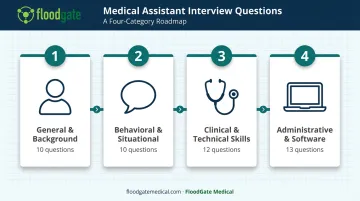
- Medical assistant interviews assess four areas: background, behavioral, clinical skills, and software competency
- The STAR method turns rambling answers into structured, memorable responses
- Employers get better hires by pairing technical screening with culture-fit and DEI-conscious evaluation
- Preparation and honesty separate strong candidates from equally qualified competitors
General & Background Interview Questions (Questions 1–10)
Consider this the "getting to know you" portion. Interviewers use these questions to gauge communication skills, motivation, and whether you'll mesh with the team — not to trip you up.
Personal Introduction & Motivation Questions
- Tell me about yourself. Keep it to education, certification, and relevant experience, not your life story.
- Why do you want to be a medical assistant? Tie your answer to a specific reason, not "I like helping people."
- Why do you want to work here? Reference something specific about the practice or organization.
- Why did you leave your last job? Stay factual and forward-looking; never badmouth a former employer.
- What are your career goals? Show ambition that aligns with growth opportunities the role offers.
Sample answer: "Tell me about yourself"
"I recently completed my Certified Medical Assistant program through a CAAHEP-accredited school, where I trained in phlebotomy, vitals, and EHR documentation. During my 160-hour internship at a family practice clinic, I assisted with over 200 patient visits and became comfortable managing a fast-paced front and back office. I'm looking for a role where I can keep building those clinical skills long-term."
Self-Assessment & Experience Questions
- What are your strengths? Pick one or two and back them with a quick example.
- What are your weaknesses? Choose something real, then show what you're doing about it.
- What's your favorite part of the job? Be specific: patient interaction, procedures, organization.
- What's your least favorite part of the job? Answer honestly, but pair it with how you manage it.
- Describe yourself in three words. Pick words you can support with evidence, not just adjectives.
Sample answer: "What are your weaknesses?"
"I used to get overwhelmed when the schedule ran behind. I've since started blocking extra buffer time for procedures that tend to run long, and I check in with the front desk mid-shift to flag delays early. It's made a noticeable difference in how smoothly my day flows."
Behavioral & Situational Interview Questions (Questions 11–20)
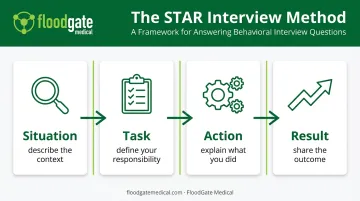
These questions predict how you'll actually behave on the job, not just what you know in theory. The STAR method (Situation, Task, Action, Result) is the best framework for structuring these answers. It keeps you concise and gives the interviewer a clear before-and-after.
Patient-Facing Scenario Questions
- How do you handle a scared or difficult patient? Describe your calming technique and communication style.
- How would you respond to an angry patient? Emphasize listening first, then problem-solving.
- How do you handle a language barrier? Mention interpreter services, translation apps, or visual aids.
- What would you do if you made a medical error? Stress immediate disclosure and following protocol.
- How do you manage a family conflict during a visit? Focus on staying neutral and involving the provider when needed.
Sample answer: needle-phobic patient (STAR format)
"Situation: A pediatric patient became extremely anxious before a blood draw. Task: I needed to complete the draw safely while keeping her calm. Action: I used distraction techniques, let her hold a comfort object, and talked her through each step in simple terms. Result: She stayed still enough for a smooth, single-attempt draw, and her mother thanked me for the patience I showed."
Patient interactions are only half the job. The next set of questions explores how you handle friction with colleagues and supervisors.
Teamwork & Workplace Conflict Questions
- How do you handle conflict with a coworker? Show you address issues directly and professionally.
- What if you disagreed with a provider's instructions? Emphasize respectful clarification, not confrontation.
- How do you handle stress during a busy shift? Name a specific coping strategy you actually use.
- How do you prioritize competing tasks? Mention triage logic — urgent patient needs come first.
- How do you respond to criticism? Show you can separate feedback from ego.
Sample answer: scheduling conflict with a coworker
"Situation: A coworker and I both requested the same day off during a short-staffed week. Task: We needed a fair resolution without escalating to our supervisor. Action: I suggested we split the day, covering half-shifts each. Result: We both got partial time off, and it became our go-to solution for future conflicts."
Clinical & Technical Skills Interview Questions (Questions 21–32)
This is where interviews get technical fast. Hiring managers want proof you can perform the hands-on duties the job actually requires, not just recite textbook definitions.
Core Clinical Competency Questions
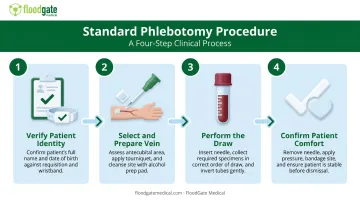
- Walk me through a blood draw. Mention technique, patient comfort, and safety checks.
- How do you take accurate vital signs? Reference proper equipment use and double-checking abnormal readings.
- What's your experience with EKGs? Note lead placement accuracy and reading basic rhythms.
- How do you prepare and administer injections? Cover dosage verification and injection site rotation.
- How do you maintain HIPAA compliance daily? Give a concrete example, like screen privacy or verbal discretion.
- How do you prevent patient safety errors? Mention double-checking charts and the "two-identifier" rule.
Sample answer: phlebotomy/blood draw question
"I'm certified through my CMA program, which included over 30 supervised blood draws. I always confirm patient identity with two identifiers, select the vein carefully, and follow up to make sure the patient feels okay before they leave. I've had zero failed draws in my last 50 attempts during my clinical rotation."
Specialized Clinical Knowledge Questions
- Have you worked in a specialty setting (pediatrics, OB-GYN)? Highlight any exposure, even brief.
- How do you handle medication administration questions from patients? Stress staying within scope and deferring to the provider.
- How do you manage specimen collection and labeling? Emphasize accuracy: mislabeling is a top error source.
- What's your infection control protocol? Reference PPE use and sanitation between patients.
- How would you respond to a medical emergency in the office? Mention CPR/BLS certification and calling for backup immediately.
- How do you document in an EHR accurately? Note real-time charting to avoid errors from delayed entry.
Staffing pressure makes cross-trained candidates more valuable than ever. According to MGMA's 2025 staffing report, 47% of practice leaders named medical assistants their hardest role to recruit — outpacing nurses, coders, and other practice staff. Practices dealing with that shortage increasingly favor MAs who can flex across specialties instead of one narrow role.
Administrative, Software & Career Interview Questions (Questions 33–45)
Clinical skills get you in the door, but the "other half" of the job (front-office and technology readiness) often decides who gets hired.
Administrative & Software Skills Questions
- How comfortable are you with computers? Mention specific software, not just "I'm tech-savvy."
- What EHR systems have you used? Name systems like Epic, Cerner, or PowerChart if applicable.
- What's your experience with medical billing or coding? Be honest about your level; note willingness to learn.
- Have you used scheduling software? Reference any platform, even a simple booking system.
- How do you handle phone etiquette with patients? Emphasize clarity, patience, and professionalism.
- What front-desk responsibilities have you managed? List check-in, insurance verification, and referrals.
Worth knowing: Microsoft Office and Epic Systems each appear in roughly 6% of medical assistant job postings, according to O*NET labor market data. That's a good reminder to brush up on both before your interview.
Career & Logistics Questions
- What are your salary expectations? Research local pay data first; give a range, not a single number.
- What shifts or hours can you work? Be upfront about availability constraints.
- Are you willing to relocate? Answer honestly based on the role's location.
- Do you plan to pursue continuing education? Show ambition toward certifications or specialties.
- Why should we hire you? Connect your certification, hands-on skills, and soft skills to their specific needs.
- Do you have any questions for us? Always have 2-3 ready.
- What questions should candidates ask? Ask about team structure, growth paths, and daily workflow.
Sample answer: "What is your expected salary?"
"Based on my research into local pay data for certified medical assistants in this area, I'm looking for a range between $38,000 and $44,000, depending on the full benefits package. I'm flexible and open to discussing what fits within your budget."
Interview Tips: For Candidates and Employers
Tips for Job Seekers
A little preparation goes a long way in a 30-minute interview:
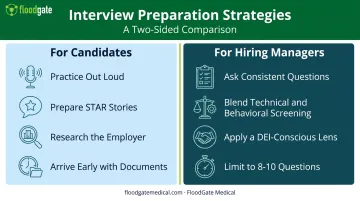
- Practice out loud with a friend or family member, not just in your head
- Write out STAR-formatted answers in advance for your top three work stories
- Research the employer: their specialties, patient volume, and recent news
- Arrive 10-15 minutes early, and bring resume copies plus certification documents
- Send a thank-you note within 24 hours of the interview
Prepare 2-3 thoughtful questions about team culture, growth opportunities, and how the clinical team is structured. It shows genuine interest, not just eagerness for an offer.
Tips for Hiring Managers
Consistency produces fairer, better hiring decisions:
- Ask the same core questions of every candidate for the same role
- Combine technical screening with behavioral and culture-fit questions
- Evaluate through a DEI-conscious lens to build stronger, more representative clinical teams
- Limit yourself to 8-10 well-chosen questions rather than an exhaustive list
Healthcare organizations often need to fill roles beyond entry-level clinical positions, including commercial, clinical affairs, and R&D functions. FloodGate Medical applies an equity- and diversity-driven methodology to connect MedTech employers with vetted talent in those areas. This makes it a useful complement to in-house hiring as your organization scales its broader clinical and device-adjacent teams.
Frequently Asked Questions
What are common medical assistant interview questions and answers?
Common questions span four categories: background ("Tell me about yourself"), behavioral scenarios, clinical skills (phlebotomy, vitals), and administrative topics (EHR software). See the categorized list above for full sample answers.
What are the 5 Cs of interviewing?
Recruiters commonly cite Competence, Confidence, Communication, Compatibility (culture fit), and Career direction. Demonstrate each by pairing concrete examples with clear, honest answers about your goals.
How many questions are typically asked in a medical assistant interview?
Most interviews cover 8 to 10 carefully chosen questions within a 30- to 60-minute session, though this varies by employer and role complexity.
How do I answer "why should we hire you" as a medical assistant?
Connect your certification, hands-on clinical experience, and soft skills directly to the employer's stated needs. Reference something specific from the job posting or your conversation.
What should I bring to a medical assistant interview?
Bring at least five resume copies, your certification documents, a reference list, and a notepad with prepared questions — ideally organized in a professional folder.
How can I stand out with no experience?
Emphasize your clinical rotation or internship hours, willingness to learn, and any transferable customer-service or teamwork skills from previous jobs. Confidence and honesty matter more than a long resume.