
But the path is long. Most radiologists spend 13 to 15 years in training after high school, moving through undergrad, medical school, licensing exams, residency, and often a fellowship. The steps aren't always clearly laid out in one place, which leaves a lot of pre-med students (and career-changers) confused about what's actually required versus optional.
This guide breaks down every stage of that journey, what it costs, what you'll earn, and where the career can take you after board certification.
Key Takeaways
- Radiology training spans 13-15 years after high school: bachelor's degree, medical school, and residency.
- Average radiology compensation reached $571,749 in 2025, according to Doximity's Physician Compensation Report.
- American Board of Radiology certification isn't legally required, but nearly every employer expects it.
- Radiologists increasingly move into medical technology and device companies, applying imaging expertise to non-clinical roles.
What Is a Radiologist? Role & Responsibilities
A radiologist is an MD or DO physician trained to use imaging technology, including X-ray, CT, MRI, ultrasound, and PET, to diagnose and sometimes treat disease. They don't just take pictures. They interpret them, correlate findings with a patient's history and lab work, and often recommend next steps in care.
Day-to-day, a radiologist's work typically includes:
- Interpreting diagnostic scans across multiple modalities and flagging abnormalities
- Consulting with referring physicians to clarify findings and guide treatment decisions
- Performing image-guided procedures, such as biopsies or catheter placements, in interventional subspecialties
Radiologist vs. Radiologic Technologist: The Key Difference
This distinction trips up a lot of people early in their research into radiology careers. A radiologic technologist operates equipment like CT scanners and MRI machines, positions patients correctly, and captures the images used for diagnosis. It's a skilled, certified role—achieved through the American Registry of Radiologic Technologists—but it doesn't require a medical degree.
A radiologist is the physician who reads and interprets those images to make a diagnosis. Technologists produce the picture; radiologists tell you what it means.
Step-by-Step Path: Radiologist Requirements & Education
Most of these steps aren't optional. They're set by medical licensing boards, accreditation bodies, and the American Board of Radiology (ABR), and skipping one simply isn't possible if you want to practice.
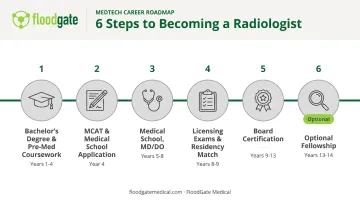
Step 1: Complete a Bachelor's Degree & Pre-Med Coursework
Most aspiring radiologists major in biology, chemistry, or a related science, though no specific major is required. What matters more is completing pre-med prerequisites:
- Biology and biochemistry
- General and organic chemistry
- Physics
- Math or statistics
A strong, competitive GPA matters here more than the major itself.
Step 2: Take the MCAT & Apply to Medical School
The MCAT tests scientific knowledge, critical reasoning, and psychology/sociology concepts across four sections. According to AAMC data, 2025 matriculants averaged a 3.81 GPA and 512.1 MCAT score, compared to 3.67 and 506.3 among all applicants. Those aren't cutoffs, just a picture of where accepted students tend to land.
Step 3: Complete Medical School (MD or DO)
Medical school runs four years, split roughly in half:
- Years 1-2: Classroom-based basic sciences, anatomy, pharmacology, pathology
- Years 3-4: Clinical rotations across specialties, including radiology electives where students first get hands-on exposure to the field
Step 4: Pass Licensing Exams & Match Into a Radiology Residency
MD students take the USMLE (Steps 1, 2 CK, and 3); DO students take COMLEX-USA (Levels 1, 2-CE, and 3). Passing these is required for state licensure.
After graduation, students compete through the National Resident Matching Program for a spot in a diagnostic radiology residency. In the 2025 Match, 1,778 diagnostic radiology positions were offered and 1,774 filled, with 1,114 going to U.S. MD seniors.
Once matched, residency requires one accredited clinical (intern) year followed by 48 months of diagnostic radiology training, four to five years total.
Step 5: Earn Board Certification
ABR certification happens in two parts:
- Core Exam, taken after 36 months of residency
- Certifying Exam, available 12 months after residency completion
Board certification isn't a legal requirement to practice medicine; state licensure covers that. But nearly every hospital, health system, and payer network expects it before granting privileges.
Step 6 (Optional but Common): Complete a Fellowship
Most residents pursue a 1-2 year fellowship in a subspecialty like neuroradiology, interventional radiology, or pediatric radiology. It's not mandatory, but it boosts employability and often leads to higher earning potential in competitive markets.
How Long Does It Take & What Does It Cost to Become a Radiologist?
Here's the timeline, laid out year by year:
| Stage | Years | Cumulative |
|---|---|---|
| Bachelor's degree | 4 | 4 |
| Medical school (MD/DO) | 4 | 8 |
| Clinical intern year | 1 | 9 |
| Diagnostic radiology residency | 4 | 13 |
| Optional fellowship | 1-2 | 14-15 |
Bottom line: 13 years minimum, 14-15 with a fellowship.
The financial picture is just as important. According to the Association of American Medical Colleges (AAMC), the median education debt for the medical school class of 2025 was $215,000 among indebted graduates. Four-year cost estimates for the class of 2026 run $297,745 at public schools and $408,150 at private schools.
Is It Worth the Investment?
Weighing over a decade of training and a quarter-million dollars in potential debt against radiology's earning power and strong job security, most who complete the path consider it worth it. The specialty offers:
- Above-average physician compensation
- Steady demand tied to aging populations and expanding diagnostic imaging use
- More schedule flexibility than many hospital-based specialties
The catch is the delayed payoff. You won't see full attending-level income until your mid-to-late 30s in most cases.
Radiologist Salary, Job Outlook & Specializations
Radiology consistently ranks among the higher-paid physician specialties. Doximity's 2025 Physician Compensation Report puts average radiology compensation at $571,749, up 7.5% year-over-year.
Pay varies meaningfully by setting and subspecialty. A 2025 JACR study found nonacademic median compensation exceeded academic pay by 27% in diagnostic radiology and 32% in interventional radiology. In other words, private practice tends to pay more than teaching hospitals, though academic roles offer research opportunities and often lighter call schedules.
What Drives the Pay Range
- Geographic location: Rural and underserved markets often pay a premium to attract talent
- Years of experience: Compensation typically climbs steadily through the first decade of practice
- Practice setting: Private groups vs. academic medical centers vs. hospital employment
- Subspecialty: Interventional and neuroradiology tend to command higher pay than general diagnostic work
On the demand side, the Bureau of Labor Statistics projects physician and surgeon employment to grow 3% from 2024 to 2034, with about 23,600 openings annually across all physician specialties. That's a broad category, not radiology-specific, but it reflects a labor market that continues to need more doctors, not fewer.
Popular Radiology Subspecialties
- Breast imaging: mammography, ultrasound, biopsy guidance
- Musculoskeletal imaging: sports medicine and orthopedic-focused
- Neuroradiology: brain, spine, and head/neck imaging
- Interventional radiology: image-guided treatments, often the highest-paid track
- Nuclear medicine: PET scans and radioactive tracer studies
AI-assisted diagnostics are also starting to reshape the workload. The 2023 MASAI mammography trial found AI-supported screen reading reduced radiologist workload by 44.3% while maintaining similar cancer detection rates. That's early evidence of task-specific efficiency gains, not proof that AI will replace radiologists or shrink pay. If anything, it may let radiologists handle higher case volumes without burning out.
Career Growth: From Residency to Industry Opportunities
Most radiologists build their careers in hospitals, outpatient imaging centers, or academic institutions. That's the default path, and it's a good one. But it's not the only one.
A growing number of radiologists, especially mid-career and beyond, are pivoting into non-clinical or hybrid roles within the medical technology and device industry. Companies building imaging equipment, AI diagnostic tools, and interventional devices need physicians who understand how images get read and acted upon in real practice. That expertise translates well into:
- Medical affairs — bridging clinical evidence and product strategy
- Clinical research — designing and overseeing device or software trials
- Product development — shaping imaging tools from a user's perspective, not just an engineer's
FloodGate Medical, a MedTech-focused recruitment firm, connects physicians and other healthcare professionals with medical technology companies. Its DEI-driven approach matches candidates to roles where they'll genuinely fit, not just check boxes.

The firm also publishes a monthly career newsletter covering industry trends, compensation benchmarks, and job-search strategy for clinicians considering a MedTech shift.
If you're a radiologist considering a broader or later-career move, your imaging expertise carries real weight in the industry side of healthcare. Clinical practice isn't the only path worth considering; industry roles deserve a serious look too.
Frequently Asked Questions
What are the requirements of a radiologist?
A radiologist needs a bachelor's degree, an MD or DO degree, passing scores on licensing exams (USMLE or COMLEX), completion of a diagnostic radiology residency, and typically board certification through the ABR.
Are radiologists highly paid?
Yes. Radiology ranks among the higher-earning physician specialties, with average compensation reaching $571,749 in Doximity's 2025 report. Pay varies by subspecialty, location, and whether you work in academic or private practice.
How many years does it take to be a radiologist?
Generally 13 to 15 years after high school: four years of undergrad, four years of medical school, one intern year, four years of residency, and often a 1-2 year fellowship.
What is the difference between a radiologist and a radiologic technologist?
A radiologist is a physician (MD/DO) who interprets images and diagnoses disease. A radiologic technologist operates the imaging equipment and captures the scans but doesn't hold a medical degree or make diagnoses.
Is becoming a radiologist worth it?
For most, yes. The training is long and debt can reach $215,000 or more, but strong salaries and solid job security make it pay off, especially given radiology's comparatively manageable work-life balance.
What skills do radiologists need to succeed?
Strong attention to detail and sharp analytical problem-solving are essential, paired with clear communication skills for consulting with referring physicians. Radiologists also need comfort working with fast-evolving imaging technology and, increasingly, AI-assisted tools.