Introduction
Healthcare compliance keeps getting messier. Every claim submitted, every code assigned, and every note in a patient chart now carries financial and legal weight it didn't have a decade ago.
Regulators aren't backing off, either. CMS estimated a 7.66% improper payment rate for Medicare fee-for-service claims in FY2024, roughly $31.70 billion in errors and questionable payments.
Someone has to catch these problems before they turn into six-figure penalties. That's the job of a medical records auditor.
This guide covers what the role actually involves, the education and certifications employers expect, current salary data, and whether it's worth pursuing, especially as MedTech companies build out their own compliance functions.
Key Takeaways
- Auditors verify documentation, coding, and billing against payer rules, HIPAA, ICD-10, and CPT standards.
- Most auditors pair a health information degree with a CPMA or CEMA certification and coding experience.
- BLS projects 7% job growth for medical records specialists through 2034, double the national average.
- Career paths lead toward compliance officer, HIM manager, or clinical data specialist roles.
What Is a Medical Records Auditor?
A medical records auditor reviews patient charts, coding assignments, and billing claims to confirm they meet payer requirements and federal regulations. Think of the role as quality control for the revenue cycle: checking that what's documented matches what's billed, and that both match what actually happened during patient care.
Auditors don't create the records they review. They validate them.
Auditor vs. Coder vs. Biller
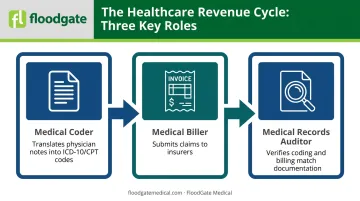
The three roles work in sequence but serve different functions:
- Medical coders translate physician notes into standardized diagnosis and procedure codes.
- Medical billers take those codes and submit claims to insurers for reimbursement.
- Medical records auditors check whether coding and billing match the documentation, catching errors before they become bigger problems.
An auditor might review a cardiologist's chart, confirm the CPT code matches the documented procedure, and flag a mismatch that could otherwise trigger a payer audit months later. That level of scrutiny is needed everywhere claims get filed, which is why the role turns up in so many corners of healthcare.
Who Hires Medical Records Auditors
The role shows up across a wide range of healthcare settings:
- Hospitals and health systems
- Physician practices and specialty clinics
- Health insurance companies
- Government agencies, including CMS and state Medicaid offices
- MedTech and health technology companies building internal compliance teams
That last category is growing fast. As medical device and digital health companies take on more billing-adjacent responsibilities, many are hiring auditors in-house instead of outsourcing the function.
Demand backs this up. BLS projects 7% growth for medical records specialists through 2034, more than double the 3.1% average across all U.S. occupations, with roughly 13,800 new positions expected.
Medical Records Auditor Job Description: Core Duties & Responsibilities
Job postings for this role blend clinical knowledge with detective work. Here's what auditors actually do.
Reviewing Records for Accuracy
Auditors examine patient charts to confirm:
- Documentation is complete and legible
- Diagnoses align with the codes assigned
- Billed procedures match what's documented in the clinical note
Any mismatch gets flagged for correction before it turns into a denied claim or a compliance flag.
Ensuring Regulatory Compliance
Auditors need working fluency in the codes and rules that govern reimbursement:
- ICD-10-CM/PCS for diagnosis and inpatient procedure codes
- CPT codes for medical services and procedures
- HCPCS Level II for supplies, equipment, and services outside CPT
- Medicare, Medicaid, and HIPAA requirements governing billing and patient privacy
Catching Errors, Fraud, and Abuse
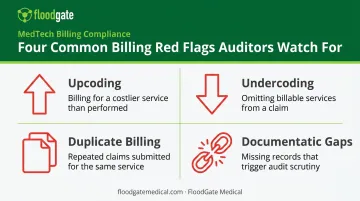
This is the part that protects the bottom line. Auditors watch for specific red flags, including:
- Upcoding: billing for a more expensive service than what was actually performed
- Undercoding: omitting billable services, which cuts into revenue
- Duplicate billing and missing modifiers that trigger automatic payer denials
- Documentation gaps that draw scrutiny during a federal audit
Conducting Routine and Targeted Audits
Audits aren't just reactive. Some follow a routine cycle, like quarterly reviews of high-risk departments such as cardiology or orthopedics. Others are targeted investigations triggered by an unusual claim pattern, a payer request, or a compliance complaint.
Reporting Findings and Educating Staff
After each audit, the auditor compiles a report covering:
- Error rates and specific findings
- Root causes, whether training gaps, system issues, or documentation habits
- Recommended corrective actions
Then comes the harder part: working directly with coders, billers, and providers to close those gaps. That might mean a coaching session with a physician whose notes keep triggering denials, or a team-wide refresher on a new coding guideline.
Sample Job Description Template for Employers
MedTech companies building out compliance or health information teams can adapt this template.
Responsibilities:
- Review patient records, coding, and billing documentation for accuracy and completeness
- Ensure compliance with ICD-10, CPT, HCPCS, Medicare, Medicaid, and HIPAA standards
- Identify and report billing discrepancies, coding errors, and potential fraud
- Conduct routine and targeted audits across departments and claim types
- Compile audit reports with corrective action recommendations
- Partner with coders, billers, and providers on documentation training
Qualifications:
- Associate's or bachelor's degree in health information management or a related field
- CPMA, CEMA, RHIA, or RHIT certification, or willingness to obtain one
- Two or more years of coding, billing, or health records experience
- Strong analytical skills and working knowledge of medical terminology
Hiring gets harder when a role blends clinical, compliance, and technical requirements, which is common at MedTech companies expanding their audit function. FloodGate Medical's recruitment specialists work with MedTech employers to source and vet candidates against criteria like these, drawing on a network built specifically around the medical device and health technology sector.
Medical Records Auditor Requirements: Education, Certifications & Skills
Education & Certification Requirements
Most employers look for one of the following:
- A postsecondary certificate in medical coding or health information
- An associate's degree in health information management
- A bachelor's degree in healthcare administration, HIM, or a related field
Bachelor's degrees open more doors, especially for auditors eyeing management-track roles later.
Certification carries real weight in this field, and four credentials stand out as the most recognized:
| Certification | Issued By | Best For |
|---|---|---|
| CPMA (Certified Professional Medical Auditor) | AAPC | General coding/billing auditors; 2+ years coding experience recommended |
| CEMA (Certified Evaluation and Management Auditor) | NAMAS | Auditors focused on E/M documentation and visit-level coding |
| RHIA (Registered Health Information Administrator) | AHIMA | Management or director-track roles; requires a bachelor's-level HIM degree |
| RHIT (Registered Health Information Technician) | AHIMA | Entry to mid-level auditors; requires an associate-level HIM degree |
Each credential requires ongoing continuing education units to stay active, typically 12 to 36 CEUs per renewal cycle depending on the certification.
Experience & Core Skills
Very few people start their career as a medical records auditor; instead, most spend two to five years first in:
- Medical coding
- Medical billing
- Health records or HIM support roles
That hands-on experience teaches the coding systems, payer rules, and documentation patterns auditors later need to evaluate critically.
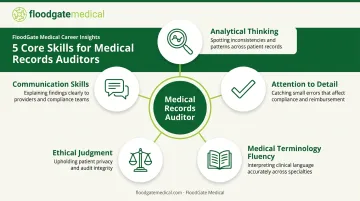
Beyond hands-on experience, employers look for specific core skills:
- Analytical thinking for spotting patterns across hundreds of claims
- Attention to detail, since a single missing modifier can trigger a denial
- Medical terminology fluency to read clinical notes accurately and quickly
- Ethical judgment to flag fraud even when it's uncomfortable
- Communication skills to explain findings without sounding punitive
Coding guidelines shift constantly, with CMS updating ICD-10 codes annually and payer rules changing even more often. Auditors who skip continuing education fall behind fast, which is exactly why maintenance CEUs aren't optional busywork.
Medical Records Auditor Salary & Job Outlook
There's no BLS category specifically for "medical records auditor," so salary data comes from two overlapping sources: the broader Medical Records Specialists occupation and industry surveys from AAPC.
BLS reports a $50,250 median annual wage for medical records specialists as of May 2024. AAPC's 2025 member survey, covering more than 20,000 respondents across coding, billing, and auditing roles, found an average annual pay of $65,007, a figure skewed higher by certified, experienced professionals.
| Employer Type | Median Annual Wage (BLS, May 2024) |
|---|---|
| Management/consulting firms | $60,750 |
| Hospitals (state, local, private) | $56,520 |
| Professional/technical services | $49,970 |
| Administrative support services | $49,590 |
| Physician offices | $45,620 |
Health-system employers in AAPC's survey paid even higher, averaging $67,657 in 2025. Certified auditors with hospital-system experience tend to command a premium over those in smaller practice settings.
Why Demand Keeps Climbing
This occupation grows at a steady, above-average pace, outpacing the broader job market. Demand drivers include:
- An aging population requiring more medical services
- Rising prevalence of chronic conditions like diabetes and heart disease
- Continued complexity in coding and reimbursement rules
- Expanding regulatory requirements tied to electronic health records
For context, medical and health services managers (a role many auditors grow into) are projected to grow 23% through 2034, more than seven times the national average.
Is Medical Records Auditing a Good Career Path?
Short answer: yes, if you like detail work and don't mind the occasional compliance deadline pressure.
Advancement Opportunities
Audit experience translates directly into higher-level roles:
- Compliance officer, overseeing audit programs and regulatory training organization-wide
- HIM manager, directing health information departments and EHR data integrity
- Clinical data specialist, abstracting and analyzing patient data across systems
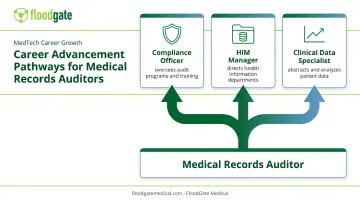
None of these are automatic promotions. Each requires meeting that role's own education and certification bar, but audit experience gives candidates a real head start.
Stability and Flexibility
Health information roles have adapted well to remote work. Much of the job is document review and reporting, which doesn't require being on-site.
That flexibility is opening up new markets, too. MedTech companies are expanding compliance and reimbursement-support functions as they take on more billing-adjacent responsibilities, creating fresh demand for auditors outside traditional hospital settings.
If you're weighing a move into medical records auditing or a related MedTech compliance role, FloodGate Medical recruits specifically within the medical device and health technology sector. Subscribing to their monthly newsletter is a simple way to keep tabs on open roles and industry shifts.
Frequently Asked Questions
How much do medical auditors make in the US?
Medical records specialists earn a median of $50,250 a year, per BLS data, while AAPC's member survey puts average pay closer to $65,000 for certified professionals. Pay varies by employer type, certification, and experience.
What is the role of a medical records auditor?
A medical records auditor reviews patient charts, coding, and billing claims to confirm they're accurate and compliant with payer and federal regulations. They flag errors and recommend corrective action.
Is medical auditing a good career?
Yes. The field offers steady job growth, clear advancement into compliance and management roles, and increasing remote flexibility. MedTech companies are also creating new opportunities outside traditional hospital settings.
What certification do you need to become a medical records auditor?
The most common credentials are CPMA (AAPC) and CEMA (NAMAS), both aimed at coding and billing auditors. RHIA and RHIT from AHIMA are also valuable for management-track careers.
What's the difference between a medical auditor and a medical coder?
Coders assign diagnosis and procedure codes based on clinical documentation. Auditors review that work afterward, or during, to confirm it's accurate and properly supported by the record.
What skills are most important for a medical records auditor?
Analytical thinking, attention to detail, and strong knowledge of coding systems and healthcare regulations top the list. Clear communication matters too, since auditors regularly explain findings to providers and staff.