Healthcare's growing dependence on complex technology has pushed demand for these skilled workers higher than ever. Yet many job seekers still don't understand what the role actually involves, what skills it requires, or how to break in.
This guide covers what a medical device technician does day-to-day, the skills that matter most, the education and certification path, realistic salary expectations, and practical steps for landing your first role in the field.
Key Takeaways
- Medical device technicians install, calibrate, troubleshoot, and repair equipment across hospitals, clinics, and manufacturers.
- The role typically requires an associate degree or apprenticeship, not a four-year degree.
- Median pay sits at $62,630 annually, with strong long-term job growth projected.
- Certifications like CBET and CRES boost job prospects but aren't always mandatory.
- IT and networking skills are becoming as important as traditional electronics knowledge.
What Is a Medical Device Technician?
A medical device technician installs, maintains, calibrates, and repairs the equipment that hospitals and clinics depend on for patient care. Think ventilators, infusion pumps, patient monitors, and diagnostic imaging systems. When that equipment fails, patient safety is on the line.
The job carries several different titles depending on the employer, but they all describe the same work:
| Job Title | Where It's Commonly Used |
|---|---|
| Biomedical Equipment Technician (BMET) | Hospitals, formal/certified contexts |
| Medical Equipment Repairer | Official government job classification |
| Biomedical Engineering Technician | Manufacturer and technical job postings |
| Field Service Technician | Device manufacturers and third-party service firms |
Where They Work
Technicians land jobs across a range of settings:
- Hospitals and health systems (in-house biomedical departments)
- Outpatient clinics and surgical centers
- MedTech device manufacturers
- Third-party equipment service providers
- Government and VA healthcare facilities
Technician vs. Biomedical Engineer
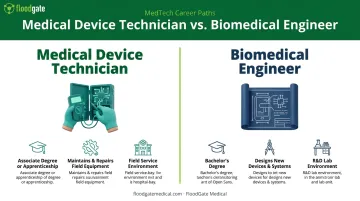
People frequently confuse these two roles, but the distinction matters. A medical device technician typically holds an associate degree or completes an apprenticeship, then spends their career maintaining and repairing equipment already in use.
A biomedical engineer, in contrast, usually holds a bachelor's degree and focuses on designing new devices and systems rather than fixing them in the field.
This distinction isn't academic. The FDA has warned that poor-quality servicing of medical devices can lead to malfunction and adverse patient events, which is exactly why the technician role exists as its own specialized profession rather than an afterthought handled by whoever's available.
According to the FDA's guidance on servicing medical devices, servicing quality directly affects device performance and patient safety, including cybersecurity considerations for connected equipment.
Core Responsibilities of a Medical Device Technician
Daily duties shift depending on facility size and equipment specialization. A technician at a large hospital system handles different work than one specializing in imaging equipment for a manufacturer. Still, the responsibilities generally break down into four categories.
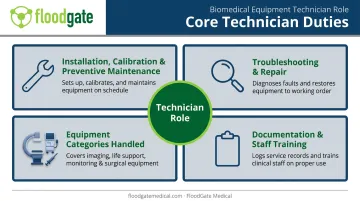
Installation, Calibration & Preventive Maintenance
New equipment doesn't just get plugged in and left alone. Technicians install devices according to manufacturer specifications and calibrate them precisely, since even small deviations can trigger misdiagnosis or treatment errors.
Preventive maintenance is the less glamorous but equally critical part of the job:
- Scheduled inspections at set intervals
- Cleaning and lubricating mechanical components
- Replacing worn parts before they fail
- Testing performance against manufacturer benchmarks
This routine work reduces unplanned downtime, and on a ventilator, that lost time isn't just an inconvenience.
Troubleshooting & Repair
When equipment fails, technicians follow a structured diagnostic process, often under real-time pressure. They inspect the malfunctioning unit, isolate the problem, disassemble components as needed, and repair or replace defective parts. A monitor going dark mid-procedure demands a faster response than a scheduled inspection ever will.
Consider a bedside patient monitor that suddenly loses signal mid-procedure: the technician checks cable connections, tests the sensor array, and swaps a faulty circuit board on the spot rather than waiting for a scheduled service window.
Equipment Categories They Handle
Technicians work across a broad range of device types:
| Category | Examples |
|---|---|
| Diagnostic imaging | X-ray, ultrasound, CT, mammography |
| Life support | Ventilators, anesthesia machines, dialysis units |
| Patient monitoring | EKG, pulse oximeters, telemetry systems |
| Surgical/specialized | Surgical robots, electrosurgical units, centrifuges |
Documentation & Staff Training
Compliance is non-negotiable. Technicians maintain detailed logs of every repair, calibration, and maintenance visit for regulatory audits. They also train clinical staff on proper equipment use, which cuts down on user error before it becomes a service call.
Essential Skills Every Medical Device Technician Needs
Succeeding in this field means combining hands-on technical ability with the soft skills that keep a busy hospital running smoothly.
Technical & Mechanical Skills
Core hardware skills haven't changed much:
- Diagnose electrical faults using multimeters and oscilloscopes
- Repair components using soldering irons
- Identify system errors with diagnostic software
What has changed is the digital layer on top of it. Modern equipment is increasingly software-integrated, from IoT-enabled monitors to networked imaging systems.
That shift shows up clearly in training standards. AAMI's BMET apprenticeship allocates 700 to 1,100 hours specifically to IT topics, including wireless configuration, VPN troubleshooting, and network security, according to AAMI's published apprenticeship training objectives. A technician who only knows electronics will struggle with today's connected equipment.
Soft Skills That Set Top Technicians Apart
Technical chops get you in the door. These skills keep you there:
- Problem-solving under pressure: equipment can fail mid-procedure, and hesitation isn't an option
- Clear communication: explaining an issue to a nurse or physician requires plain language, not jargon
- Documentation accuracy matters because sloppy records create compliance headaches down the line
- Time management: most technicians juggle multiple service requests across a facility at once
Education & Certification Path
Getting started in this field doesn't require a four-year degree, which is one reason it appeals to career-changers and recent graduates alike.
Standard entry point: a two-year associate degree in biomedical engineering technology or a closely related field. Coursework typically covers electronics, mechanical systems, and device theory. Some employers also accept relevant apprenticeships or hands-on training combined with a high school diploma.
Apprenticeship alternative: AAMI runs a two-year, paid, competency-based apprenticeship requiring 4,000 to 6,000 hours of on-the-job learning plus at least 144 related-instruction hours per year. It's a legitimate path for people who want to earn while they learn rather than sit in a classroom full-time.
Beyond these entry paths, a bachelor's degree isn't the standard requirement, though it can open doors to specialized or management-track roles later in a career.
Certifications Worth Pursuing
| Certification | Focus | Eligibility Snapshot |
|---|---|---|
| CBET | General biomedical equipment/HTM | Associate degree + 2 years of BMET work, or 4 years full-time experience |
| CRES | Radiology equipment specialization | Same base requirements, plus recent work concentrated in radiology |
These credentials, offered through AAMI, aren't always mandatory for entry-level work, but they validate expertise and noticeably improve job prospects. Internships or entry-level hospital and clinic positions provide the hands-on hours candidates need before sitting for certification exams. MedTech career coaching, like the guidance FloodGate Medical offers job seekers, can help match the right certification path to target employers.
Career Outlook: Salary & Growth Opportunities
Pay varies widely based on experience, certification, and specialization. According to the Bureau of Labor Statistics, national wage data for medical equipment repairers breaks down like this:
| Percentile | Annual Wage |
|---|---|
| 10th (entry-range) | $41,710 |
| 25th | $49,650 |
| Median | $62,630 |
| 75th | $80,850 |
| 90th (experienced) | $101,220 |
Beyond the paycheck, the job market outlook is strong. Employment is projected to grow 13% from 2024 to 2034, adding roughly 8,800 jobs and creating about 7,300 openings annually. That growth is driven by two forces: an aging population needing more medical care, and increasingly sophisticated equipment that requires skilled maintenance.
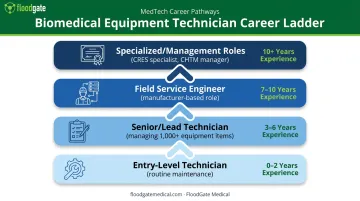
That momentum opens up a clear career path:
- Entry-level technician handling routine maintenance and basic repairs
- Senior or lead technician, sometimes managing 1,000+ equipment items across a facility
- Field service engineer, often working directly for a device manufacturer
- Specialized or management roles, such as radiology equipment specialist (CRES) or healthcare technology manager (CHTM)
FloodGate Medical's career coaching helps MedTech job seekers map out moves like these, from entry-level roles into specialized certifications.
How to Land Your First Medical Device Technician Job
Breaking in requires more than a diploma. Here's what actually moves the needle.
Build a resume that shows, not just tells:
- Highlight hands-on training, not just coursework titles
- List any certifications, even in-progress ones
- Name specific equipment you've worked on (ventilators, imaging systems, monitors)
- Quantify anything measurable, like number of units serviced during an internship
Network strategically:
- Connect with hospital biomedical engineering departments directly
- Reach out to MedTech manufacturers with field service openings
- Work with recruiters who specialize in the medical technology space rather than generalist staffing firms
That last point matters more than people expect. A recruiter who understands MedTech can match your specific skills to the right opening faster than a broad job board search ever will.
FloodGate Medical, for example, focuses exclusively on the MedTech industry. Its recruiting approach centers on equity, diversity, and inclusion, connecting skilled professionals with device manufacturers and healthcare organizations that value diverse teams.
The firm also maintains career resources, including resume guidance and a BootCamp program, that help candidates entering technical and clinical roles sharpen their job search strategy.
Frequently Asked Questions
What is a medical device technician?
A medical device technician installs, maintains, and repairs medical equipment to keep it safe and functional in healthcare settings. The work directly supports patient safety and proper device performance.
What's the difference between a medical device technician and a biomedical equipment technician (BMET)?
The terms are largely interchangeable. BMET tends to be the more formal, often certified title used specifically in hospital settings.
What certifications do I need to become a medical device technician?
CBET (Certified Biomedical Equipment Technician) and CRES (Certified Radiology Equipment Specialist) are the main industry credentials, offered through AAMI. They aren't always required for entry-level work, but they strengthen job prospects.
How long does it take to become a medical device technician?
Most people complete a two-year associate degree in biomedical technology or a related field. Certification exams typically follow after gaining several years of hands-on field experience.
What is the average salary of a medical device technician?
Median pay is $62,630 annually, according to the Bureau of Labor Statistics. Salaries range from around $41,710 at the lower end to $101,220 for experienced, specialized technicians.
Is becoming a medical device technician a good career choice?
Yes. The field offers strong job stability, a projected 13% growth rate through 2034, and the satisfaction of directly supporting patient care through hands-on technical work.