Introduction to the MedTech Hiring Process
Every job search runs through the same basic machine: the hiring process. This is the structured journey a company follows to find the right hire, and in MedTech, that journey has extra layers.
This guide is for MedTech professionals—engineers, QA specialists, sales reps, and everyone in between—who want to know what happens behind the scenes. In a regulated, innovation-driven industry, employers need candidates with the right technical skills, cultural fit, and commitment to quality.
FloodGate Medical works exclusively in MedTech recruiting, matching candidates to companies that need them.
Many candidates move through this process without understanding why each step exists. That gap creates anxiety and, sometimes, missed opportunities. Below, we break down each of the five hiring stages and show you how to stand out at every one of them.
Key Takeaways
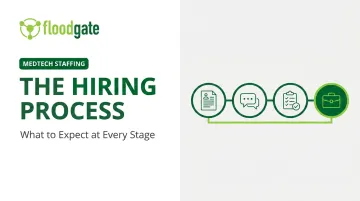
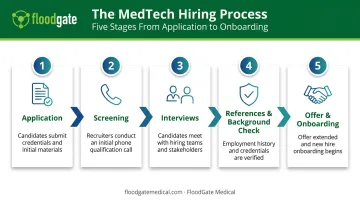
- The MedTech hiring process runs through five stages: Application, Screening, Interviews, Reference/Background Checks, and Offer/Onboarding.
- A structured, DEI-informed process signals a well-run, quality-focused employer.
- Prepare thoroughly, tailor your resume, and ask sharp culture and compliance questions.
- Specialized recruiters offer coaching, market insight, and access to unlisted openings.
What Is a Hiring Process?
A hiring process is a systematic series of steps an organization follows to fill an open role. It typically starts with posting a job and ends with a signed offer and onboarding plan.
The goal is to identify the most qualified candidate, not simply fill an open seat. That means running a process that's fair and legally sound, while efficient enough to keep candidates engaged along the way.
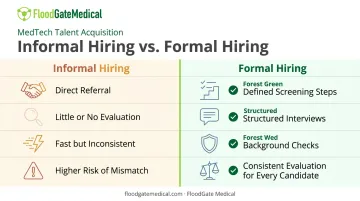
Formal versus informal hiring:
- Informal hiring — a direct referral hired with little or no evaluation. Fast, but risky and inconsistent.
- Formal hiring — a defined sequence of screening, interviews, and checks applied consistently to every candidate.
Formal processes are the standard in professional industries like MedTech, where quality and fairness carry real consequences.
Why a Structured Hiring Process Is Crucial in the MedTech Industry
MedTech is a specialized, regulated field, so a structured hiring process exists to verify the technical competencies that matter: R&D expertise, engineering rigor, or fluency in quality assurance and regulatory affairs.
RAPS' Regulatory Competency Framework outlines what regulatory professionals need at four distinct career levels, giving employers a clear reference point for what "qualified" looks like at each stage.
Structure Reduces Bias
Objective criteria matter for another reason: diversity, equity, and inclusion. SHRM notes that structured interviews with standardized questions and scoring systems create consistency and reduce bias across candidates. That's why leading MedTech companies build interviews this way instead of relying on guesswork.
That structure benefits diverse, innovative teams tackling complex healthcare challenges. It also benefits candidates directly:
- A transparent process signals an organized company culture.
- Consistent evaluation criteria mean candidates are judged on skill, not connections.
- Companies that invest in fair hiring often invest just as much in employees after they're hired.
The 5 Key Stages of the Modern Hiring Process
Stage 1: The Application
This is your entry point. You submit a resume, complete an online form, or both.
Behind the scenes, an Applicant Tracking System (ATS) often scans your submission before a human ever sees it. Jobscan found an ATS in use at 489 of the 2025 Fortune 500 companies, or 97.8% of that group. While that figure describes the Fortune 500 specifically, it reflects how common ATS software has become across large employers, including many MedTech companies.
These systems scan for keywords tied to the job description, things like "ISO 13485," "catheter design," or "capital equipment sales."
Tip: Tailor your resume for every application. Mirror the language and required skills from the job posting so the ATS—and the recruiter reading it next—sees an obvious match.
Stage 2: The Screening
This is your first human touchpoint, usually a recruiter or HR representative. It's a short call, typically around 30 minutes, designed to:
- Verify your experience and background
- Confirm genuine interest in the role
- Discuss salary expectations early to check for alignment
- Assess basic communication skills
This conversation runs both ways. It's your first real chance to ask about the role, the team, and company culture, so come with at least one or two questions ready.
Stage 3: The Interviews
MedTech interviews are rarely a single conversation. Expect a multi-layered process:
- The Hiring Manager Interview: focuses on direct experience, problem-solving, and immediate team fit.
- The Technical or Skills-Based Interview: for engineers, this might be a design challenge; for sales candidates, a mock sales presentation.
- The Panel or Cross-Functional Interview: you'll meet people from Marketing, Clinical Affairs, or R&D, testing collaboration across disciplines.
- The Final/Executive Interview: usually with a department head, focused on strategic thinking, career trajectory, and cultural fit at a higher level.
Each layer serves a purpose. Skipping preparation for any one of them tends to show.
Stage 4: References and Background Checks
Once interviews go well, the company will request professional references to verify your work history and performance.
Choose references who can speak to specific accomplishments, and give them a heads-up before recruiters call. A reference caught off guard rarely gives their best answer.
A contingent offer usually comes before the background check itself. That check typically verifies employment history, education, and criminal records where permitted by law. Under EEOC guidance, employers can review this information but must apply it consistently and avoid discriminatory use. Medical inquiries generally can't happen before a conditional offer is extended.
Stage 5: The Offer and Onboarding
The offer stage brings a formal letter covering salary, bonus structure, benefits, start date, and other terms. Read it carefully before you sign anything.
Negotiation is normal and expected. Come prepared to discuss compensation and terms professionally, backed by market research rather than assumptions.
Onboarding starts once you accept, covering paperwork, orientation, and initial training.
Take it seriously: Gallup found only 12% of employees strongly agreed their organization did onboarding well, yet employees who rated their onboarding as exceptional were 2.6 times as likely to report being extremely satisfied with their workplace. A structured onboarding program signals a company invested in your long-term success.
How to Successfully Navigate the MedTech Hiring Process
Prepare for the Interview
Research the company's products, their FDA approval status, market position, and recent news. Look up the leadership team. Then prepare a few thoughtful questions that show you actually did the reading, not generic ones you'd ask any employer.
Once that homework is done, structure your behavioral answers using the STAR method: Situation, Task, Action, Result. MIT's career center suggests weighting your response roughly 20% situation, 10% task, 60% action, and 10% result, which keeps the focus on what you actually did rather than background.
Assess the Company's Hiring Process
Watch for signs of an inclusive, well-run process:
- A diverse interview panel
- Questions centered on skills and competencies rather than personal background
- Clear, consistent evaluation criteria across candidates
These signals often point to a healthier, more forward-thinking workplace. Not every process runs this smoothly, though, so watch for red flags too:
- A disorganized or constantly rescheduled interview process
- Vague, evasive answers from interviewers about the role or team
- High visible employee turnover
- Pressure to accept an offer immediately, with no time to think
- Personal questions that have nothing to do with the job
SHRM's research on candidate-reported red flags points to similar warning signs, including "you're joining a family" language and glorified long hours. Trust your instincts here.
Partner with a Specialist Recruiter
Working with a firm that focuses exclusively on MedTech, like FloodGate Medical, changes the equation. A specialized recruiter can:
- Coach you through interview prep with real feedback, not generic tips
- Help you frame your work history around what MedTech hiring managers actually want to see
- Represent your interests during offer discussions
- Connect you with companies aligned to your career goals, not just any open role
FloodGate Medical's Futures program pairs this with structured resources like resume coaching and peer-based career bootcamps, useful even before you're actively interviewing.
Conclusion
Five stages, one goal: matching the right person to the right role. Application, screening, interviews, reference and background checks, and the offer and onboarding phase each serve a distinct purpose for both sides of the table.
Understanding why each stage exists gives you the confidence to showcase your skills and make informed decisions about where you want to work. The MedTech industry moves fast, and a great company runs a process that's transparent and professional from your first application to your first day. At FloodGate Medical, we build our recruiting process around that same standard, connecting MedTech professionals with companies that get hiring right.
Frequently Asked Questions
What are the steps in the hiring process?
The typical hiring process includes five stages: application, screening, interviews, background checks, and offer/onboarding. Each stage narrows the candidate pool while giving both sides more information.
What is the 30-60-90 rule in an interview?
It's a framework where you outline your plan for the first 30, 60, and 90 days in a new role. Presenting one during an interview demonstrates proactivity and strategic thinking to a hiring manager.
How long does the average hiring process take in the MedTech industry?
Timelines vary widely based on seniority, company size, and interview rounds, generally landing somewhere between 3 and 8 weeks. Executive or highly technical roles often take longer.
What are some red flags to look for in a company's hiring process?
Watch for poor communication, interviews that get rescheduled repeatedly, unprepared interviewers, or questions that feel inappropriate or illegal. Any of these can signal deeper organizational issues.
How should I follow up after an interview if I haven't heard back?
Send a polite follow-up email about a week after your interview. Reiterate your interest and ask for an update on the decision timeline.
Is it okay to ask about salary and benefits in the first interview?
It's usually best to wait until the recruiter or hiring manager raises it, or save detailed questions for a later round. If your initial recruiter screen didn't cover it, a brief mention is fine.