
Introduction
Every drug label, clinical trial report, and device manual you've ever seen started as a jumble of raw data, lab notes, and regulatory requirements. Someone had to turn that mess into something a physician, regulator, or patient could actually understand. That someone is a medical writer.
Despite how essential the role is, many job seekers and hiring managers remain unclear on what medical writers actually do day to day. Questions about the required skills and career path persist, too.
Some assume it's just "writing." In reality, it's closer to translation work: moving dense science into language that regulators approve and patients trust.
This guide breaks down what the job entails, from document types to the skills and credentials you'll need. You'll also learn where medical writers find work, including the fast-growing MedTech sector, and what you can expect to earn as you advance.
Key Takeaways
- Medical writers convert clinical data into documents for regulators, clinicians, marketers, and patients
- The role blends scientific knowledge, technical writing skill, and project management ability
- Employers span pharma, biotech, CROs, agencies, and a growing number of MedTech companies
- Career paths run junior writer → senior writer → director, with salary jumps at each stage
What Does a Medical Writer Do?
A medical writer researches, drafts, and edits documents that communicate scientific or clinical information to a specific audience, whether that's an FDA reviewer, a practicing cardiologist, or a patient reading a device manual. The job title covers a lot of ground, but the underlying skill is always the same: making complexity accessible without sacrificing accuracy.
Core Daily Responsibilities
On a typical day, a medical writer might:
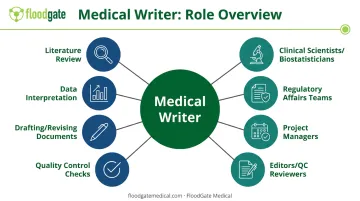
- Conduct literature reviews to support a manuscript or regulatory submission
- Interpret raw clinical trial data and translate it into narrative form
- Draft or revise protocols, study reports, or promotional copy
- Run quality control checks for factual accuracy, formatting, and regulatory compliance
Quality control is not optional. A single misstated statistic in a clinical study report can delay a regulatory filing by months.
Who Medical Writers Work With
This is a highly collaborative role. Writers coordinate closely with:
- Clinical scientists and biostatisticians (for data accuracy)
- Regulatory affairs teams (for compliance with submission standards)
- Project managers (for timelines and deliverables)
- Editors and QC reviewers (for consistency and clarity)
Responsibilities shift depending on the employer and specialization. A regulatory writer at a biotech firm spends most of their time on clinical study reports and submissions, while a promotional writer at an agency focuses on sales aids and marketing content.
Either way, the core job description holds steady: writing and editing clinical protocols, publications, marketing materials, and patient-facing content while keeping scientific accuracy and regulatory compliance front and center.
Types of Documents and Specializations Medical Writers Produce
Medical writing spans multiple specializations, each with its own document types and skill requirements.
| Category | Example Documents |
|---|---|
| Regulatory & clinical | Clinical trial protocols, study reports (ICH E3 format), investigator brochures, FDA/EMA submissions |
| Scientific publications | Peer-reviewed journal articles, conference abstracts, white papers |
| Patient & consumer materials | Device instructions for use (IFUs), drug leaflets, health education content |
| Marketing & promotional | Sales aids, advertisements, press releases for product launches |
| Educational content | CME modules, training slide decks for healthcare professionals |
MedTech writers deserve a special mention here, since device manufacturers work under a different set of rules. They need clinical evaluation reports (CERs), 510(k) submissions, and PMA documentation. These documents demand writers who understand device mechanics and regulatory frameworks built for hardware, not pharmaceuticals.
Five Core Specialization Paths
If you're deciding which path fits, these are the broad lanes:
- Regulatory writing: protocols, submissions, study reports
- Publication writing: journal articles and abstracts
- Promotional/marketing writing: sales and advertising content
- HEOR writing: health economics and outcomes research reports
- CME writing: continuing education content for clinicians
Skills, Qualifications, and How to Get Started
Most medical writers hold a bachelor's, master's, or PhD in a life science, such as biology, chemistry, or pharmacology. A PhD is common in regulatory and scientific writing roles but isn't a strict requirement everywhere.
Technical and Soft Skills
The role demands a specific mix:
- Scientific literacy — the ability to read and interpret primary research
- Technical writing proficiency — clear, structured, audience-appropriate prose
- Data interpretation — pulling accurate conclusions from clinical datasets
- Medical terminology fluency — knowing the language before you can simplify it
- Attention to detail — a wrong decimal point can change a clinical claim
- Project management — juggling multiple stakeholders and hard deadlines
Certifications Worth Pursuing
Credentials won't replace experience, but they signal competence to hiring managers:
- AMWA Medical Writer Certified (MWC) — requires a bachelor's degree plus two years of paid experience
- ISMPP CMPP — bachelor's plus two years, or high school diploma plus five years
- EMWA EPDP — earned through workshop credits
- RAPS RAC — regulatory affairs certification tiered by degree and years of experience
Certifications aren't the only way in, though. Common entry points include research assistant roles, clinical research associate (CRA) positions, regulatory affairs jobs, or healthcare professionals transitioning out of clinical practice.
Steps to Launch a Medical Writing Career
- Build foundational competency through a relevant science degree or a medical writing certificate program.
- Create a portfolio using internship work, freelance assignments, or academic writing samples that show you can simplify complex material.
- Connect with recruiters who understand the niche. Generalist recruiters often don't grasp the difference between a Clinical Evaluation Report (CER) and a Clinical Study Report (CSR). Specialized firms like FloodGate Medical focus specifically on MedTech talent acquisition, which matters when you're trying to land a device-documentation role rather than a pharma one.
Where Do Medical Writers Work?
Employer type shapes both the work itself and the paycheck.
- Pharmaceutical and biotech companies — the largest and often highest-paying employers, though competitive to break into
- CROs and medical communications agencies — variety across multiple clients and therapeutic areas, good for building broad experience
- MedTech and medical device companies — growing demand for writers who can produce device-specific documentation like clinical evaluation reports and 510(k)/PMA submissions
- Other employers — government health agencies, academic institutions, publishers, and healthcare associations
MedTech is worth watching closely. EU MDR requirements have increased documentation demands for clinical evidence and post-market clinical follow-up, pushing device manufacturers to hire writers who understand both the science and the regulatory paperwork trail.
FloodGate Medical works directly in this space, connecting device manufacturers with candidates who have the specific documentation skill set MedTech roles demand rather than a general pharma writing background.
Medical Writer Salary and Career Progression
Compensation climbs steadily with experience and specialization. According to AMWA's 2024 Compensation Survey, mean income varied by track:
| Track | Mean Annual Income |
|---|---|
| General medical writing | $149,846 |
| Regulatory writing | $166,457 |
| Freelance writing | $214,227 |
For broader context, the U.S. Bureau of Labor Statistics reports a 2024 median pay of $72,270 for writers and authors generally, with 4% projected growth through 2034. Medical writing specifically commands a premium over that baseline due to its technical demands.
Typical Career Trajectory
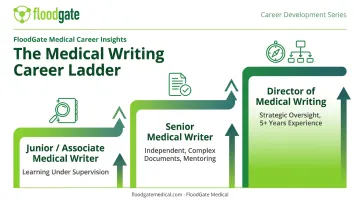
- Junior/associate medical writer: learning the ropes, drafting under supervision
- Senior medical writer: handling complex documents independently, mentoring juniors
- Director of medical writing: strategic oversight, often reached after five or more years
Salary depends heavily on a few variables:
- Specialization: regulatory writing typically pays more than promotional writing
- Employer type: pharma and biotech often outpace agencies and academic institutions
- Employment status: freelance writers can out-earn salaried peers but trade stability for flexibility
Navigating these variables often benefits from expert guidance: FloodGate Medical's career coaching helps writers align specialization choices with long-term career goals.
Frequently Asked Questions
What is the job description of a medical writer?
Medical writers research, draft, and edit scientific and clinical documents, everything from regulatory submissions to marketing materials, ensuring accuracy and clarity for the intended audience. The specific mix depends heavily on the employer and specialization.
What skills do you need to be a medical writer?
You need scientific literacy, strong technical writing ability, data interpretation skills, and attention to detail. Project management and stakeholder communication matter just as much as the writing itself.
Is medical writing a good career?
Yes. Salary potential is strong, freelance and remote options are widely available, and demand is growing across pharma and especially MedTech. It also offers a clear path from junior roles to director-level positions.
Do medical writers need a PhD?
Not always. A PhD is common and helpful for regulatory or highly scientific writing, but a relevant bachelor's or master's degree paired with solid experience can get you into the field.
Can you become a medical writer without a science background?
It's possible but uncommon. You'll need to self-teach medical terminology and clinical concepts quickly, and most employers still prefer candidates with formal science training.
Is medical writing in demand in the MedTech industry?
Yes, demand is rising as device innovation and regulatory complexity increase documentation needs. Recruitment firms like FloodGate Medical help MedTech companies find and hire this specialized talent, including experienced medical writers.