
The problem? Nobody agrees on what the title actually means. One employer's "clinical coordinator" is another's "care coordinator" or "clinical supervisor," and job seekers often apply to roles that look identical on paper but pay and function completely differently.
Demand for this kind of operational leadership isn't slowing down. The U.S. Bureau of Labor Statistics projects 23% growth for medical and health services managers between 2024 and 2034, with roughly 62,100 openings expected each year, according to the BLS Occupational Outlook Handbook. This guide breaks down what clinical coordinators actually do, what employers require, what the role pays, and how to hire or land one of these positions in healthcare or MedTech.
Key Takeaways
- Clinical coordinators oversee daily operations, staffing, and patient care across hospitals, clinics, and MedTech companies
- Core duties span patient liaison, scheduling, compliance documentation, budgeting, and quality-improvement tracking
- Most employers require a bachelor's degree in nursing or healthcare administration plus 2-5 years of clinical experience
- MedTech clinical coordinators often add clinical trial coordination alongside standard patient-care duties
What Is a Clinical Coordinator?
A clinical coordinator organizes and oversees the daily activities of a healthcare facility or clinical program. Think of it as an office manager role with clinical teeth: the person still needs to understand patient charts, staffing ratios, and regulatory requirements, not just spreadsheets.
The role bridges departments, staff, patients, and families. When a patient needs to move from radiology to surgery without delay, the clinical coordinator usually solves it in real time. The same holds true when a nursing shift is short-staffed on a Tuesday.
**In MedTech and life sciences companies**, the job looks different. Clinical coordinators here often support clinical trial or device evaluation studies, working alongside contract research organizations (CROs) and principal investigators, plus internal regulatory teams. This version of the role leans heavily on protocol compliance and subject enrollment, along with documentation for FDA and IRB review.
Common Job Titles & Where Clinical Coordinators Work
Titles vary widely by employer size and specialty. You'll see clinical coordinators advertised under names like:
- Patient Care Coordinator
- Clinical Supervisor
- Director of Nursing (smaller facilities)
- Referral Coordinator
- Clinical Program Coordinator
The O*NET occupational database lists "Clinical Coordinator" as an alternate title for Clinical Research Coordinators specifically, while broader facility-operations coordinators often fall under the Medical and Health Services Managers classification. That distinction matters: a hospital-based coordinator manages people and budgets, while a trial-side coordinator manages protocol compliance and study data.
Clinical coordinators show up most in:
- General medical and surgical hospitals
- Physician offices
- Outpatient care centers
- Home health care agencies
Each setting shapes the job differently, so read the actual responsibilities list, not just the title, before applying or hiring.
Core Responsibilities of a Clinical Coordinator
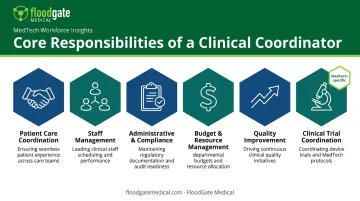
The daily workload centers on keeping people, paperwork, and patients moving in sync. Six areas make up most of the job:
- Patient care coordination - Acting as the liaison between departments, patients, and families so treatment happens on schedule and nothing falls through the cracks.
- Staff management - Training, scheduling, and supervising nurses or support staff, including performance evaluations and shift coverage.
- Administrative and compliance duties - Implementing facility policies, maintaining HIPAA-compliant documentation, and tracking regulatory changes.
- Budget and resource management - Monitoring supply levels, managing departmental budgets, and tracking expenditures against forecasts.
- Quality improvement - Participating in initiatives that raise patient outcomes and operational efficiency, then monitoring the metrics that prove it worked.
- Clinical trial coordination (MedTech-specific) - Liaising with sponsors, regulatory bodies, and clinical research staff on device evaluation studies.
How These Responsibilities Play Out in Practice
That last point deserves more detail. In device and diagnostics companies, coordinators often handle tasks like preparing IRB submission documents, tracking subject enrollment, and reporting adverse events alongside investigators. According to O*NET's Clinical Research Coordinator profile, this work includes reviewing records for participant eligibility, overseeing informed consent, and supporting sponsor or federal audits.
Not every coordinator role touches all six areas equally. A small physician's office might lean heavily on scheduling and patient liaison work, while a hospital department coordinator spends more time on budgets and staff evaluations. Read the job posting closely — the weighting tells you what the employer actually values.
Skills, Requirements & Qualifications
Employers want a mix of clinical grounding and administrative competence. Nobody expects a coordinator to be a top-tier clinician and a financial analyst simultaneously, but you do need working fluency in both worlds.
Education & Certifications
- Bachelor's degree in nursing or healthcare administration is the baseline most employers list
- Master's degree preferred for senior-level or director-track positions
- CPR/BLS certification current and valid, especially where hands-on clinical duties apply
- ICD/CPT coding familiarity helpful where billing or documentation overlaps with the role
- HIPAA training specific to the employer's own policies (there's no single universal HIPAA certificate)
O*NET data backs up the education split. Among the broader facility-management coordinator profile, 46% hold a bachelor's degree and 21% hold a master's; for research/trial coordinators specifically, 60% report a bachelor's as their credential.
Skills Employers Prioritize
Soft skills consistently top the list: critical thinking, active listening, clear speaking, and monitoring performance against goals. Technical skills matter too — familiarity with EMR platforms like Epic Systems or MEDITECH, plus general proficiency in Microsoft Office for documentation and reporting.
Most job postings expect 2-5+ years of clinical experience, with prior supervisory work strongly favored for senior openings. If you're a job seeker without direct supervisory history, highlight informal leadership: charge nurse shifts, precepting new hires, or leading quality projects all count.
Clinical Coordinator Salary & Career Outlook
Pay varies widely depending on the data source, location, and how the employer defines the role. Here's a snapshot of current figures:
| Source | Metric | Range |
|---|---|---|
| Salary.com (2026) | Average salary | $50,453-$58,821 (25th-75th percentile) |
| Glassdoor | Median total pay | $63,000-$109,000 total compensation |
| Salary.com, New York City | Local average | $63,163 |
| Salary.com, Virginia | Local average | $55,233 |
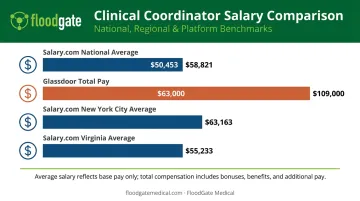
These numbers come from Salary.com's Clinical Coordinator salary data, and they highlight a key point: methodology differs between sources. Salary.com reports averages; Glassdoor models total pay from submitted salaries. Don't compare them apples-to-apples.
Key drivers of pay variation:
- Geography - Metro areas like New York consistently outpace national averages
- Facility type - Hospitals typically pay more than outpatient centers
- Experience level - Senior coordinators with supervisory history command higher offers
- Education - A master's degree opens doors to better-compensated roles
Career Progression
Most clinical coordinators advance toward clinical director, healthcare administrator, or medical and health services manager positions. That progression usually requires expanding scope from execution and compliance work toward departmental policy, staffing authority, and budget ownership.
Advancement to top executive roles often requires a master's degree. Combined with the U.S. Bureau of Labor Statistics' projected 23% job growth for medical and health services managers, this makes clinical coordination a reasonable entry point into a longer healthcare management career.
Hiring the Right Clinical Coordinator
Writing a clear job description saves everyone time. Vague postings attract mismatched applicants and lead to costly turnover once the wrong hire realizes the job isn't what they expected.
Practical tips for employers:
- Separate must-have qualifications (degree, licensure, years of experience) from nice-to-haves (specific EMR software, industry certifications)
- Specify whether the role includes budget authority or just budget monitoring — these are very different jobs
- Clarify reporting structure upfront (does this person report to a director, or manage other staff directly?)
- If the role involves clinical trial work, state that explicitly; it changes the entire skill profile you need
A DEI-driven hiring approach also strengthens the candidate pool. Teams built with varied clinical backgrounds and career paths tend to solve operational problems faster. They also represent patient populations more accurately, a factor that shows up in patient satisfaction and outcome metrics over time.
That same DEI-driven thinking is where FloodGate Medical specializes. As a recruitment firm focused exclusively on the MedTech industry, it connects companies with clinical coordination talent using an equity-focused methodology.
The firm also supports job seekers through career coaching and interview preparation. That specialized focus helps whether you're a hiring manager filling a niche clinical trial coordination role or a professional moving from hospital-based coordination into MedTech. Either way, it tends to surface better matches than a general staffing firm would.

Frequently Asked Questions
What is the average salary for a medical clinic coordinator in the US?
Salary.com reports an average range of roughly $50,000-$59,000 annually, while Glassdoor's total pay figures run higher, from $63,000-$109,000. Location, facility type, and experience level cause most of the variation.
Is a medical clinic coordinator a supervisor or manager?
Clinical coordinators typically supervise nursing or support staff, handling scheduling and performance reviews. They usually report to a clinical director or higher-level manager rather than sitting at the top of the org chart.
What are the job responsibilities of a medical clinic coordinator?
Core duties include patient care coordination, staff scheduling and training, compliance documentation, budget tracking, and quality improvement monitoring. In MedTech settings, clinical trial coordination is often added to that list.
What qualifications do you need to become a clinical coordinator?
Most employers require a bachelor's degree in nursing or healthcare administration, current CPR certification, and 2-5 years of clinical experience. A master's degree strengthens candidacy for senior-level openings.
What's the difference between a clinical coordinator and a clinical director?
A clinical coordinator focuses on day-to-day execution: staffing, scheduling, and compliance. A clinical director holds broader strategic authority over policy, budgets, and long-term planning, with the coordinator typically reporting to them.
Is clinical coordinator a good career path within the MedTech industry?
Yes, particularly for professionals interested in clinical trial work, since it builds skills that transfer into regulatory affairs, clinical operations, and management roles. Recruiters like FloodGate Medical specialize in connecting candidates with these niche MedTech openings.