
The Bureau of Labor Statistics projects 12% employment growth for medical assistants between 2024 and 2034, translating to roughly 101,200 new jobs — much faster than the average occupation.
Yet many job postings for this role are vague. They list generic duties, skip scope-of-practice details, and attract candidates who don't understand what the job actually demands day to day. Job seekers, meanwhile, often can't tell how the role differs from nursing.
This guide breaks down core MA responsibilities, gives you a ready-to-use job description template, covers certification requirements, and clarifies exactly how medical assistants differ from nurses.
Key Takeaways
- Medical assistants split time between clinical tasks (vitals, patient prep, specimens) and administrative work (scheduling, billing, records)
- Employers prefer candidates who've completed an accredited MA program and hold a certification like CMA, RMA, or CCMA
- Effective job postings need four parts: summary, responsibilities, requirements, and skills
- MAs and nurses differ in scope of practice, licensing, and training length
What Does a Medical Assistant Do? Roles & Responsibilities
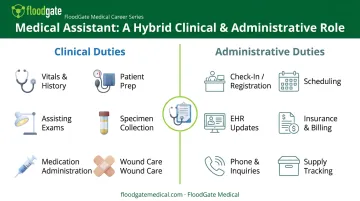
Most MAs divide their shift between front-office administrative work and back-office clinical support. The exact split depends on state law, employer policy, and practice size. A solo family practice might lean heavily on one MA for everything, while a larger clinic assigns dedicated clinical and administrative staff.
Clinical Duties
Core clinical responsibilities typically include:
- Recording vital signs and updating medical history
- Prepping patients and exam rooms before provider visits
- Assisting physicians during exams and minor procedures
- Collecting and preparing lab specimens for testing
- Administering medications or injections per provider order
- Performing basic wound care and dressing changes
Important distinction: MAs cannot interpret test results or diagnose conditions independently. That responsibility stays with the licensed provider. Every clinical task an MA performs happens under delegation and supervision, and permitted tasks vary by state. California, for example, requires 10 hours of documented training plus 10 supervised performances before an MA can give injections or draw blood.
Administrative Duties
On the administrative side, MAs typically handle:
- Checking in patients and completing registration forms
- Scheduling appointments and follow-up visits
- Updating electronic health records (EHR)
- Verifying insurance and handling basic billing tasks
- Answering phones and managing patient inquiries
- Tracking and reordering clinical supplies
Work setting shapes which duties dominate. According to the BLS Occupational Outlook Handbook, 57% of medical assistants worked in physician offices in 2024, with another 17% in hospitals, 10% in outpatient care centers, and 7% in offices of other health practitioners. A physician's office MA might handle more scheduling and billing; a hospital-based MA often skews clinical.
Medical Assistant Job Description Template
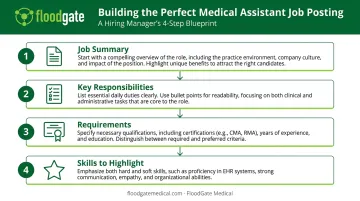
Use this as a starting framework, then adjust language to match your specialty, shift structure, and organizational culture.
Job Summary
"We're seeking a Medical Assistant to support our clinical team by preparing patients for exams, assisting providers during visits, and managing key front-office tasks. This role blends hands-on patient care with administrative coordination, and it's essential to keeping our daily practice operations running smoothly."
Key Responsibilities
Copy-ready bullets covering both sides of the role:
Clinical duties:
- Measure and record patient vital signs prior to provider visits
- Prepare exam rooms and assist providers during exams and minor procedures
- Collect, label, and prepare specimens for laboratory testing
- Administer medications or injections as directed by supervising provider
- Uphold HIPAA compliance in all patient interactions
Administrative duties:
- Schedule appointments, confirm visits, and manage patient follow-ups
- Update and maintain accurate EHR documentation
- Verify insurance coverage and process basic billing tasks
- Answer phones and respond to patient inquiries professionally
- Maintain inventory of clinical and office supplies
Requirements & Skills to Highlight
Must-have qualifications:
- High school diploma or GED
- Completion of an accredited medical assistant program
- National certification preferred (CMA, RMA, CCMA, or NCMA)
- Proficiency with EHR systems
- Physical stamina for standing, walking, and lifting throughout shifts
- Ability to pass background check and provide immunization records
Skills worth featuring:
- Clear communication with patients and care teams
- Strong attention to detail in charting and specimen handling
- Comfort multitasking across clinical and administrative duties
- Understanding of HIPAA and patient confidentiality standards
- Collaborative, team-oriented mindset
- Specialty experience such as phlebotomy or EKG certification (where applicable)
Customize the compensation, shift, and benefits section for your specific opening, then close with a direct call-to-action. Naming the specialty and shift type upfront (for example, "cardiology MA, Monday-Friday day shift" instead of just "medical assistant") filters out mismatched applicants before they apply.
Qualifications, Education & Certification Requirements
The typical path into medical assisting starts with a high school diploma, followed by a postsecondary program. The Bureau of Labor Statistics (BLS) notes these programs generally run about one to two years, with certificate and diploma tracks trending shorter and associate degree programs running closer to the two-year mark. Coursework usually covers anatomy, medical terminology, pharmacology basics, and clinical procedures.
Certification isn't federally required, but many employers prefer or require it. The major credentialing bodies include:
| Credential | Issuing Body | Recertification Cycle |
|---|---|---|
| CMA | AAMA | Every 60 months |
| RMA | AMT | Annual renewal + 3-year CE cycle |
| CCMA | NHA | Every 2 years |
| NCMA | NCCT | Annual |
Each body sets its own continuing education requirements, so candidates should confirm specifics before committing to a program.
Scope-of-practice rules also vary meaningfully by state. Two examples show the range:
- Washington requires MAs to hold a state Department of Health credential, with permitted tasks depending on credential category
- California skips state licensure but sets specific training thresholds for injections and blood draws
Employers and job seekers alike should verify local rules before finalizing a job posting or enrolling in a program.
Medical Assistant vs. Nurse: Key Differences
Confusing these two roles in a job posting leads to mismatched applicants and frustrated hiring managers. Here's where they actually diverge.
Scope of practice. MAs perform delegated clinical and administrative tasks under a supervising provider. They don't independently assess patients or develop care plans. Licensed nurses (LPNs and RNs) are trained and licensed to assess patients, plan care, and make independent clinical judgments within their scope.
Education and licensing. MA training runs roughly one to two years, with certification optional but often preferred. Nursing requires completing an accredited program (typically an associate or bachelor's degree) and passing the NCLEX: either NCLEX-RN or NCLEX-PN, depending on the license type. There's no equivalent licensure exam for medical assistants.
Compensation. The Bureau of Labor Statistics reports separate median annual wages for May 2024:
- Medical assistants: $44,200
- Registered nurses: $93,600
- LPN/LVNs: $62,340
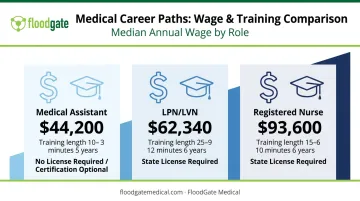
The gap reflects the difference in licensure, scope, and training length — not the value of the work itself. Plenty of MAs use the role as a practical stepping stone. It's a way to gain hands-on clinical exposure while working toward nursing school or another allied health credential, often while earning income in the process.
Hiring the Right Medical Assistant: Tips for Employers
Filling MA roles has gotten harder, not easier. A May 2025 MGMA Stat poll of 420 medical practice leaders found 47% named medical assistants their hardest role to recruit, ahead of nurses (15%) and billers (10%).
A few practical fixes help:
- Separate must-haves from nice-to-haves. Requiring certification when your state doesn't mandate it (and your team doesn't strictly need it) narrows your pool unnecessarily. Reserve strict requirements for genuine non-negotiables.
- Sell growth opportunities, not just duties. With projected double-digit demand growth over the next decade, candidates have options. Highlight advancement paths, team culture, and benefits, not just a task list.
- Get specific in the posting. Name the specialty, shift, and patient volume. Vague postings draw vague applications.
These fixes apply to traditional bedside MA roles. MedTech companies and healthcare organizations increasingly need to fill different, hybrid clinical-support or technical-adjacent positions, such as clinical product specialists or field-based clinical liaisons.
For those roles, a specialized talent partner can help. FloodGate Medical works within the MedTech space, using compensation benchmarking and talent mapping to help hiring managers build accurate postings. Its "Hiring for Attitude" approach weighs culture fit alongside credentials to find candidates who actually fit the role.
Frequently Asked Questions
What are a medical assistant's responsibilities?
MAs handle clinical tasks like taking vitals, prepping patients, and collecting specimens, alongside administrative work such as scheduling, updating records, and handling billing. The exact mix depends on the practice setting.
What's the difference between a nurse and a medical assistant?
MAs perform delegated clinical and administrative tasks under provider supervision. Licensed nurses (LPN/RN) are independently licensed to assess patients, plan care, and make clinical judgments within their scope.
Do medical assistants need certification to get hired?
Certification isn't legally required in most states, but many employers prefer or require credentials like CMA, RMA, or CCMA when hiring.
How long does it take to become a medical assistant?
Most programs take about one to two years. Certificate and diploma tracks tend to run shorter, while associate degree programs typically take closer to two years.
Can a medical assistant give injections or draw blood?
Yes, within their delegated scope and under provider supervision, but specific training requirements and permitted tasks vary by state law.
Is medical assisting a good long-term career?
It can be either a stable long-term career or a stepping stone toward nursing or other allied health fields, supported by strong projected job growth through 2034.