Here's the tension worth resolving: a lot of career-advice sites still quote an older federal projection of 11-13% growth. The newest data tells a different story. This guide breaks down what's actually happening in 2026, why the numbers shifted, and how to build a lab career that holds up regardless of which projection you believe.
Key Takeaways
- Lab technologist and technician job growth has slowed to about 2% through 2034.
- About 22,600 openings are still expected yearly, mostly replacing retirees, not new positions.
- Automation and AI are reshaping lab work, not replacing skilled technologists.
- Certification and specialization remain the best hedges against a slower job market.
The Real Medical Technologist Job Outlook for 2026: What the Latest Data Shows
If you've read that medical technology is a fast-growing field, you're not wrong. You're just working from outdated numbers.
The Bureau of Labor Statistics' 2020-2030 projection pegged growth for this occupation at 11%, well above the average for all jobs. That figure still circulates on career sites, college brochures, and forum threads. But the current BLS Occupational Outlook Handbook covering 2024-2034 puts growth at just 2%, slower than the average occupation.
Here's the current snapshot, straight from BLS:
- 351,200 jobs nationwide in 2024
- $61,890 median annual wage (May 2024)
- 22,600 projected annual openings through 2034
- Only about 6,000 net new positions expected over the entire decade
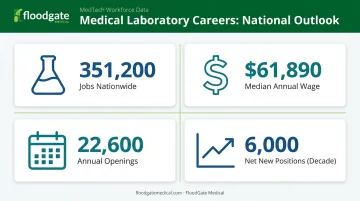
That last point matters most. Most of those 22,600 annual openings exist because someone retired or transferred out, not because labs are expanding headcount.
Medical Technologist vs. Medical Laboratory Technician
BLS lumps two distinct roles into one category, which muddies the outlook numbers:
| Role | Degree | Scope of Work |
|---|---|---|
| Medical Technologist (Medical Laboratory Scientist) | Bachelor's degree | Performs complex testing, often supervises technicians |
| Medical Laboratory Technician | Associate's degree | Performs routine tests under supervision |
If you're weighing which path fits your goals, know that the blended BLS figures don't separate outlook or pay by credential level.
National numbers also hide huge regional swings. A shortage in rural Montana looks nothing like the market in Boston or Dallas. Before committing to a program or relocating for a job, check state-level tools like Projections Central or BLS's state OEWS data.
Despite the slower national growth rate, diagnostic testing isn't going anywhere. Hospitals, reference labs, and physician offices still need someone running the samples.
Why the Job Outlook Is Shifting: Growth Drivers and Emerging Challenges
Two forces are pulling in opposite directions, and that tug-of-war explains almost everything about the 2% number.
Demand Drivers: Aging Population and Expanding Testing
Older adults need more diagnostic testing, period. Conditions like cancer and type 2 diabetes drive repeat lab work, and the CDC reports diabetes prevalence reaches 28.8% among adults 65 and older. This demand is structural, not a temporary spike. It will keep climbing as the population ages over the next decade.
At the same time, the test menu itself is growing. Clinical labs now offer testing for more than 10,000 genetic conditions, and molecular and prenatal diagnostics keep expanding. More tests, more volume, more work hitting the bench every day.
Automation and AI's Growing Role
So why isn't job growth keeping pace with rising test volume? Automation.
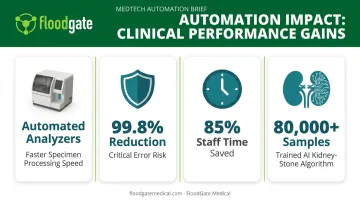
- Automated analyzers now process specimens far faster than manual workflows
- One documented blood bank automation project cut critical error risk by 99.8% and staff time by 85%
- AI-assisted tools, like a kidney-stone algorithm trained on 80,000+ samples, now match technologist accuracy on certain interpretations
Will AI replace medical laboratory technologists? Not in any near-term scenario. Industry groups like ADLM are explicit: AI needs human oversight for validation, quality control, and complex specimen interpretation. Automation acts as a multiplier, letting one technologist handle more volume while trained judgment still drives every diagnostic decision.
The Retirement Wave and Job Stress
Attrition is doing a lot of the hiring work. The ASCP's 2024 Vacancy Survey found retirement rates rose in 10 of 17 lab departments compared to 2022, even as overall vacancy rates improved.
This helps explain why the job gets called stressful. Tight turnaround windows, high-stakes accuracy, biohazard exposure, and chronic understaffing add up. Roughly 85% of lab professionals report having experienced burnout at some point, with inadequate staffing cited most often as the cause. It's demanding work, but it's also work that directly shapes patient outcomes.
Medical Technologist Salary and Career Snapshot
Pay varies more by setting than most people expect. Nationally, the median sits at $61,890 annually, with the bottom 10% earning under $38,020 and the top 10% clearing $97,990.
| Employer Type | Median Annual Wage (2024) |
|---|---|
| General medical & surgical hospitals | $66,650 |
| State/local/private educational services | $62,470 |
| Medical & diagnostic laboratories | $59,070 |
| Offices of physicians | $53,920 |
| Other ambulatory healthcare services | $46,610 |
Hospitals consistently pay the most, likely because they require broader test menus and round-the-clock staffing. Physician offices, which usually run simpler test panels, tend to pay less.
Specialization builds career resilience. Tracks like these tend to open doors to higher pay and steadier demand:
- Blood bank technology
- Cytotechnology
- Molecular biology
- Microbiology
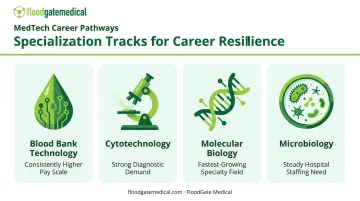
The 2023 ASCP Wage Survey found molecular biology techs saw real wage gains even as general staff pay stagnated in some categories. FloodGate Medical's career coaches can help you match your skills to these higher-paying specialties as you plan your next move.
How to Become a Medical Technologist in 2026
The path depends on which role you're targeting.
- Choose your credential level. A bachelor's degree in medical technology or a related life science leads to the technologist/MLS track. An associate's degree supports the technician/MLT track, which can later bridge into MLS with additional coursework and clinical experience.
- Complete a NAACLS-accredited program. Accreditation matters for certification eligibility down the line.
- Sit for certification. The two main certifying bodies are:
- ASCP (American Society for Clinical Pathology) – MLS and MLT credentials
- AMT (American Medical Technologists) – parallel MLS pathway with education, military, or alternate-education routes
- Check state licensure. Requirements vary. States including California, Florida, New York, and Louisiana require licensure on top of national certification, so confirm rules with your specific state board.
- Keep learning after you're certified. Both ASCP and AMT require ongoing continuing education credits every three years, and labs increasingly expect familiarity with automation, digital pathology, and molecular techniques.
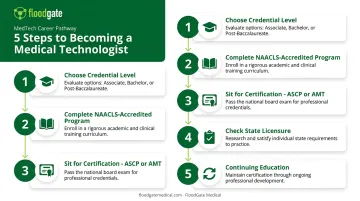
Skipping that last step is a mistake. Programs that don't teach automated workflows are graduating people into labs that no longer look like their textbooks. Career coaching services, like those FloodGate Medical offers MedTech job seekers, can help you figure out which certifications and skill sets employers are actually prioritizing before you commit years to a specific track.
Future-Proofing Your Medical Technology Career
A 2% growth rate doesn't mean your career stalls. It means the easy, generic path gets more competitive, while specialized and adjacent skills become more valuable.
A few moves worth making:
- Build fluency in informatics like data analysis and lab information systems to become more valuable than automated systems.
- Pursue certifications in high-growth niches like molecular diagnostics and genetic testing, which are expanding faster than routine lab work.
- Connect with the broader MedTech industry, where diagnostics intersects with device innovation and clinical trials, opening up new career paths.
That last point is where firms like FloodGate Medical fit in. They specialize in connecting professionals with MedTech companies using a DEI-driven approach that goes beyond matching keywords on a resume.
For lab professionals eyeing adjacent career paths—in clinical affairs, quality, or commercial roles—staying plugged into recruiter networks like FloodGate's can surface opportunities you won’t find on standard job boards.
The technologists who thrive over the next decade won't just be the most technically skilled. They'll be the ones who kept building skills nobody automated away.
Frequently Asked Questions
Is a medical technologist in demand in the USA?
Yes, though growth has slowed. Demand stays steady because of an aging population and constant diagnostic testing needs, even as the BLS projects only 2% job growth through 2034.
Will AI replace medical laboratory technologists?
Unlikely in the near term. AI and automation speed up specimen processing and flag results, but human oversight, troubleshooting, and complex interpretation still require trained professionals.
Is MLT a stressful job?
It can be. Tight turnaround times, high accuracy demands, and understaffing contribute to burnout risk, though many professionals find the direct impact on patient care rewarding.
What is the difference between a medical technologist and a medical laboratory technician?
Technologists typically hold a bachelor's degree and handle complex testing. Technicians usually hold an associate's degree and perform routine tests under a technologist's supervision.
How long does it take to become a medical technologist?
Most programs take four years for a bachelor's degree, followed by a certification exam. Those with prior science coursework can sometimes complete accelerated or certificate programs faster.
What is the average salary for a medical technologist in 2026?
The most recent BLS data shows a median annual wage of $61,890, though pay ranges from about $38,020 to $97,990 depending on setting, specialization, and location.