That blank is the real problem. Most career change advice assumes you already know your target: a specific job title, industry, or company. But when you're stuck at "I don't know," standard advice like "update your resume" or "network more" doesn't help. You need a different starting point.
This guide covers the mindset shift and small, concrete actions that move you from confusion toward clarity, without requiring you to have it all figured out first.
Key Takeaways
- Feeling directionless is common because career advice assumes a target already exists.
- Small experiments create real clarity faster than quizzes, research, or overthinking.
- Self-assessment tools surface themes and directions, not final job titles.
- Financial and emotional planning matter as much as finding the "right" path.
- Healthcare and MedTech are worth exploring for stability and long-term growth.
What Is a Career Transition (And Why "No Idea" Is Normal)
A career transition is a significant shift in your professional direction. It can be voluntary, like choosing to pursue something more meaningful, or involuntary, triggered by a layoff, health issue, or industry disruption.
Either way, it involves crossing a professional boundary, whether that's your industry, your role, or your employment status.
Common Types of Career Transitions
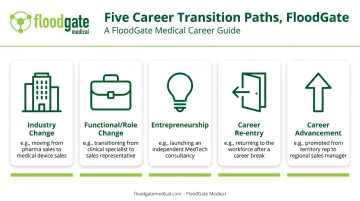
Most transitions fall into one of five buckets:
- Industry change – Same skill set, new sector. A hospital administrator moves into corporate healthcare operations.
- Functional/role change – Same industry, different job. A nurse moves from bedside care into medical device sales.
- Entrepreneurship – Leaving traditional employment to start your own venture.
- Career re-entry – Returning to the workforce after a break, often through a returnship program.
- Career advancement – Moving up into higher-responsibility roles, sometimes through lateral steps first.
Here's the gap almost nobody talks about: nearly all career transition content assumes you've already picked your destination. It tells you how to network your way into "Product Marketing at a SaaS company" or how to negotiate a switch into "UX Design." That's fine if you already know where you're headed.
But if you don't? You're not broken, and you're not behind. You're just missing a step that most guides skip entirely, which is exactly what the rest of this article addresses.
Why You Feel Stuck: The Real Obstacles to Figuring It Out
The obstacles keeping you stuck are rarely external. They're internal, and they're common enough that you'd probably recognize them in a coworker before you'd admit them in yourself.
The fears nobody names out loud:
- Taking a pay cut and having to explain it to family
- Starting over at a level below where you currently sit
- Being judged for "throwing away" years of experience
- Losing the professional identity you've built
There's also a visibility problem. You've spent years inside one industry, so that's the lens you see career options through. You don't know what you don't know, which makes it nearly impossible to imagine alternatives that exist just outside your field of view.
The instinct is to think your way out of that fog. Overthinking makes it worse, not better. Taking another personality quiz or spending another weekend making pros-and-cons lists rarely produces a breakthrough. If this could be solved by thinking harder, most people would have solved it already.
Even after you quiet the overthinking, the hiring process itself works against you. Traditional job hunting fails career changers specifically, because you can't win a paper-based comparison against candidates with direct, relevant experience. That's a structural disadvantage, not a resume problem.
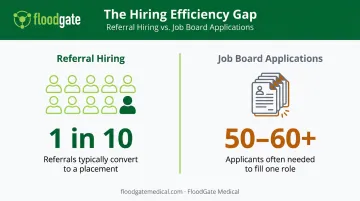
Referral-based hiring performs far better: enterprise data shows roughly 1 in 10 employee referrals converts to a hire, compared to 50-60+ cold applicants needed per hire through job boards.
If it feels like you're the only one stuck between "hate this job" and "no idea what's next," you're not. A Pew Research survey found that 53% of employed adults who quit a job in 2021 changed their field or occupation entirely. You're in the majority, not the exception.
Self-Assessment: Uncovering Clues Before You Have a Destination
Skip trying to name a job title right now. Instead, take inventory using a simple framework: Values, Interests, Personality, and Skills (VIPS).
Ask yourself:
- What makes me genuinely excited to start the week?
- How does money actually factor into my priorities, versus what I assume it should?
- Where do I need support from colleagues and workplace culture to stay engaged?
- Which parts of my current job do I actively avoid, and which do I lean into?
Three low-commitment tools worth trying:
| Tool | What It Measures | Cost |
|---|---|---|
| Myers-Briggs (MBTI) | Personality preferences across 16 types | Paid (around $60 for the official version) |
| O*NET Interest Profiler | Six occupational interest areas tied to real job categories | Free |
| CareerOneStop | Interests, skills, and work values matched to careers | Free |
None of these tools will hand you a job title. They're designed to surface themes, like "you value autonomy" or "you're drawn to problem-solving work," which narrow your search from thousands of jobs to a few promising categories. If you're deciding whether to stay in MedTech or move into something new, a career coach — like those on FloodGate Medical's team — can help you translate these themes into concrete next steps.
While you're at it, list the transferable skills from your current role: project management, client communication, data analysis, and team leadership. These carry value across multiple paths and shrink the "starting from zero" fear that keeps a lot of people frozen in place.
Act Your Way to Clarity: Why Small Moves Beat Big Analysis
Here's the mindset shift that changes everything: clarity comes from action, not from more thinking. You don't figure out your next career and then go test it. You test small things, and clarity shows up as a byproduct.
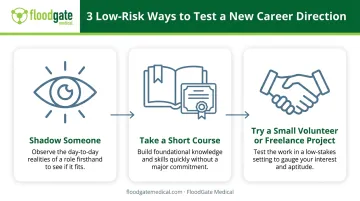
Low-risk experiments to try:
- Shadow someone for half a day in a role or industry you're curious about.
- Take one short course related to a field you keep circling back to.
- Take on a small volunteer or freelance project that lets you sample the work before committing.
None of these require quitting your job or making a public announcement. Talking to people who already do the work matters just as much as testing it yourself.
Prioritize conversations over job boards. Informational interviews, informal 20-30 minute conversations with someone doing the work you're curious about, reveal things a job posting never will.
These conversations show you:
- What a typical day actually feels like
- What skills genuinely matter on the job
- What nobody puts in the listing
They also surface opportunities that were never advertised in the first place.
None of this works well alone, though. Isolation breeds inertia. Whether it's peers, a coach, or a structured community, having people to process the ambiguity with keeps you moving instead of stuck in another research loop. This is part of why programs like FloodGate Medical's career coaching build in peer accountability alongside one-on-one guidance.
One more mindset shift: every experiment succeeds if it helps you cross an option off your list. You're not trying to nail it on the first try. You're narrowing the field.
Build a Realistic Transition Plan
Once a direction starts to feel promising, build a plan around it, not a leap of faith.
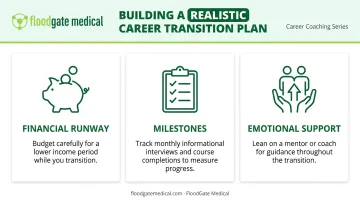
Financial runway:
- Calculate the actual gap between your current income and a realistic target-role salary.
- Try living on that projected lower salary for a couple of months before you make the jump, so the number stops being theoretical.
- Budget separately for retraining costs, certification fees, or a temporary step down in seniority.
Set milestones instead of one big deadline:
- Complete one informational interview per month.
- Finish one relevant course by a specific date.
- Apply to one stretch opportunity per quarter.
Prepare emotionally, too. Milestones keep you accountable, but the emotional side of a transition matters just as much.
Status changes and setbacks are part of the process, not signs you chose wrong.
Identify who can support you through the uncertain middle stretch, whether that's a partner, a mentor, or a career coach, like the specialists at FloodGate Medical who work exclusively with MedTech professionals.
What Is a Good Career to Transition Into?
There's no universally "best" industry to jump into. A good transition target is one that matches your VIPS findings to a field with genuine growth and stability, not whatever's trending on social media.
That said, some sectors offer more room to build a long-term career than others. Healthcare and medical technology are worth serious consideration if you value both security and meaningful work.
The U.S. Bureau of Labor Statistics projects steady growth for both fields through 2034:
| Sector | Projected Growth (2024–2034) |
|---|---|
| Healthcare & social assistance | 8.4% |
| Medical equipment & supplies manufacturing | 4.8% |
Both are expanding. Healthcare overall grows faster, but MedTech manufacturing remains a genuinely growing field, not a shrinking niche.
FloodGate Medical works exclusively with MedTech companies and candidates, which gives it visibility into the roles and skills in demand across commercial, clinical, regulatory, and operational functions. If MedTech feels like a fit worth investigating, a few resources can help you go deeper:
- The Career Transition Guide walks through what a move into medical devices typically looks like.
- Breaking Into MedTech covers common entry points for people coming from adjacent fields like clinical care, pharma, or general sales.
- Futures for Veterans supports military professionals exploring a move into the industry.
FloodGate Medical also applies a DEI-driven approach to how it advises candidates, aiming to widen the door for people who don't fit the traditional MedTech mold rather than narrowing it further.
Frequently Asked Questions
What is a career transition?
A career transition is a significant shift in your professional direction, such as changing industries, roles, or employment status. It can be voluntary or triggered by external circumstances like a layoff.
What is a good career to transition into?
The "best" career depends on matching your values, interests, personality, and skills to a field with real growth and stability. Healthcare and MedTech are strong examples worth researching if security and impact both matter to you.
Is 27 too late for a career transition?
Not at all. 27 is early in most careers, and many people make major transitions well into their 30s, 40s, and beyond.
How long does it typically take to change careers?
Timelines vary widely, from several months to a few years, depending on how much retraining or networking your target field requires. Set milestone-based expectations instead of a fixed deadline.
Do I need to go back to school to change careers?
It depends entirely on your target field. Some transitions rely mostly on transferable skills, while others require specific certifications or degrees, and flexible online programs can help bridge that gap.
How do I know if I'm ready to change careers?
Look for persistent dissatisfaction, clarity around themes from your self-assessment (not necessarily a job title yet), and a workable financial and emotional plan. If those three are in place, you're ready to start experimenting, ideally with support from a career coach like FloodGate Medical.