The problem? Job titles in this space are a mess. Medical documentation specialist, clinical documentation specialist, medical records specialist, medical transcriptionist — employers often use these terms loosely, and candidates end up applying for roles that don't match what they actually want to do.
This guide clears up the confusion. You'll learn what the role actually involves day-to-day, the skills that get you hired, education and certification paths, realistic salary numbers, and where the career can lead — including newer opportunities inside MedTech and medical device companies.
Key Takeaways
- Medical documentation specialists keep patient records accurate, complete, and HIPAA-compliant.
- A four-year degree isn't required — certificates and associate degrees are common entry points.
- RHIT or CHDS certifications aren't required, but they strengthen a resume and support pay growth.
- Employment is projected to grow 7% from 2024 to 2034, driven by an aging population.
What Does a Medical Documentation Specialist Do?
A medical documentation specialist organizes, reviews, and maintains patient records so they're accurate, complete, and legally sound. Think of them as the quality-control layer between what happens in an exam room and what ends up in a patient's permanent file.
The title overlaps with several related roles, and employers rarely draw a clean line between them:
- Medical records specialist: the closest federal occupational match, focused on compiling files, entering EHR data, and assigning diagnosis/procedure codes.
- Clinical documentation specialist (CDI): reviews clinical records to confirm diagnoses and treatments fully reflect the patient's condition, often working closely with physicians on documentation accuracy.
- Medical transcriptionist: converts provider dictation into written reports or edits speech-recognition drafts, a narrower and more technical function.
In practice, a documentation specialist might touch medical histories, discharge summaries, operative reports, referral letters, and insurance paperwork, all in the same week.
Where Medical Documentation Specialists Work
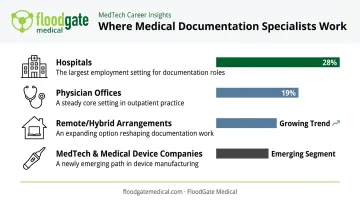
Most of this work still happens inside hospitals and physician offices, but the setting is broadening.
- Hospitals employ the largest share of medical records specialists, at roughly 28% of the workforce.
- Physician offices account for another 19%.
- Remote and hybrid arrangements have grown as cloud-based EHR platforms make off-site record review practical.
- MedTech and medical device companies now hire documentation-savvy professionals for regulatory submissions and clinical trial paperwork, a path that didn't exist at this scale a decade ago.
That last point matters. As of 2024, 91% of office-based physicians and more than 99% of non-federal acute-care hospitals had adopted certified EHRs, according to ONC's national EHR adoption data. That near-universal digital environment is exactly why documentation accuracy skills translate so well across clinical and MedTech settings alike.
Key Responsibilities & Daily Tasks
No two days look identical, but the core rhythm of the job is consistent. A typical shift involves reviewing patient files for completeness, flagging missing or conflicting information, and querying physicians when something doesn't add up.
Core daily tasks include:
- Reviewing charts for gaps, contradictions, or outdated information before they reach billing or coding
- Validating diagnosis and procedure codes so insurance claims aren't kicked back
- Following facility-specific documentation protocols and safeguarding patient confidentiality under HIPAA
- Collaborating with physicians, nurses, coders, and insurance reps to resolve discrepancies quickly
- Working inside EMR/EHR systems, and in some roles, editing speech-recognition or transcribed dictation
The stakes here are measurable: denied claims tied to documentation problems cost real money to fix.
Industry estimates put the average rework cost at $25 for a denied practice claim and $181 for a denied hospital claim, according to a 2022 Journal of AHIMA analysis. Multiply that across hundreds of claims a month, and it's clear why facilities lean so heavily on this role to catch problems before they compound.
Essential Skills for Success
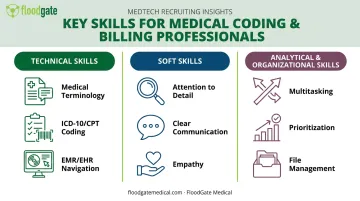
The best documentation specialists blend technical fluency with people skills — this isn't purely a desk job where you never talk to anyone.
Technical skills:
- Master medical terminology and basic anatomy/physiology concepts
- Understand ICD-10 and CPT coding fundamentals
- Navigate EMR/EHR platforms confidently, along with speech-recognition software when required
Soft skills:
- Maintain sharp attention to detail: small errors compound into billing and compliance headaches
- Communicate clearly, in writing and verbally, when querying physicians without slowing their workflow
- Show empathy when handling sensitive patient information, especially in cases involving mental health or chronic illness
Analytical and organizational skills round it out. You're often managing dozens of active patient files simultaneously, spotting inconsistencies across large volumes of records, and prioritizing which discrepancies need immediate physician input versus routine follow-up. Multitasking isn't a bonus skill; it's a core, non-negotiable part of the role.
How to Become a Medical Documentation Specialist
Education Requirements
A four-year degree is not the default entry point. Most medical records specialists start with a postsecondary certificate, and some enter with just a high school diploma paired with on-the-job training.
That said, employers increasingly favor candidates with an **associate's or bachelor's degree in health information management** for advancement, especially in hospital systems or larger organizations. Relevant coursework typically covers:
- Medical terminology
- Anatomy and physiology
- Healthcare data standards
- Pharmacology basics
- Health information systems
Certification & Credentials
Certification isn't universally required, but it does improve competitiveness. Two credentials stand out:
- Registered Health Information Technician (RHIT), offered through AHIMA, requires completion of an associate-level, CAHIIM-accredited HIM program and covers information governance, privacy, compliance, and data analytics.
- Certified Healthcare Documentation Specialist (CHDS), offered through AHDI, is geared toward advanced acute-care transcription and documentation work, and typically requires prior experience.
Requirements and employer preferences vary by state and organization, so it's worth checking job postings in your target market before investing in a specific credential.
Gaining Experience
Breaking in usually starts with practical, hands-on exposure rather than a credential alone.
- Internships or externships built into a degree program
- Related roles like medical scribe, administrative assistant, or medical coder, all of which build transferable documentation skills
- Staffing partners who understand where documentation skills are in demand
This is where working with a specialized recruiting partner can pay off. FloodGate Medical, for instance, connects professionals with MedTech and healthcare technology companies through a diversity-driven placement approach.
For documentation specialists exploring roles in medical device or clinical research settings, that network can open doors to positions adjacent to regulatory affairs and clinical trial support.
Salary, Job Outlook & Career Growth
Pay varies significantly by setting. The Bureau of Labor Statistics reports a $50,250 median annual wage for medical records specialists as of May 2024, per the BLS Occupational Outlook Handbook.
| Work Setting | Median Annual Wage |
|---|---|
| Management of companies/enterprises | $60,750 |
| Hospitals | $56,520 |
| Professional/scientific/technical services | $49,970 |
| Administrative support services | $49,590 |
| Physician offices | $45,620 |
Job growth looks solid: BLS projects 7% growth from 2024 to 2034, adding roughly 13,800 jobs and creating about 14,200 openings annually, well above the average for all occupations. The main driver is an aging population generating more chronic-condition care and, in turn, more documentation volume. However, AI-assisted coding tools could temper demand somewhat over time.
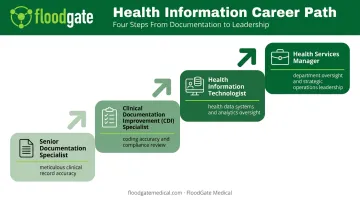
Advancement paths typically include:
- Senior documentation specialist
- Clinical Documentation Improvement (CDI) specialist
- Health information technologist
- Health services manager
There's also a growing lane inside MedTech itself. Medical device and health tech companies need documentation-focused talent for regulatory submissions and clinical trial paperwork, drawing on the same accuracy and compliance instincts as traditional health records roles.
Firms like FloodGate Medical specialize in placing candidates into this niche, offering hospital-based specialists a path into the broader healthcare technology industry.
Frequently Asked Questions
What does a medical documentation specialist do?
They review, organize, and update patient records for accuracy and regulatory compliance. This includes coordinating with physicians, coders, and insurance representatives to resolve discrepancies.
Do you need a degree to be a medical documentation specialist?
No. A postsecondary certificate is often enough to start. An associate's or bachelor's degree in health information management can improve job prospects and long-term pay.
What is the difference between a medical documentation specialist and a medical transcriptionist?
Transcriptionists convert provider dictation into written text, a narrower technical task. Documentation specialists handle broader record review, compliance checks, and coordination with clinical staff.
How much does a medical documentation specialist earn?
The median annual wage for medical records specialists is $50,250, according to the U.S. Bureau of Labor Statistics. Pay varies by setting, ranging from around $45,620 in physician offices to over $60,000 in corporate settings.
What certifications help advance a medical documentation specialist career?
RHIT (through AHIMA) and CHDS (through AHDI) are the two most recognized credentials. Neither is mandatory everywhere, but both improve job competitiveness and support pay growth.
Can you work remotely as a medical documentation specialist?
Yes. Many documentation and transcription roles now offer remote or hybrid arrangements, largely because cloud-based EHR systems make secure off-site record access practical.