

Introduction
Somewhere behind almost every diagnosis sits a test nobody sees. The CDC has stated that laboratory professionals run roughly 14 billion tests a year, underpinning as much as 70% of medical decisions.
People repeat that number constantly, though a 2020 peer-reviewed study points out the evidence behind the exact percentage is thinner than most assume. Either way, lab work drives nearly every treatment call a physician makes.
Whether you're a MedTech or healthcare employer building out your lab team, or a professional weighing this career path, the responsibilities hiding behind the job title matter.
This guide breaks down what medical laboratory technicians actually do day to day, the skills and credentials to look for, current salary data, and a ready-to-use job description outline you can adapt.
Key Takeaways
- MLTs handle diagnostic testing under supervision, from specimen collection through result reporting
- This role requires an associate degree plus ASCP or AMT certification; licensure varies by state
- Combined technologist/technician wages reached a median of $61,890 in May 2024, per BLS
- Job growth is projected at 2% through 2034, adding about 22,600 annual openings
- A clear, bias-free job description widens the candidate pool and shortens time-to-hire
What Is a Medical Laboratory Technician?
A medical laboratory technician (MLT) processes and tests blood, urine, and tissue samples to help physicians diagnose and treat disease. MLTs work under the supervision of a Medical Laboratory Scientist, technologist, or pathologist, handling testing that ranges from routine to moderately complex.
Job postings often use "MLT," "lab tech," and "certified clinical laboratory technician" interchangeably. But the distinction between an MLT and a Medical Laboratory Scientist (MLS) actually matters for hiring, pay, and scope of practice:
| Factor | Medical Laboratory Technician (MLT) | Medical Laboratory Scientist (MLS) |
|---|---|---|
| Education | Associate degree in clinical laboratory science | Bachelor's degree in medical technology or related science |
| Testing scope | Routine, often automated tests | Complex procedures, greater QA responsibility |
| Supervision | Works under a technologist or lab manager | Carries more autonomy and oversight duties |
Where MLTs work: According to BLS occupational data, employment breaks down across several settings:
- Hospitals, which employ the largest share of the workforce
- Independent diagnostic laboratories
- Physicians' offices
- Educational institutions
A growing number of MLTs also land roles inside MedTech and diagnostic device companies, running quality testing on products before they reach clinical use. That's a path worth knowing about if you're mapping out where this career can go.
Key Responsibilities and Daily Duties of a Medical Laboratory Technician
MLT duties span three phases of testing (pre-analytical, analytical, and post-analytical) across hematology, chemistry, microbiology, immunohematology, and coagulation. A single shift might touch all five disciplines depending on lab size and patient volume.
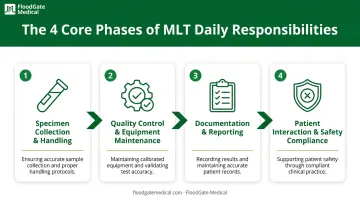
Specimen Collection, Handling & Testing
MLTs match specimen labels against computer orders before anything else happens. Mislabeled samples cause more downstream errors than almost any other lab mistake. From there, technicians:
- Sort, prepare, and preserve samples for the appropriate test type
- Run routine to moderately complex tests using automated analyzers, microscopes, and cell counters
- Reject specimens that fail acceptance criteria (hemolyzed blood, insufficient volume, expired collection tubes)
Quality Control & Equipment Maintenance
Every analyzer needs daily attention. Technicians calibrate instruments, run standards and controls before processing patient samples, and troubleshoot when results drift outside expected ranges. Skipping this step risks compliance failures and lets equipment problems slip through before they affect patient results.
Documentation, Reporting & Physician Communication
Once results are validated, MLTs record them in the laboratory information system or patient chart. Critical or abnormal values get flagged immediately, often triggering a direct call to the ordering physician or supervising technologist. This documentation is the handoff that turns a validated result into clinical action for the physician.
Patient Interaction & Safety Compliance
Many MLTs collect specimens directly from patients, which means explaining procedures, managing anxious reactions, and protecting patient confidentiality at every step. Safety protocols run in parallel: PPE, infection control, biohazard disposal, and sterility testing on equipment that touches multiple patients daily.
Essential Skills and Qualifications for Medical Laboratory Technicians
The best MLT candidates combine technical precision with steady composure. Employers screening resumes or writing job postings should look for:
- Analytical and problem-solving skills — spotting abnormalities in results and interpreting them accurately, not just running the machine
- Attention to detail — following strict protocols, since small errors carry real patient consequences
- Manual dexterity — handling needles, specimens, and delicate lab equipment with precision
- Communication skills — explaining procedures to nervous patients while coordinating with technologists, nurses, and physicians
- Physical stamina — standing for long stretches, managing high sample volumes, and working shifts that often include nights, weekends, and holidays
None of these show up on a diploma. They show up in how someone handles a backed-up queue of STAT orders at 2 a.m.
Education, Training & Certification Requirements
Education, Training & Certification Requirements
Most MLT roles require an accredited associate degree in Clinical Laboratory Science, a two-year program that includes a clinical externship. Medical Laboratory Scientists (MLS), by contrast, need a bachelor's degree, which allows for broader testing authority and more autonomy.
Certification routes vary by organization:
- ASCP (American Society for Clinical Pathology): Requires an associate degree or 60 semester hours, plus completion of an accredited MLT program within the last five years.
- AMT (American Medical Technologists): Requires a recent associate degree (within five years) or 1,040 hours of approved clinical experience for older graduates.
Some states also require licensure on top of national certification. Requirements differ by state, so it's crucial to check local rules on a resource like CareerOneStop's License Finder before applying.
Advancement path: Experienced MLTs often pursue additional coursework to transition into MLS roles or other specialized technologist positions. This provides a clear path for career growth without needing to start over.
Salary Expectations and Career Outlook
BLS combines technologists and technicians into one wage category, so there's no perfectly isolated MLT figure. That said, the May 2024 data from BLS shows:
- Median annual wage: $61,890 (about $29.75/hour)
- Lowest 10%: below $38,020 — a reasonable entry-level benchmark for technicians specifically
- Highest 10%: above $97,990, typically technologists in specialized or supervisory roles
Job outlook: Employment in this combined category is projected to grow 2% from 2024 to 2034, adding roughly 6,000 jobs. That translates to about 22,600 openings annually, mostly from workers retiring or transferring out, not rapid expansion. An aging population and increased genetic testing are pushing demand up, while automation keeps growth modest.

Is it a good career? For a two-year degree, yes. Entry barriers stay low, job stability holds steady, and the advancement path into MLS or specialized technologist roles is clear.
Some MLTs also move beyond bench work entirely, into quality, regulatory, or field roles at MedTech companies. If that's the direction you're considering, FloodGate Medical's content hub tracks MedTech career opportunities and industry insights worth following as you plan that transition.
How to Write an Effective Medical Laboratory Technician Job Description
A strong job posting starts before the bullet points. Open with a brief intro about your facility, lab culture, and what makes your team worth joining. Serious candidates skip past generic postings fast.
Core sections every MLT job description needs:
- Responsibilities: specimen handling, testing disciplines, QC duties, and reporting expectations
- Required qualifications: degree, certification (ASCP or AMT), and any state licensure
- Work hours & benefits: shift patterns, weekend/holiday rotation, and compensation range
- Call to action: a clear, simple next step for applying
Bias-free language matters in your qualifications section. Swap "recent graduate" for "candidates at any career stage" and avoid unnecessary jargon that filters out qualified applicants who phrase their experience differently than you expect. This practice widens your candidate pool measurably.
Employers struggling to find qualified lab talent, especially from underrepresented backgrounds, don't have to solve this alone. FloodGate Medical works with MedTech companies and healthcare employers through permanent placement and contract staffing. Its DEI-driven approach connects vetted MLT and MedTech candidates with the right roles faster than a generic job board.
Frequently Asked Questions
What is the role of a medical laboratory technician?
MLTs perform routine diagnostic tests on blood, urine, and tissue samples under supervision, helping physicians diagnose and treat disease. Their work spans specimen collection, testing, quality control, and result reporting.
What is the salary of a medical laboratory technician in the US?
According to the BLS Occupational Outlook Handbook, combined technologist and technician wages show a median of $61,890 as of May 2024. Technician-specific pay tends to sit closer to the lower deciles, below $38,020, and varies by state and employer type.
Is a medical laboratory technician a good career?
Yes — it offers job stability, a low-cost two-year entry path, and steady demand tied to an aging population. Advancement into MLS or specialized MedTech roles adds long-term earning potential.
What skills do you need to be a medical laboratory technician?
Analytical thinking, attention to detail, manual dexterity, and clear communication with patients and clinical staff. Physical stamina matters too, given shift work and standing for long stretches.
What is the difference between a medical laboratory technician and a medical technologist?
MLTs hold an associate degree and perform routine testing under supervision. Medical technologists (MLS) hold a bachelor's degree, handle more complex procedures, and carry broader quality-assurance responsibility.
How long does it take to become a medical laboratory technician?
Most programs take about two years to complete an accredited associate degree, including clinical externship hours. Certification exam prep adds additional time, though neither ASCP nor AMT specifies a standard duration.