
Introduction
Hospital and clinic construction starts are projected to climb 11.6% to $30.7 billion in 2026, according to HFMA's construction spending forecast.
That kind of capital activity means one thing for MedTech companies and health systems alike: someone has to translate clinical needs into functional, technology-ready spaces.
That someone is the medical planner. But hiring managers often confuse this title with "discharge planner" or "healthcare facility planner," and the mix-up leads to vague job postings, mismatched candidates, and slower fills.
This guide breaks down what a medical planner actually does, the qualifications worth screening for, and realistic 2026 salary data. You'll also learn how to write a job description that attracts the right talent — whether you're hiring or job hunting.
Key Takeaways
- Medical planners translate clinical operations into facility layouts, equipment placement, and workflows
- Core duties span space planning, supply coordination, communication, and compliance monitoring
- Most roles require a bachelor's degree in architecture or healthcare design, plus certification
- U.S. pay ranges from roughly $63,800 to $97,000+, depending on scope and employer
- Specialized MedTech recruiters like FloodGate Medical help fill these niche roles faster
What Does a Medical Planner Do?
A medical planner works with hospitals, MedTech manufacturers, and design teams to convert clinical operations into functional space and equipment plans. In healthcare design specifically, this means gathering utilization data, mapping department adjacencies, and building the functional program that architects use to design a facility.
In MedTech contexts, the role stretches further. Medical planners also oversee how new devices get rolled out within care settings, checking that a cath lab or imaging suite has the electrical capacity, gas lines, and spatial clearance a new system needs before it ever arrives.
Bridging Clinical, Design, and Budget Priorities
Medical planners spend a lot of time in rooms full of people who don't speak the same professional language. Surgeons think in workflow. Architects think in square footage. Administrators think in budget line items.
The planner's job is building consensus across all three. That typically involves:
- Facilitating meetings between clinicians, architects, and hospital administrators
- Developing schematics, floor plans, and presentation graphics that non-technical stakeholders can actually understand
- Translating clinical requirements into design specifications architects can build from
Core Responsibilities & Duties
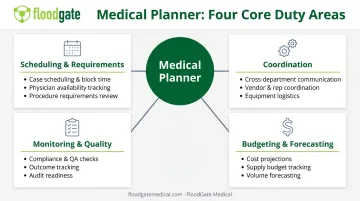
Day-to-day, the role breaks into four functional buckets:
Scheduling and requirements
- Distributes production schedules and work orders to relevant teams
- Reviews design and clinical documents to determine personnel or material needs
- Confirms staffing and equipment availability align with proposed project timelines
Coordination
- Arranges delivery and assembly of equipment and supplies
- Confers regularly with department supervisors on changing needs
- Revises schedules when design changes or material shortages hit
Monitoring and quality
- Examines documents and drawings for accuracy
- Monitors construction and procurement processes for conformance to codes and standards
- Records and compiles production and project-status data for stakeholders
Budgeting and forecasting
- Calculates labor and material costs for planning phases
- Uses sales or demand forecasts to plan production and equipment commitments
- Prepares cost projections for leadership approval
Medical Planner Qualifications & Skills
Education & Certifications
Most employers look for a bachelor's degree in architecture, healthcare design, interior design, or a related field. Beyond the degree, a recognized healthcare design credential carries real weight:
| Credential | Best For |
|---|---|
| EDAC (Evidence-Based Design) | Planners focused on outcomes-driven design decisions |
| ACHA Board Certification | Licensed architects specializing in healthcare (requires 3+ years licensed, 6,000+ healthcare hours) |
| CHID (Healthcare Interior Design) | Interiors-focused planners with 3+ years healthcare experience |
For senior-level or MedTech-specialized planning positions (where equipment rollout and infrastructure readiness matter as much as floor plans), employers frequently prefer a master's degree in architecture, healthcare administration, or a related discipline.
Essential Skills
Technical knowledge only gets a medical planner halfway there. The rest comes down to soft skills that don't show up on a blueprint:
- Reading comprehension and active listening: interpreting dense clinical, technical, and regulatory documents accurately
- Written and verbal communication: explaining complex plans clearly to clinicians, executives, and equipment vendors who all need different levels of detail
- Critical thinking and judgment: weighing design, cost, and equipment tradeoffs when priorities conflict
- Coordination and time management: juggling multiple concurrent projects, teams, and suppliers without dropping a deadline
A planner who's strong technically but weak on stakeholder communication tends to create friction fast. Hire for both.
Medical Planner Salary Expectations
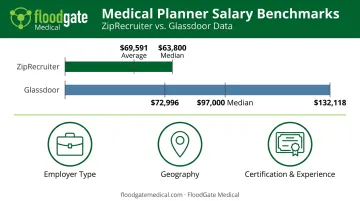
Pay data for this exact job title is inconsistent, so treat any single number with caution. Two of the most-cited salary trackers illustrate just how wide that gap can be:
| Source | Pay Metric | Figure |
|---|---|---|
| ZipRecruiter's 2026 data | Average annual pay | $69,591/year (~$33.46/hour); median ~$63,800 |
| Glassdoor's 2026 figures | Median total pay | $97,000; 25th–75th percentile $72,996–$132,118 |
Why the gap? Sample size and title scope. Neither platform consistently isolates facility-design medical planners from adjacent titles.
What actually moves the number:
- Employer type: private MedTech companies and public health systems don't pay identically, though no controlled study confirms which pays more
- Geography: coastal markets and major metros typically command higher rates
- Experience and certification: ACHA-certified or EDAC-credentialed planners with MedTech equipment specialization sit at the top of the range
Use these figures as a starting range, not a fixed benchmark, and adjust based on the specific scope of your opening.
How to Hire (or Become) a Medical Planner
For employers writing the job description:
- Name the deliverables up front (functional program, department layout, equipment plan, or device rollout) instead of a vague "planning" title
- Distinguish the role explicitly from discharge planning or general facility management in the posting itself
- Specify MedTech requirements if the position involves equipment infrastructure, such as imaging suite readiness or cath lab electrical capacity
- List required credentials by scope (architecture license for build-focused roles, EDAC or CHID for design-focused roles)
Niche roles like this are exactly where generalist job boards struggle. FloodGate Medical specializes in MedTech talent acquisition and draws on an extensive network of MedTech professionals. Its DEI-driven recruitment approach helps companies build more diverse, qualified candidate slates faster than a standard posting typically would.
For job seekers:
Your resume should lead with the stakeholder management piece, not just the design credentials. This job comes down to two things hiring managers screen for first:
- Cross-functional coordination: getting a surgeon, a hospital CFO, and an architect to agree on a floor plan
- Concrete examples of equipment or facility projects you've delivered
Lead with both, and you'll stand out from candidates who only list technical skills.
Related Healthcare Planning Career Paths
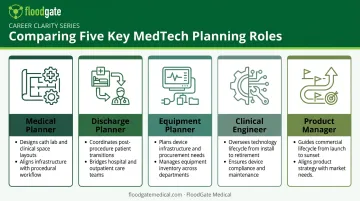
Discharge planner. Don't confuse this with medical planning. CMS discharge planning requirements define discharge planning as managing patient transitions to post-acute care, not facility or equipment design. It's a clinical case-management role typically filled by nurses or social workers.
Healthcare or hospital equipment planner. This one overlaps heavily with medical planning, especially in MedTech settings. Equipment planners focus narrowly on device selection, placement, and infrastructure readiness. They check that a new imaging system has the power, gas, and space it needs, rather than programming the entire department.
Other adjacent MedTech paths worth exploring:
- Clinical engineer: owns technology performance, safety, and lifecycle management once equipment is installed
- Product manager: owns a device's commercial lifecycle, from market research through launch, rather than the physical space it occupies
Candidates weighing a move into or out of medical planning often find these titles are where their design and stakeholder-management skills transfer most directly.
Frequently Asked Questions
What do healthcare planners do?
Healthcare planners assess clinical operations and design facility layouts, workflows, and equipment placement to improve patient care and operational efficiency. They act as the bridge between clinicians and architects.
How much do planners get paid?
U.S. medical planner pay ranges from roughly $63,800 to $97,000+ depending on the source, with senior and MedTech-specialized roles trending higher. Pay varies by experience, employer type, and region.
What skills do you need to be a discharge planner?
Discharge planners need clinical knowledge, care coordination skills, strong communication, and organizational ability. The role centers on patient transitions, not facility design.
What is the difference between a medical planner and a healthcare planner?
The terms are often used interchangeably. "Medical planner" sometimes leans more heavily toward MedTech equipment and technology integration, while "healthcare planner" often skews toward architecture and space programming.
What qualifications do you need to become a medical planner?
Most roles require a bachelor's degree in architecture, healthcare design, or a related field, plus a certification like EDAC, CHID, or ACHA board certification. Senior and MedTech-specialized roles often prefer a master's degree too.
Is medical planning a good career path in the MedTech industry?
Yes, ongoing hospital construction and equipment upgrades keep demand steady for planners who understand facility design and device rollout. Specialized recruiters like FloodGate Medical connect qualified candidates to relevant MedTech opportunities.
![Medical Scheduler Job Description [Updated for 2026]](https://file-host.link/website/floodgatemedical-yc9tym/assets/blog-images/692cc1a1-aabe-486c-8c34-f627625d633f/1785145458154350_2bcaf2d1c39c43d58f2b1428a008affc/1080.webp)
![Medical Practice Manager Job Description [Updated for 2026]](https://file-host.link/website/floodgatemedical-yc9tym/assets/blog-images/aaa27d1a-a01c-4fb8-b5f3-41b7461ce7f8/1785145357693488_9e5775b277a243ac90b133a686093465/1080.webp)