If you're researching a Certified Medical Technician (CMT) role, you've probably noticed the job title confusion. CMT, CNA, CMA. Different states use these terms differently, and job postings rarely explain the distinctions.
This article breaks down what CMTs actually do, how to get certified, what skills employers expect, typical pay ranges, and how the role stacks up against CNAs and CMAs.
Key Takeaways
- CMTs administer medications and provide hands-on care under nurse or physician supervision
- Certification requires an accredited training program plus a state exam that varies by state
- Medication administration authority is the main line separating CMTs from CNAs
- Experienced CMTs can advance into supervisory roles, certifications, or healthcare careers
What Is a Certified Medical Technician (CMT)?
A CMT is a healthcare worker trained to administer medications and provide basic clinical support under the supervision of a licensed nurse or physician. Think of it as a step beyond a nursing assistant, with added authority to handle medication tasks that CNAs typically can't perform.
Here's where it gets confusing: the CMT acronym isn't standardized nationally. Missouri calls this role "Certified Medication Technician." Texas uses "Medication Aide." Some states don't formally use the CMT title at all, instead folding medication administration into an add-on credential for existing CNAs.
Where CMTs typically work
CMTs are concentrated in long-term care, not hospitals. While national CMT-specific employment data doesn't exist, the closest available proxy (nursing assistant employment by setting) shows:
- Nursing care facilities: 35%
- Hospitals: 33%
- Assisted living/continuing care communities: 11%
- Home healthcare: 5%
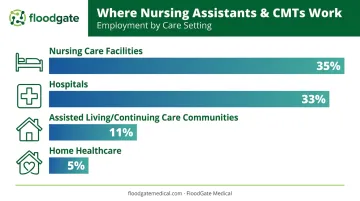
State regulations reinforce this pattern. Texas and North Carolina both center their medication-aide rules on nursing facilities and related long-term-care institutions, not acute-care hospitals.
Don't confuse this with "medical technologist"
One more wrinkle: CMT sometimes gets confused with clinical laboratory technologist, a completely different job that performs diagnostic lab testing on blood and tissue samples. According to the BLS profile on clinical laboratory technologists, these roles work in labs analyzing specimens, not administering medications bedside.
If a job posting says "CMT" and mentions lab work, read carefully. It's likely referring to a different occupation entirely.
Core Responsibilities and Daily Duties of a CMT
CMT duties center on medication administration, but the day-to-day workload extends well beyond passing pills.
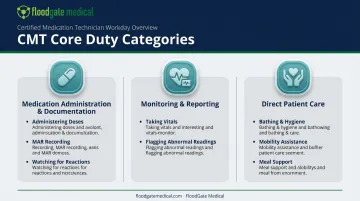
Medication administration and documentation
- Administering prescribed medications through authorized routes (oral, topical, ophthalmic, and others, depending on state rules)
- Recording every dose on the Medication Administration Record (MAR), whether on paper or through an EMR system
- Watching for medication errors, side effects, or adverse reactions
Monitoring and reporting
- Taking vital signs (blood pressure, temperature, pulse, respiration) tied to medication administration
- Flagging abnormal readings to nursing staff immediately, not at the end of a shift
- Observing residents for changes in condition
- Rechecking vital signs when initial readings fall outside normal ranges
Direct patient care
Many CMTs also carry over duties from an underlying CNA role, such as:
- Bathing, dressing, and hygiene support for residents who need it
- Mobility assistance, including transfers and safe repositioning
- Meal support, from setting up trays to hands-on feeding assistance when required
Beyond hands-on care, specimen collection is authorized in some states (Indiana's Qualified Medication Aide role permits urine or fecal specimen collection under physician order) but not universally. Always check your state's specific scope of practice before assuming a task is included.
Communication rounds out the role. CMTs relay patient status changes to the care team and often provide emotional reassurance to residents and families navigating a difficult health situation.
How to Become a Certified Medical Technician
The path to becoming a CMT starts with a high school diploma or equivalent. From there, training length and structure depend heavily on your state.
Training program structure
Programs typically combine classroom instruction with supervised clinical practice, offered through community colleges, vocational schools, or employer-based training. Verified training hour requirements vary widely:
| State | Training Hours | Format |
|---|---|---|
| North Carolina | 24 hours | Board-approved course, requires active Nurse Aide I status first |
| Texas | 140 hours | 100 classroom hours + 20 skills lab hours + supervised clinicals |
There's no single national standard, so confirm your state's exact requirement before enrolling.
Core curriculum topics generally include:
- Medication administration routes and dosage forms
- Infection control and safety protocols
- Basic anatomy and physiology
- Vital sign measurement and abnormal-finding reporting
- Medication error recognition and prevention
- MAR (Medication Administration Record) documentation practices
According to the Texas HHS Medication Aide curriculum, the course also explicitly excludes tasks like dose calculation, verbal medication orders, and injections, drawing a clear boundary around what CMTs are and aren't authorized to do.
Certification exam and renewal
After completing training, candidates sit for a state competency exam or a state medication-aide registry test. Some states, like North Carolina, require an active underlying CNA credential before you're even eligible.
Certification isn't permanent. Texas permits last one year, and renewal requires a small fee plus continuing education hours. North Carolina's registry renews every 24 months, contingent on a minimum number of paid work hours during that period. Skipping renewal deadlines can mean starting the certification process over, so mark your calendar.
Skills, Salary, and Career Growth for CMTs
Succeeding as a CMT takes more than memorizing medication routes. Employers look for a specific blend of technical know-how and interpersonal skills.
Essential skills:
- Attention to detail (medication errors carry real consequences)
- Compassion and patience with residents who need extra support
- Ability to multitask during high-pressure shifts
- Clear written and verbal communication with nursing staff and families
- Comfort with EMR and MAR documentation systems
Salary expectations
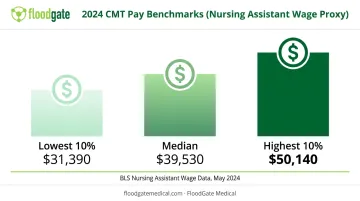
There's no dedicated national CMT wage survey. The closest reliable benchmark comes from BLS data on nursing assistants, which reported a $39,530 median annual wage in May 2024.
The lowest 10% earned below $31,390, while the highest 10% earned above $50,140. Medication-aide certification often adds a pay differential on top of base CNA wages, though the size of that bump depends on your employer and state.
Where the career goes from here
CMTs who want to grow typically move in one of a few directions:
- Supervisory tracks: charge tech, lead tech, or shift supervisor roles
- Additional certifications: phlebotomy, EKG technician, or enrollment in LPN/RN programs
- Lateral moves: switching facility types for better pay or hours
For CMTs eyeing something further afield, like transitioning bedside clinical experience into the medical technology industry, that path exists too. Recruiters who specialize in MedTech, such as FloodGate Medical, work specifically with healthcare professionals moving from direct patient care into clinical specialist or MedTech sales roles.
That kind of transition leans heavily on the communication and patient-facing skills a CMT already has, just applied in a different setting.
CMT vs. CNA vs. CMA: Understanding the Key Differences
These three titles get mixed up constantly, and the confusion is understandable. All three involve direct patient contact. Here's what actually separates them.
| Role | Primary Setting | Medication Authority | Core Focus |
|---|---|---|---|
| CMT | Long-term care, nursing facilities | Yes, within state-authorized routes | Medication administration + basic care |
| CNA | Nursing homes, hospitals | No (without separate medication-aide credential) | ADLs, mobility, hygiene support |
| CMA | Outpatient clinics, physician offices | Varies by state/delegation | Administrative + clinical support tasks |
CMT vs. CNA: A CNA certification alone doesn't grant medication authority. CMTs complete additional training specifically to administer medications, something CNAs generally cannot do without that extra credential.
CMT vs. CMA: This is where acronyms get genuinely messy. Some states use "CMA" for Certified Medication Aide, a role similar to CMT, while the American Association of Medical Assistants uses CMA for Certified Medical Assistant, an entirely different outpatient-focused role.
The distinction comes down to setting and scope:
- CMA (medical assistant): Handles scheduling, basic clinical support, and administrative tasks in a doctor's office
- CMT: Works in long-term care, focusing on medication delivery and resident care
Which is the better fit? If you want steady, hands-on resident care with medication responsibility, CMT is the more direct path. If outpatient clinic work with administrative variety appeals to you, CMA (medical assistant) may fit better. CNA remains the foundational entry point for those still deciding.
Frequently Asked Questions
What does CMT mean in healthcare?
CMT typically stands for Certified Medication Technician or Certified Medication Aide, a worker trained to administer medications and provide basic patient care under supervision, most often in long-term care settings.
What is the difference between a CMA and a CMT?
CMAs (medical assistants) usually handle administrative and clinical support tasks in outpatient clinics, while CMTs focus specifically on medication administration and direct care in long-term care facilities.
Is a CMT the same as a CNA?
No. Both provide hands-on patient care, but CMTs complete additional training that authorizes medication administration, a task CNAs generally cannot perform without that extra credential.
How long does it take to become a Certified Medical Technician?
Training length varies by state, ranging from as few as 24 hours to as many as 140 hours, followed by a state competency or registry exam.
Can a CMT legally administer medications?
Yes, but only within the specific routes, supervision requirements, and facility types authorized by their state. Scope of practice differs from state to state.
What is the average salary for a Certified Medical Technician?
There's no dedicated national CMT wage report, but the closest BLS proxy for nursing assistants shows a median of $39,530 annually as of May 2024, with pay varying by state, facility, and experience.