
Yet many employers struggle to write a job description that attracts qualified candidates, while job seekers often have no idea what separates a "medical screener" from a medical assistant or a health screener at a mall kiosk. The confusion is understandable. There's no single, standardized definition of this job across the industry.
This guide clears up that confusion. You'll get a role definition, a ready-to-use 2026 job description template with a full example, the skills and certifications that actually matter, current salary data, and practical tips for hiring the right person the first time.
Key Takeaways
- Medical screener isn't a standardized BLS or O*NET occupation, so postings must specify exact settings and duties.
- Pay typically ranges $34,000–$45,000 annually (about $16–$19/hour), depending on employer type.
- CPR/BLS certification is standard; clinical trial screening roles often require added GCP training as well.
- Related healthcare support roles are projected to grow steadily through 2034, signaling strong long-term demand.
- Setting-specific, DEI-minded job postings consistently pull in stronger, more qualified applicant pools.
What Is a Medical Screener?
A medical screener conducts initial health assessments, eligibility checks, and pre-visit screenings before a patient or clinical trial participant moves on to further evaluation, treatment, or enrollment. Think of them as the checkpoint that decides who's ready to move forward and who needs a closer look first.
The role shows up across several settings, each with a slightly different flavor:
- Hospitals and urgent care clinics — triage-style vitals and symptom checks
- Blood and plasma donation centers — donor eligibility interviews and basic health checks
- Clinical research organizations (CROs) — protocol-based prescreening of trial candidates
- MedTech clinical trial sites — device-specific eligibility screening tied to study protocols
The Core Purpose Behind the Role
Regardless of setting, a medical screener exists to do a few things well:
- Flags risk factors early, before they escalate into bigger problems
- Confirms eligibility against defined criteria for the study or care setting
- Records accurate data that clinical staff and researchers rely on downstream
Get any of these wrong, and the ripple effects hit patient safety or trial data integrity.
Medical Screener vs. Adjacent Roles
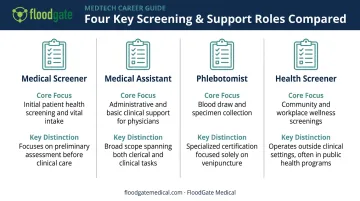
Here's where a lot of job postings go sideways. "Medical screener" gets used interchangeably with roles that actually have different scopes:
| Role | Core Focus | Key Distinction |
|---|---|---|
| Medical Screener | Eligibility checks, initial risk assessment | No standardized occupational classification |
| Medical Assistant | Administrative + clinical support | Broader scope: records, treatment rooms, specimen collection |
| Phlebotomist | Blood draws and specimen handling | Includes donor suitability checks, but role centers on venipuncture |
| Health Screener | Community/public health checks | Different pay data and typical work environment |
There's actually no formal government occupation titled "Medical Screener." The U.S. Bureau of Labor Statistics doesn't track it separately, and O*NET doesn't list it as an alternate title for medical assistants or phlebotomists.
That's not a knock against the role. It just means employers need to define the actual duties clearly instead of borrowing a job title from a neighboring position.
That said, demand for screening-related work is real. A 2024 survey of more than 850 global clinical trial sites found that 31% cited staffing as a top challenge (ACRP, 2024).
Site staff also reported that trials had grown harder to manage, with 70% pointing to rising complexity and recruitment pressure over the past five years. More trials simply mean more screening work.
Medical Screener Job Description Template (With Example)
Writing a job posting that actually attracts qualified candidates starts with clarity, not a generic copy-paste template. Here's a structure you can adapt to your setting.
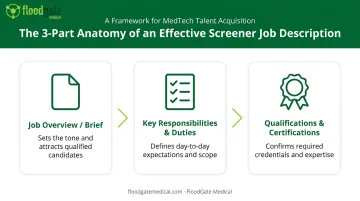
Job Overview/Brief
Use this as your starting point, then adjust the bracketed details:
Job Brief Template: We're seeking a detail-oriented Medical Screener to conduct initial health assessments and eligibility screenings for [patients / clinical trial participants] at [facility/site name]. The ideal candidate will accurately document findings, communicate clearly with [patients/participants], and follow strict regulatory and infection control protocols.
For a general clinic setting, keep the language focused on patient intake and vitals. For a **clinical trial or MedTech screening role**, add specific language about protocol adherence, informed consent, and eligibility criteria tied to a study or device trial.
Key Responsibilities & Duties
Most medical screener postings should include some version of these core duties:
- Conduct screenings, including vitals, questionnaires, and eligibility assessments, using approved protocols and tools
- Document findings accurately in EHR systems or clinical trial databases, flagging anomalies to clinical staff immediately
- Explain procedures clearly to patients or participants, ensuring informed consent and HIPAA-compliant confidentiality
- Maintain and calibrate screening equipment while following infection control and PPE protocols
- Collaborate with nurses, physicians, or clinical research coordinators to escalate at-risk cases quickly
Full Sample Job Description Example
Here's a complete, ready-to-use posting tailored to a MedTech clinical trial screening context, since generic health screener templates rarely fit this scope:
Job Title: Clinical Trial Medical Screener
Overview: [Company Name] is seeking a Clinical Trial Medical Screener to support participant eligibility screening for an active medical device study. This role is critical to ensuring accurate data capture, participant safety, and full protocol compliance throughout the enrollment process.
Responsibilities:
- Perform prescreening interviews and eligibility assessments per study protocol
- Record vitals, medical history, and screening results in the clinical trial database
- Explain study procedures and obtain documented informed consent
- Flag protocol deviations or at-risk participants to the clinical research coordinator
- Maintain screening equipment calibration and PPE compliance
- Ensure HIPAA and Good Clinical Practice (GCP) standards are followed at all times
Qualifications:
- High school diploma or GED required; medical assistant certificate preferred
- Current CPR/BLS certification
- GCP training completed or willingness to complete within 30 days of hire
- Prior healthcare, clinical trial, or customer-facing medical experience preferred
- Strong attention to detail and comfort working with EHR or trial data systems
- Bilingual candidates encouraged to apply
If you're hiring for a role like this, FloodGate Medical's contract and permanent placement teams work exclusively within MedTech to source vetted, trial-ready screeners quickly.
Medical Screener Skills & Qualifications
The strongest medical screener candidates blend technical proficiency with genuine interpersonal skill. Neither one covers for the absence of the other.
Technical Skills
Before comfort with people comes comfort with equipment and data systems. Core capabilities include:
- Operates standard screening tools, including thermometers, BP cuffs, and pulse oximeters
- Uses digital questionnaires and screening software accurately
- Navigates EHR systems or clinical trial data platforms without hand-holding
- Understands basic infection control and PPE protocols
Soft Skills That Actually Matter
Communication and empathy aren't nice-to-haves here. A screener who can't put a nervous trial participant at ease will struggle to gather accurate information. Look for:
- Clear, calm communication under pressure
- Warm empathy paired with professional boundaries
- Sharp attention to detail (small errors compound fast in trial data)
- Steady multitasking skill in a fast-paced clinical environment
Education, Certifications & Experience
Baseline education is a high school diploma or GED, though many MedTech and clinical trial employers prefer a medical assistant certificate or related associate degree. Certifications typically include:
- CPR/BLS and First Aid: standard across nearly every setting
- Good Clinical Practice (GCP) training — required for clinical research roles under global staff-qualification standards (ICH E6(R3), 2025)
Prior healthcare or customer service experience strengthens a candidate's fit considerably. Bilingual capability is a valuable asset, particularly in diverse patient or participant populations where trust and clear communication directly affect screening accuracy and follow-through.
Medical Screener Salary & Career Outlook
Pay for medical screeners varies meaningfully by employer type, and there's no single national average that tells the full story.
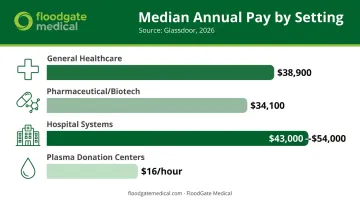
According to Glassdoor's 2026 salary data, the median total pay for a Medical Screener in the U.S. sits around $39,000 per year. The typical range runs $34,000 to $45,000, with an hourly equivalent near $19. That range shifts depending on where you're hiring:
| Employer Type | Approximate Pay |
|---|---|
| General Healthcare | ~$38,900 median |
| Pharmaceutical/Biotech | ~$34,100 median |
| Hospital Systems (such as Sutter Health) | $43,000-$54,000 |
| Plasma Donation Centers | ~$16/hour |
What Drives Pay Differences
- Location: Urban markets and higher cost-of-living regions pay more.
- Certifications: GCP training and specialized credentials command a premium.
- Experience: Prior clinical or trial-specific experience matters.
- Employer type: MedTech and pharma often outpace general clinic settings.
Career Progression
Medical screening rarely stays a career endpoint. Common next steps include:
- Medical assistant: A broader clinical and administrative scope.
- Clinical research coordinator: Manages full trial participant workflows.
- Patient care technician: Expanded hands-on clinical duties.
For candidates eyeing the clinical research track long-term, FloodGate Medical's 2026 MedTech Compensation Guide is a useful reference for benchmarking pay expectations before making a move.
How to Become a Medical Screener
There's no single certification path since this role isn't a standardized occupation, but the general roadmap looks like this:
- Complete a high school diploma or GED. Add healthcare-related coursework where possible, such as anatomy or medical terminology, to build a foundation.
- Get CPR/First Aid certified, then pursue Good Clinical Practice (GCP) training if you're targeting clinical research or MedTech trial screening roles specifically.
- Gain hands-on experience through internships, volunteering, or entry-level clinical roles, while getting comfortable with electronic health record (EHR) systems and standard screening equipment.
Job seekers new to this field can use FloodGate Medical's Breaking Into MedTech resource to see how entry-level screening roles connect to longer MedTech career paths.
Tips for Hiring the Right Medical Screener
A vague job posting attracts a vague pool of applicants. Here's how to avoid that.
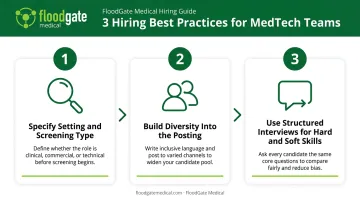
Specify the setting and screening type up front. A general clinic screening role and a clinical trial/MedTech screening role require different skills, certifications, and mindsets. Blurring that line in your posting wastes everyone's time.
Build diversity into the posting itself. Screening teams that reflect the populations they serve tend to build stronger trust with patients and trial participants.
FloodGate Medical centers its recruiting approach on equity, diversity, and inclusion. MedTech companies looking to build representative screening teams can work directly with recruiters who specialize in this space to source mission-aligned candidates.
Use structured interviews that test for both hard and soft skills. Ask candidates to walk through how they'd handle a participant who's anxious about a screening procedure, not just whether they know how to use a BP cuff. Resume review should weigh certifications (CPR/BLS, GCP) alongside evidence of real patient- or participant-facing experience, not certifications in isolation.
Frequently Asked Questions
What is the role of a medical screener?
A medical screener conducts initial health assessments, questionnaires, and eligibility checks to identify risks before a patient or participant moves on to treatment or clinical trial enrollment. The role acts as the first checkpoint in that process.
What skills are required for a medical screener?
Screeners need technical proficiency with tools like BP cuffs and EHR systems, plus strong communication, empathy, and attention to detail. Relevant certifications, like CPR/BLS, round out the requirements.
What is the difference between a medical screener and a health screener?
The terms overlap, but "medical screener" is more common in clinical, MedTech, and research settings, while "health screener" typically appears in community or public health contexts. Pay and duties can differ meaningfully between the two.
What certifications do medical screeners typically need?
CPR/BLS and First Aid certification are standard baseline requirements across most settings. Clinical research and MedTech trial screening roles often add Good Clinical Practice (GCP) training on top of that.
What is the average salary for a medical screener?
Medical screeners typically earn between $34,000 and $45,000 annually, or roughly $16 to $19 per hour, according to 2026 Glassdoor data. Location, certifications, and employer type all move that number up or down.
Is becoming a medical screener a good career path in the MedTech industry?
Yes, especially as a stepping stone into clinical research coordination or patient care technician roles. Connecting with a MedTech-focused recruiter like FloodGate Medical can help candidates understand which certifications and experience open the most doors.
![Medical Scheduler Job Description [Updated for 2026]](https://file-host.link/website/floodgatemedical-yc9tym/assets/blog-images/692cc1a1-aabe-486c-8c34-f627625d633f/1785145458154350_2bcaf2d1c39c43d58f2b1428a008affc/1080.webp)
![Medical Secretary Job Description [Updated for 2026]](https://file-host.link/website/floodgatemedical-yc9tym/assets/blog-images/ffc7c265-22d6-4d39-95d7-59dd45a456e3/1785145414676453_53d552d20c524f7f901d8b062c4fe371/1080.webp)