
Here's the challenge: pay varies enormously depending on your specialty, state, and years of experience. A sonographer in California earns far more than a lab technologist in a rural hospital, and neither number tells you what a MedTech-focused diagnostic role might pay.
This guide breaks down real salary figures by experience, setting, and location. You'll also get a clear picture of the education path, certifications you'll need, and how to move into higher-paying specializations.
Key Takeaways
- National medians span $62,930 (lab roles) to $96,590 (sonography)
- Texas pay mirrors national averages, but lower living costs stretch paychecks further
- Most roles need a bachelor's (lab science) or associate degree (imaging), plus certification
- Nuclear medicine and MedTech/corporate roles pay the most among diagnostic specialties
What Does a Medical Diagnostician Do?
"Medical diagnostician" isn't a single, official job title. It's an umbrella term covering professionals who analyze lab specimens, imaging scans, and diagnostic data to help physicians identify medical conditions. Think laboratory technologists, sonographers, and related imaging specialists.
Typical work settings include:
- Hospitals and health systems
- Diagnostic imaging centers and outpatient clinics
- Private and reference laboratories
- Academic and research institutions
- MedTech companies developing diagnostic devices or software
Employers hire for a specific mix of technical and interpersonal skills. Analytical thinking tops the list, since diagnosticians spot patterns and anomalies that inform treatment decisions. Attention to detail matters just as much: a missed abnormality on a scan or a mislabeled sample can affect patient outcomes.
Beyond the technical side, diagnosticians need to:
- Communicate findings clearly to physicians and clinical teams
- Operate and troubleshoot diagnostic equipment (analyzers, ultrasound units, imaging systems)
- Follow strict quality control and safety protocols
- Stay current on evolving diagnostic technology and testing methods
That last point is increasingly relevant. As diagnostic devices grow more sophisticated, professionals who understand both the clinical workflow and the technology itself become valuable candidates for MedTech companies building new diagnostic tools. Staffing firms like FloodGate Medical work directly with these companies to place diagnosticians into device-development and clinical-liaison roles.
Medical Diagnostician Salary Overview
Because "medical diagnostician" spans multiple occupations, there isn't one universal salary figure. The two closest benchmarks tell very different stories.
Laboratory-focused diagnosticians (medical and clinical laboratory technologists) earn a national median of $62,930 per year, or roughly $30.26 per hour, according to O*NET's 2025 wage data for laboratory technologists.
Sonography specialists earn considerably more. O*NET reports a 2025 national median of $96,590, or about $46.44 per hour, with the top 10% earning above $129,370.
That's a wide gap for what many people lump into the same career category. Your specialization determines which end of that range you land on.
Salary By Experience Level
The American Society of Radiologic Technologists' 2024 wage survey offers the clearest experience-based breakdown available for imaging professionals:
| Experience | Average Annual Pay |
|---|---|
| Less than 1 year | $62,877 |
| 1-2 years (entry-level) | $67,437 |
| 3-10 years (mid-career) | $81,462 |
| 11-20 years (senior) | $91,204 |
| 21-30 years | $97,921 |
| 31+ years | $100,988 |
The jump from entry-level to mid-career is the steepest, roughly a $14,000 increase. After that, growth flattens but remains steady through the later career stages.
Salary By Work Setting
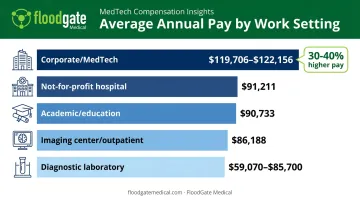
Where you work matters almost as much as how long you've worked. Corporate and industrial settings, which often include MedTech and device-related roles, pay noticeably more than clinical environments:
| Setting | Average Pay |
|---|---|
| Corporate/MedTech | $119,706-$122,156 |
| Not-for-profit hospital | $91,211 |
| Academic/education | $90,733 |
| Imaging center/outpatient | $86,188 |
| Diagnostic laboratory | $59,070-$85,700 |
Corporate and industrial roles pay roughly 30-40% more than traditional hospital or imaging center positions. That gap is a big reason diagnostic professionals eventually explore MedTech career paths, often working with specialized recruiters like FloodGate Medical to land device sales, clinical education, or product support roles.
Medical Diagnostician Salary by State & Location
Pay differences across states come down to three factors: local cost of living, regional healthcare demand, and how concentrated MedTech and biotech employers are in that market.
States with dense life-sciences hubs and higher living costs tend to top the list. Based on 2023 sonography wage data, the highest-paying states are:
- California – $122,670 average
- Hawaii – $111,690 average
- Oregon – $104,260 average
- Massachusetts – $101,420 average
- Connecticut – $99,610 average
Notice a pattern? Each of these states also has a high cost of living, which eats into the nominal pay advantage.
Medical Diagnostician Salary in Texas
Texas tells a different story. The 2023 sonography median in Texas was $84,410, almost identical to the $84,470 national median that same year. Laboratory technologists in Texas earned a median of $63,520.
On paper, Texas doesn't top the salary charts. But Texas has no state income tax and a generally lower cost of living than coastal markets like California or Massachusetts, so that paycheck stretches further.
Demand remains strong across major metros:
- Houston – anchored by the Texas Medical Center, one of the largest medical complexes in the world
- Austin – home to over 300 life-science companies spanning biotech, medical devices, and health IT
- Dallas-Fort Worth – a growing life-sciences corridor with continued employer expansion
If you're comparing job offers, don't just look at the salary number. Factor in take-home pay after taxes and housing costs before deciding a lower-paying state actually pays less. FloodGate Medical's career coaches routinely help MedTech professionals run these comparisons when weighing offers across multiple states.
Education, Certification & Licensing Requirements
The credential path depends heavily on which diagnostic specialty you're pursuing.
Degree requirements vary by track:
- Laboratory technologist/MLS roles typically require a bachelor's degree in medical technology, biology, or a related life science, plus an accredited clinical training component
- Laboratory technician roles may only require an associate degree or postsecondary certificate
- Sonography and imaging roles usually need an associate degree or certificate from an accredited program with built-in clinical hours
Once you've locked in your degree path, certification is the next milestone.
Common certifying bodies by specialty:
- ASCP (American Society for Clinical Pathology) – MLS and MLT credentials for lab professionals
- ARDMS (American Registry for Diagnostic Medical Sonography) – RDMS credential for sonographers
- ARRT (American Registry of Radiologic Technologists) – credentials for radiography, MRI, and related modalities
- NMTCB – certification for nuclear medicine technologists
Certification doesn't automatically clear you to practice everywhere, though. State licensing requirements vary significantly, and some states add their own hurdles on top of national credentials. California, for example, requires a Clinical Laboratory Scientist license involving at least one year of post-baccalaureate clinical training beyond the degree itself, while other states rely primarily on national certification without a separate state license.
Once certified, you're not done. Continuing education keeps your credential active:
- ASCP: 36 points per 3-year cycle
- ARDMS: 30 CME credits per 3-year cycle
- ARRT: 24 credits per 2-year cycle
Credentials and continuing education keep you qualified on paper, but supervised clinical internships or practicum hours build the hands-on skills and professional relationships that shape your first job offer.
Career Path: How to Become & Advance as a Medical Diagnostician
Breaking into this field, and eventually into higher-paying roles, follows a fairly predictable sequence.
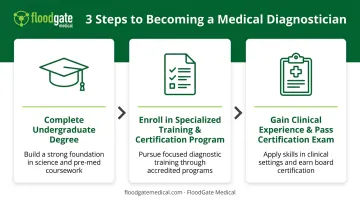
- Complete your undergraduate degree. Choose a bachelor's in a life science for lab-focused paths, or an associate degree for imaging-focused paths. Your specialty determines the exact requirement.
- Enroll in a specialized training or certification program. Align this with your target specialty, whether that's clinical laboratory science, sonography, or nuclear medicine.
- Gain supervised clinical experience and pass your certification exam. This is non-negotiable for most credentialing bodies and many state licenses.
Once you're working, specialization is where the real earning potential shows up. Nuclear medicine technologists lead direct diagnostic modalities, with an average of $103,619 according to ASRT's 2024 survey, and a BLS-reported median of $97,020. Cardiac and vascular interventional imaging roles follow closely behind.
The biggest jump, though, comes from moving into MedTech. Corporate and industrial settings pay diagnostic professionals $119,706 to $122,156 on average, well above what most hospitals or imaging centers offer. Companies building diagnostic devices, imaging software, or lab automation platforms need people who understand the clinical workflow from the inside.
Practical ways to boost your earning potential:
- Stack certifications (for example, combining a base credential with a specialty like nuclear medicine or interventional imaging)
- Pursue roles in outpatient care centers, where sonographers earn the highest median pay ($123,610) among all settings
- Target MedTech companies actively hiring clinical specialists for device development, training, or clinical affairs roles
That last point is where a specialized recruiter can save you real time.
FloodGate Medical works exclusively with MedTech companies and connects clinical professionals to roles matched to their background and salary expectations. Their resource on breaking into MedTech covers what that transition looks like, and their monthly newsletter tracks compensation trends and open roles across the industry.
Frequently Asked Questions
What is the highest paying diagnostician job?
Nuclear medicine roles top the list among direct diagnostic specialties, averaging $103,619 according to ASRT's 2024 survey. MedTech and corporate diagnostic roles pay even more, often exceeding $119,000.
How much does a medical diagnostician make in Texas?
Texas sonography professionals earned a $84,410 median in 2023, nearly matching the national median of $84,470. Lower living costs and no state income tax make that pay go further.
What degree do you need to become a medical diagnostician?
Laboratory-focused roles typically require a bachelor's degree in medical technology or a related science. Imaging-focused roles like sonography usually need only an associate degree plus certification.
Is medical diagnostician a good career choice?
Yes, particularly in sonography, which BLS projects to grow 13% through 2034, well above average. Lab technologist roles grow more slowly at 2%, but demand remains steady across both.
What is the difference between a medical diagnostician and a physician?
Diagnosticians perform and interpret tests or scans that inform a diagnosis, while physicians make the actual diagnosis and treatment decisions. Physicians require a medical degree; diagnosticians need a bachelor's or associate degree plus certification.
How long does it take to become a medical diagnostician?
Expect 2-4 years for your degree, plus certification exam prep and clinical training. Some state licenses, like California's CLS route, add at least one more year of supervised clinical work.