

The FDA classifies recalls by health risk. A Class I recall means there's a reasonable probability of serious injury or death, while Class II and III reflect progressively lower risk levels. That distinction alone explains why medical device companies can't afford a generic quality hire.
Hiring managers often struggle to write job descriptions that attract candidates fluent in both engineering rigor and regulatory compliance. Candidates, meanwhile, often walk into interviews unsure what the role actually demands day to day. This guide covers core duties, must-have skills, a ready-to-use JD template, and salary and career insights specific to the medical device industry.
Key Takeaways
- Medical device QEs combine quality engineering with regulatory compliance under ISO 13485, FDA 21 CFR 820, and ISO 14971.
- Core duties span CAPA management, FMEA-based risk analysis, supplier quality, and design control support.
- ASQ's Certified Quality Engineer (CQE) credential, paired with regulatory knowledge, strengthens a candidate's appeal.
- Average base pay for this role sits well above general manufacturing QE benchmarks.
- A well-defined, device-specific JD speeds up hiring for this notoriously hard-to-fill niche.
What Does a Quality Engineer Do in Medical Devices?
A QE designs and monitors the systems that keep products consistent and compliant. In medical devices, that job narrows sharply. The QE builds and maintains a Quality Management System (QMS) aligned with ISO 13485 and FDA 21 CFR 820. That regulation governs design, manufacturing, packaging, and servicing controls for devices sold in the US.
Not Your Typical Manufacturing QE Role
General manufacturing QEs focus on process efficiency and defect reduction. Medical device QEs carry an added burden: maintaining design control documentation and full traceability so the company can survive an FDA inspection or notified body audit without gaps in the paper trail. A missed link in that trail, such as an unrecorded supplier substitution on a catheter component, can trigger a warning letter or a full recall investigation. That level of scrutiny doesn't exist on a typical factory floor, which is why design history files and risk management documentation sit at the center of the job, not on the periphery of it.
Day-to-Day Reality
On a given week, a device QE might:
- Review nonconformance reports and lead root cause investigations
- Prepare documentation for internal audits or an upcoming FDA inspection
- Coordinate with R&D on design verification testing
- Follow up with suppliers on corrective actions for a flagged component
The role is cross-functional by design. QEs act as the connective tissue between R&D, manufacturing, regulatory affairs, and suppliers, keeping everyone aligned on what "compliant" actually means for a given product.
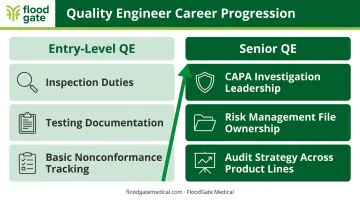
That cross-functional weight scales with seniority. Entry-level QEs typically handle inspection, testing documentation, and basic nonconformance tracking. Senior QEs lead CAPA investigations, own risk management files, and shape audit strategy across product lines.
Key Responsibilities and Duties of a Medical Device Quality Engineer
These are the functions that should anchor any job description for this role:
- QMS Development and Maintenance: Build and update procedures aligned with ISO 13485, FDA's Quality System Regulation, and ISO 14971 risk management requirements.
- Risk Management and FMEA: Conduct design and process failure mode and effects analyses, and maintain risk management files across the entire product lifecycle, not just at launch.
- CAPA and Nonconformance Management: Lead root cause analysis, implement corrective and preventive actions, and track closure to prevent recurring defects.
- Verification and Validation: Oversee test protocols and process validations, including installation, operational, and performance qualification (IQ/OQ/PQ), to confirm devices meet design specs.
- Supplier Quality and Auditing: Qualify suppliers, conduct audits, and manage incoming inspection and nonconforming material.
- Documentation and Regulatory Support: Prepare technical files and support submissions such as 510(k) or PMA filings while maintaining continuous audit readiness.
Supplier quality deserves extra attention here. Many device components, from electromechanical assemblies to sterile packaging, depend on tightly controlled outside vendors. A QE who can't audit and qualify suppliers effectively creates risk that no amount of internal testing can fully offset.
Risk management also isn't a one-time exercise. ISO 14971 requires ongoing hazard identification, risk estimation, and control monitoring throughout a device's life, not just before submission. FMEA is one tool within that broader process, not a replacement for it.
Required Skills, Qualifications, and Certifications
Most employers expect a bachelor's degree in biomedical, mechanical, or industrial engineering, or a related life sciences field. A master's degree can accelerate progression into senior or lead roles, though it's rarely a strict requirement at entry level.
Regulatory and Technical Fluency
Beyond the degree, candidates need working knowledge of:
- ISO 13485 (QMS requirements)
- ISO 14971 (risk management)
- FDA 21 CFR 820 (US Quality System Regulation)
- EU MDR, increasingly important for companies selling internationally
On the technical side, familiarity with Six Sigma, Statistical Process Control, and Design of Experiments matters. Comfort with statistical software helps, though no single tool is a universal industry standard.
Certifications That Stand Out
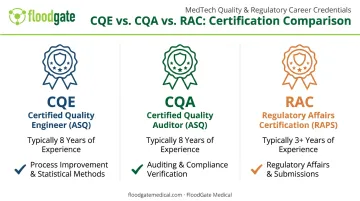
| Certification | Issuing Body | Typical Requirement |
|---|---|---|
| Certified Quality Engineer (CQE) | ASQ | 8 years of relevant experience, including 3 in a decision-making capacity |
| Certified Quality Auditor (CQA) | ASQ | 8 years of relevant experience, same decision-making threshold |
| Regulatory Affairs Certification, Devices (RAC) | RAPS | Bachelor's plus 3 years of regulatory experience (less with advanced degrees) |
ASQ's CQE credential covers process improvement, quality control, statistics, and compliance, making it one of the most recognized markers of readiness for this role.
Soft skills matter just as much. Precise documentation habits, clear cross-functional communication, and staying calm when an auditor pushes back often separate a good QE from a great one.
Sample Medical Device Quality Engineer Job Description Template
Use this condensed structure as a starting point, then adjust language based on device classification.
Position Summary Seeking a Quality Engineer to support QMS maintenance, risk management, and design control activities for [device type], ensuring compliance with ISO 13485 and FDA 21 CFR 820 throughout the product lifecycle.
Key Responsibilities
- Lead CAPA investigations and root cause analysis for nonconformances
- Conduct FMEA and maintain risk management files per ISO 14971
- Support supplier audits and incoming inspection processes
- Prepare technical documentation for regulatory submissions
Required Qualifications
- Bachelor's degree in engineering or related life sciences field
- 2-5 years of quality engineering experience in a regulated industry
- Working knowledge of ISO 13485 and FDA QSR
Preferred Qualifications
- ASQ CQE or CQA certification
- Experience with Class II or III devices
- Familiarity with EU MDR requirements
Compensation and Benefits Competitive base salary, performance bonus, health benefits, and professional development support for certification pursuits.
Adjusting for Device Classification
Class I devices carry lighter regulatory rigor, so the JD can emphasize general controls and documentation basics. Class II and III devices require far more emphasis on design controls, special controls, and premarket submission support, since these products carry higher patient risk and stricter FDA scrutiny.
Regardless of device classification, sourcing candidates who understand both the engineering and compliance sides of this role isn't easy. That's where specialized MedTech recruiters make the difference. FloodGate Medical combines deep MedTech recruiting expertise with a DEI-driven approach, connecting employers with pre-vetted quality engineering candidates who already understand both technical execution and regulatory expectations.
Salary Expectations and Career Outlook
Medical device QE pay tends to run higher than general manufacturing quality roles, reflecting the added regulatory burden. According to PayScale's compensation data, average base pay for this role is $81,688, with a typical range of $65,000 to $111,000 depending on experience and location. Entry-level total compensation, for those with under a year of experience, averages around $69,956.
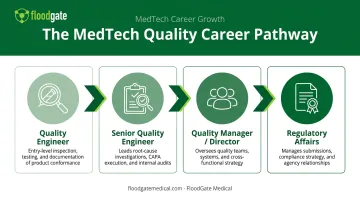
Typical Career Path
- Quality Engineer — hands-on inspection, testing, and documentation
- Senior Quality Engineer — leads CAPA investigations and audit strategy
- Quality Manager or Director — oversees the broader quality system and team
- Lateral move into Regulatory Affairs, since quality experience satisfies part of the eligibility basis for credentials like the RAC (Regulatory Affairs Certification)
Is This a Good Long-Term Career?
Yes, for most candidates. The Bureau of Labor Statistics projects 10% growth for industrial engineering roles through 2032, well above the average for all occupations, and quality engineering falls within that broader category. Medical device manufacturing alone supports hundreds of thousands of US jobs, and demand for regulatory-savvy quality talent keeps rising as global rules like the EU MDR tighten postmarket monitoring requirements.
Evaluating an offer or weighing your next move? FloodGate Medical's monthly MedTech newsletter offers market insights, salary benchmarks, and open roles worth checking before you negotiate.
Frequently Asked Questions
What does a medical device Quality Engineer do?
They build and maintain QMS compliance, manage CAPA and risk assessments, and ensure devices meet FDA and ISO standards throughout the product lifecycle. The role blends hands-on engineering with regulatory documentation work.
Is a Quality Engineer a good career?
Yes. It offers strong job stability tied to the growing medical device market, competitive pay, and clear paths into quality management or regulatory affairs. Demand remains steady as global regulations tighten, and specialized MedTech recruiters like FloodGate Medical continually connect skilled engineers with growing employers.
What certifications should a medical device Quality Engineer have?
ASQ's Certified Quality Engineer (CQE) and Certified Quality Auditor (CQA) are the most widely recognized. A Regulatory Affairs Certification (RAC) adds real value for those eyeing regulatory career moves.
What's the difference between a Quality Engineer and a Quality Assurance Manager in medical devices?
QEs focus on hands-on technical execution: testing, CAPA, and risk analysis. QA Managers oversee the broader quality system, manage teams, and make strategic compliance decisions.
How much do medical device Quality Engineers typically earn?
Average base pay lands around $81,688, with a range of roughly $65,000 to $111,000 depending on experience and location. Certifications and years of hands-on regulated-industry experience move pay higher.
What degree or background do you need to become a medical device Quality Engineer?
Most roles require a bachelor's degree in engineering or a life sciences field, often paired with quality certifications and practical experience in a regulated manufacturing environment.
![Medical Scheduler Job Description [Updated for 2026]](https://file-host.link/website/floodgatemedical-yc9tym/assets/blog-images/692cc1a1-aabe-486c-8c34-f627625d633f/1785145458154350_2bcaf2d1c39c43d58f2b1428a008affc/1080.webp)