Introduction
A hiring manager posts a job for a "MedTech Engineer." Forty applicants respond. Only three actually have the device-specific regulatory experience the role requires.
This happens constantly in healthcare technology hiring. Job seekers and recruiters often use "MedTech" and "medical devices" as if they mean the same thing. They don't.
The global MedTech industry generated $584 billion in revenue in 2025, according to EY's Pulse of the MedTech Report, and that figure covers far more than physical devices. Confusing the two terms leads to mismatched job applications, inaccurate job postings, and slower hiring cycles.
This article breaks down what each term actually means, where they overlap, and why getting the distinction right matters for your career or your next hire.
Key Takeaways
- MedTech is the umbrella term for devices, diagnostics, digital health, and software
- Medical devices are a regulated subset defined by intended medical purpose
- The MedTech industry generated $584 billion in 2025 revenue; medical devices alone reached $572.31 billion
- Precise terminology helps job seekers target roles and employers craft clearer job descriptions
MedTech vs Medical Devices: Quick Comparison
Here's a side-by-side look at how these terms differ across the categories that matter most for careers and hiring.
| Category | MedTech | Medical Devices |
|---|---|---|
| Scope | Umbrella term: devices, diagnostics, digital health, software, wearables | Specific subset with a defined medical purpose |
| Regulatory status | Not a regulatory category itself | Formally regulated (FDA Class I/II/III, EU MDR) |
| Product examples | Surgical robots, glucose monitors, health apps, AI diagnostics | Syringes, pacemakers, MRI machines, microcatheters |
| Primary users | Clinicians, patients, health systems, consumers | Primarily healthcare professionals in clinical settings |
| Common career roles | R&D, digital health product management, data science, software engineering | Device engineering, quality/regulatory, clinical affairs, manufacturing |
The core distinction: every medical device belongs to the MedTech industry, but not every MedTech product qualifies as a medical device. A wellness app that tracks steps sits under MedTech. A pacemaker sits under both MedTech and the medical device category, because it carries a regulated medical purpose.
That difference in scope explains why the market figures look similar but measure different things. Fortune Business Insights pegs the global medical device market at $572.31 billion in 2025, projecting growth to over $1 trillion by 2034.
Compare that to EY's $584 billion MedTech revenue figure. The two markets run nearly parallel, though they're calculated differently and shouldn't be treated as interchangeable metrics.
What is MedTech?
MedTech Europe, one of the industry's leading trade bodies, defines medical technology as products, services, or solutions used to save and improve people's lives. That's a broad mandate on purpose.
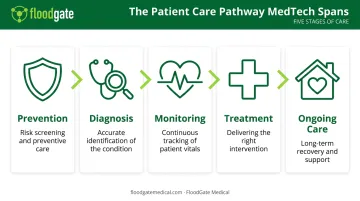
MedTech spans the entire patient pathway:
- Prevention
- Diagnosis
- Monitoring
- Treatment
- Ongoing care
This breadth matters because MedTech innovation drives measurable outcomes. It reduces hospital readmissions through remote monitoring, enables personalized treatment plans, and extends care beyond hospital walls into patients' homes.
Under the MedTech umbrella, you'll find:
- Medical devices
- In vitro diagnostics (IVDs)
- Digital health solutions
- Software as a Medical Device (SaMD)
- Consumer-health crossover technology (fitness trackers that flag irregular heart rhythms, for example)
Use Cases of MedTech
MedTech shows up everywhere along the patient journey, not just inside a hospital. A patient might wear a continuous glucose monitor at home and use a digital therapeutics app to manage a chronic condition. At a follow-up visit, an AI-assisted diagnostic system could flag an anomaly for a radiologist to review.
Industries where MedTech dominates:
- Digital therapeutics
- Remote patient monitoring
- AI-assisted diagnostics
- Wearable health tech
Investment activity backs up this expansion. McKinsey estimates that generative AI alone could deliver $14 billion to $55 billion annually in productivity value across MedTech companies, largely through faster R&D cycles, smarter diagnostics, and streamlined clinical trials. That kind of growth signals that MedTech's scope keeps widening beyond physical products into data, software, and AI-driven care.
What is a Medical Device?
A medical device has a much narrower, regulation-grounded definition. The FDA describes it as an instrument, apparatus, implant, software, or related article intended for diagnosis, prevention, monitoring, or treatment, one that doesn't achieve its primary purpose through chemical action within the body.
That precision isn't bureaucratic hairsplitting. It determines:
- Which regulatory pathway a product must follow
- What compliance documentation is required
- How narrow or broad a job function's scope actually is
Getting classification right protects patients. It's the reason a company building a pacemaker faces years of clinical trials and premarket approval, while a company building a bandage faces far lighter oversight.
Medical devices fall into three FDA risk classes:
- Class I (low-risk): Tongue depressors, manual stethoscopes
- Class II (moderate-risk): Infusion pumps, external pacemaker generators
- Class III (high-risk): Pacemakers, artificial hearts, ventricular assist devices
Use Cases of Medical Devices
Medical devices sit at the center of clinical workflows, including surgery, diagnostics, monitoring, and rehabilitation. They're the tools clinicians touch every day, not the apps patients check at home.
Interventional cardiology offers a clear example. Consider a chronic total occlusion (CTO) procedure, where a coronary artery is completely blocked and standard guidewires can't cross it. ASAHI's microcatheter line illustrates how specialized devices solve specific clinical problems:
- Corsair Pro provides torqueable support for navigating calcified, tortuous coronary anatomy during CTO crossing
- Corsair Pro XS offers a lower-profile design built for retrograde CTO access through narrow collateral channels
- Tornus penetrates highly stenosed lesions that resist conventional wire crossing
- SASUKE, a dual lumen catheter, maintains guidewire stability during complex PCI, including bifurcation lesions
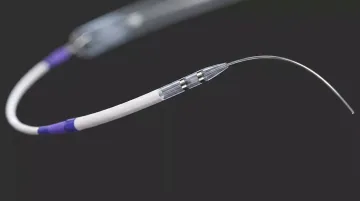
In a retrograde CTO case, an operator might deploy the Corsair Pro XS to cross septal collaterals, then rely on SASUKE to manage wire position during final stenting. Each device serves a distinct, regulated purpose. That's the medical device category in action: precise tools built for precise clinical problems.
Surgical robotics tells a similar story at a system level. A 2024 review published in npj Digital Medicine identified 49 FDA-cleared surgical robots, with 86% operating at the most basic autonomy level, meaning human surgeons still control most of the procedure.
The technology is advancing, but the regulatory bar for higher autonomy remains high, and for good reason.
Why This Distinction Matters for MedTech Careers and Hiring
Here's a scenario that plays out often: a company needs a device-specific regulatory specialist, someone who understands FDA 510(k) submissions and ISO 13485 quality systems. Instead, they post a job titled "MedTech Engineer."
What happens next:
- Software engineers and digital health candidates apply, assuming the role fits their background
- Regulatory specialists skip the posting, assuming it's a software role
- The hiring team wades through dozens of mismatched resumes
- Time-to-fill stretches out, and the right candidates never see the posting
This isn't a hypothetical problem. Life sciences recruiting data from BioSpace's employment outlook shows that 59% of surveyed organizations were actively recruiting, yet candidates frequently reported rejection for lacking the exact niche experience a role demanded. Vague titles only widen that gap.
Companies that fix this usually do two things:
- Rewrite job descriptions with precise, regulation-aware language that distinguishes device-specific requirements from broader digital health skill sets
- Partner with recruiters who understand the nuance between a Class III device engineering role and a health-tech data science role
That's where specialized recruiting expertise pays off. FloodGate Medical works exclusively within the MedTech and medical device space. Its recruiters already know the difference between a regulatory affairs specialist who needs deep device classification knowledge and a digital health product manager who needs software and data fluency.

That specialization, combined with FloodGate's DEI-driven sourcing approach, helps close the gap between what a job posting says and what a role actually requires.
Precise terminology directly shapes hiring speed. Clear, specific job titles produce fast, well-matched hires, while vague language drags out searches and frustrates everyone involved.
Conclusion
Medical devices are a critical, tightly regulated subset within the much larger MedTech ecosystem. Understanding where one term ends and the other begins helps professionals describe their skills accurately and helps companies write job postings that actually attract the right candidates.
Get this right, and the payoff is practical. Job seekers target roles that match their experience, employers write postings that pull in qualified applicants, and the entire hiring process runs smoother from first posting to final offer. FloodGate Medical's recruiters apply this same distinction to match MedTech candidates with the right roles.
Frequently Asked Questions
Is MedTech the same as medical devices?
No. MedTech is the broader industry term covering all health technology, while medical devices are one specific, regulated category within it. Every medical device is MedTech, but not every MedTech product is a medical device.
What falls under MedTech?
MedTech includes medical devices, in vitro diagnostics, digital health tools, and software-based solutions like Software as a Medical Device (SaMD). It spans the full patient pathway from prevention to treatment.
Is MedTech an MD?
Not exactly. "MD" typically refers to a regulated medical device (not a medical doctorate), one specific product category. MedTech is the umbrella industry term that encompasses medical devices along with diagnostics, software, and digital health.
What's the difference between MedTech and HealthTech?
HealthTech often skews consumer-facing, think fitness apps and telemedicine platforms, while MedTech includes professional-grade clinical tools and regulated devices. The terms overlap in areas like AI diagnostics and robotic surgery.
Do MedTech and medical device jobs require different qualifications?
Often, yes. Medical device roles typically demand regulatory or engineering specialization tied to a specific device class, while broader MedTech roles may call for software, data science, or digital health expertise. Recruiters like FloodGate Medical match candidates to the right specialization across both tracks.
Can a company work in both MedTech and medical devices?
Absolutely, and most do. The majority of medical device manufacturers operate within the broader MedTech industry, and many MedTech companies build both physical devices and digital health solutions side by side.