If you're weighing this career, you've probably got questions: What does the schooling actually involve? What can you expect to earn? What does a normal shift look like? This guide walks through all of it, from entry requirements to salary data to where the specialty can take you long-term.
Key Takeaways
- Nuclear medicine technologists administer radiopharmaceuticals and operate PET and gamma camera equipment to diagnose disease
- Entry requires an accredited associate's or bachelor's degree, plus ARRT or NMTCB certification
- Median pay sits at $97,020 annually ($46.64 per hour), with top earners exceeding $128,090
- Specializing in PET, nuclear cardiology, or CT opens doors to leadership, research, and industry roles
What Does a Nuclear Medicine Technologist Do?
A nuclear medicine technologist (NMT) prepares and administers radioactive materials, called radiopharmaceuticals, that travel through a patient's body and collect in specific organs or tissues. Using gamma cameras or PET scanners, the technologist then captures images that reveal how organs are functioning, not just what they look like structurally.
Core daily responsibilities include:
- Preparing and measuring radiopharmaceutical doses according to physician orders
- Administering doses via injection, ingestion, or inhalation
- Operating imaging equipment and adjusting settings for optimal image quality
- Monitoring patients for adverse reactions during and after procedures
- Following radiation safety protocols, including shielding, dosimetry, and proper disposal of radioactive waste
Types of Nuclear Medicine Technologist Roles
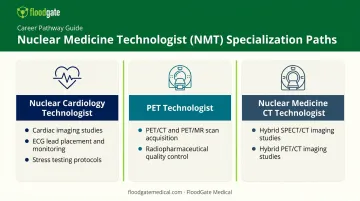
Not every NMT does the same work. Three common focus areas stand out:
- Nuclear cardiology technologists handle cardiac imaging, place ECG leads, and monitor patients through exercise or pharmacologic stress tests
- PET technologists run PET, PET/CT, or PET/MR scans and manage PET-specific radiopharmaceuticals and quality control
- Nuclear medicine CT technologists perform hybrid SPECT/CT or PET/CT studies, which require documented CT training beyond core NMT certification
These specializations often develop through additional certification and hands-on experience, allowing technologists to focus on cardiac, PET, or hybrid imaging work as their careers progress. Regardless of specialty, all NMTs share the same foundation of patient care and radiation safety training that shapes their daily routine.
A Day in the Life
A typical shift blends technical work with direct patient contact. The technologist preps patients by explaining the procedure, administers the radiopharmaceutical, then waits for it to distribute through the body before imaging begins. That waiting period varies from minutes to hours depending on the study.
Most technologists work in hospitals, which employ 61% of the profession, according to BLS data. Others work in outpatient imaging centers or physician offices. Full-time schedules are standard, but hospital-based roles often require evening, weekend, or on-call coverage since imaging needs don't stop at 5 p.m.
The interpersonal side matters as much as the technical side. Patients undergoing nuclear medicine procedures are often anxious, sometimes scared, and need reassurance alongside precise, careful work.
How to Become a Nuclear Medicine Technologist
Step-by-Step Education Path
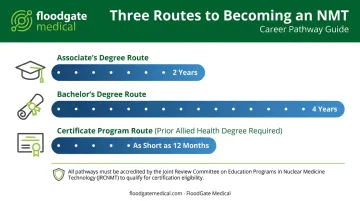
The typical path starts with prerequisite coursework in math and science, followed by enrollment in a program accredited by the Joint Review Committee on Educational Programs in Nuclear Medicine Technology (JRCNMT). You have three route options:
- Associate's degree in nuclear medicine technology
- Bachelor's degree for those wanting broader coursework or advancement flexibility
- Certificate program for professionals already working in a related allied health field, like radiologic technology or nursing
Program coursework typically covers nuclear physics, radiopharmacology, radiation biology, anatomy and physiology, and clinical nuclear medicine procedures. Every accredited program also builds in supervised clinical rotations, where students work directly with patients under direct or indirect supervision until they've demonstrated competence.
Certification and Licensure
After graduating, you'll need to pass a certification exam. Two organizations offer this credential:
- ARRT (American Registry of Radiologic Technologists) certifies NMTs through an exam covering patient care, radiation safety, and imaging procedures
- NMTCB (Nuclear Medicine Technology Certification Board) offers the CNMT credential through a similar entry-level exam
Certification supports state licensure, but it's not the same thing. Licensing requirements vary by state, so verify your state's specific rules rather than assuming certification alone qualifies you to practice.
Once certified, you can pursue additional specialty credentials:
- PET certification (NMTCB requires 700 clinical hours for active CNMT holders)
- Nuclear cardiology certification (also 700 clinical hours)
- CT certification (300 clinical hours plus 35 didactic hours)
These specialty credentials boost employability and often open doors to higher-paying, more specialized positions.
Timeline to Entry
So how long does this actually take?
- Associate's route: roughly 2 years
- Bachelor's route: roughly 4 years
- Certificate route: as short as 12 months for those who already hold a related healthcare degree
According to JRCNMT accreditation standards, accredited programs must run at least 12 months equivalent, including breaks, and must integrate supervised clinical education throughout. Exact timelines still depend on your specific program and prior education.
Nuclear Medicine Technologist Salary and Job Outlook
Let's talk numbers. According to the Bureau of Labor Statistics, nuclear medicine technologists earn a median annual salary of $97,020 ($46.64 per hour). The bottom 10% earn under $75,570, while the top 10% earn more than $128,090.
Pay varies noticeably by work setting:
| Work Setting | Employment Share | Median Annual Wage |
|---|---|---|
| Hospitals | 61% | $97,410 |
| Physician offices | 12% | $92,150 |
| Medical and diagnostic labs | 6% | $102,740 |
| Outpatient care centers | 3% | $158,510 |
State-level pay also varies, so check regional wage data before assuming national figures apply to your area.
Is There a Future in Nuclear Medicine?
The BLS projects 3% job growth from 2024 to 2034, classified as about average compared to other occupations. That's not explosive growth, but it's steady, and roughly 900 openings a year add up over time, mostly from workers retiring or transferring out.
What sustains this demand? Cancer risk climbs steadily with age. A CDC-published study projected total US cancer cases will rise nearly 50% by 2050, with 63% of those patients aged 65 or older. More cancer diagnoses mean more need for the diagnostic imaging that nuclear medicine technologists provide.
Specialization strengthens your position further. PET and nuclear cardiology credentials tend to correlate with stronger job security, even if no official data quantifies an exact salary premium.
Skills and Qualities for Success
Technical skill alone won't carry you through this career; success requires blending hard and soft skills together, using both in daily practice.
Technical skills:
- Radiopharmaceutical handling and precise dose calculation
- Imaging equipment operation, including PET scanners and gamma cameras
- Radiation safety protocol adherence
- Image quality evaluation and troubleshooting
Interpersonal skills:
- Clear communication with anxious or confused patients
- Compassion during sensitive or uncomfortable procedures
- Attention to detail, since dosing errors carry real consequences
- Collaboration with radiologists, physicians, and broader care teams
Don't overlook the physical side either — plan for long periods of standing, along with occasional lifting or repositioning of patients who are ill, injured, or unable to move independently.
Specializations and Career Advancement Opportunities
Once you've got a few years of clinical experience under your belt, several paths open up:
- PET imaging — higher-complexity scans, often paired with oncology diagnostics
- Nuclear cardiology — cardiac stress testing and imaging
- Pediatric imaging — adapting protocols and patient care for younger patients
- Research technologist roles — supporting clinical trials or academic studies
Beyond clinical specialization, experienced technologists often pursue:
- Lead technologist positions overseeing daily operations and staff scheduling
- Staff education roles training new hires and maintaining compliance standards
- Department management overseeing multiple modalities and budget planning
- Industry-facing roles such as clinical specialist, technical trainer, or field support for device manufacturers
That last path is where a MedTech-focused recruiting firm can matter. As technologists build certifications and clinical experience, device manufacturers and healthcare technology companies increasingly value professionals who understand the clinical side firsthand.
FloodGate Medical works exclusively within the MedTech industry, connecting clinical professionals with device manufacturers and healthcare technology organizations that need real procedural expertise. If you're an experienced NMT considering a move into industry, that clinical background is exactly the specialized knowledge these companies are searching for.

Frequently Asked Questions
How long does it take to become a nuclear medicine technologist?
The associate's degree route takes about 2 years, while a bachelor's degree takes about 4 years. If you already hold a related healthcare degree, a certificate program can take as little as 12 months.
Does nuclear medicine have a future?
Yes, though growth is classified as average rather than rapid, at 3% through 2034. Rising cancer diagnoses tied to an aging population continue to sustain steady demand for diagnostic imaging services.
What is it like being a nuclear medicine technologist?
It's a mix of precise technical work and direct patient care, often in fast-paced hospital settings. You'll prepare radioactive materials one moment and reassure a nervous patient the next.
What is the difference between a nuclear medicine technologist and a radiologic technologist?
Nuclear medicine technologists administer radioactive materials internally to capture functional imaging of organs. Radiologic technologists use external X-ray equipment to capture structural images of bones and tissue.
Is nuclear medicine technology a good career choice?
It offers above-average pay, a relatively short training timeline compared to many healthcare careers, and stable demand. For those interested in both technology and patient care, it's a solid fit.
Do nuclear medicine technologists work nights or weekends?
Most work full-time schedules, but hospital-based technologists often need to cover evenings, weekends, or on-call shifts since imaging needs can arise outside standard business hours.