But "looks good" isn't the same as knowing the numbers. Many students and mid-career professionals hesitate because they're not sure whether this path offers real stability or just another cycle of grant-funded uncertainty.
This article breaks down the actual growth projections, current salary benchmarks, daily responsibilities, education requirements, and how AI is changing the job. No guesswork, just the data.
Key Takeaways
- Medical scientist jobs are projected to grow 9% through 2034 — nearly 3x the average across all occupations.
- Median salary is $100,590, with top earners in private R&D clearing $168,210+.
- AI speeds up research tasks but hasn't replaced the human judgment this field requires.
- MedTech recruiters like FloodGate Medical can surface roles and salary data that aren't publicly listed.
Medical Scientist Job Outlook: Growth & Demand Drivers
The Bureau of Labor Statistics projects medical scientist employment will grow 9% between 2024 and 2034, compared to just 3.1% for the economy as a whole. That's the kind of gap that gets attention in a job market where "stable" often means "flat."
Here's the raw data:
| Metric | Figure |
|---|---|
| Current employment (2024) | 165,300 |
| Projected employment (2034) | 179,600 |
| New jobs added | 14,300 |
| Average annual openings | 9,600 |
Source: Bureau of Labor Statistics, Occupational Outlook Handbook
Key Drivers Fueling Demand
A few forces are pushing this growth:
- An aging population. Americans 65 and older grew 38.6% between 2010 and 2020, and older adults need more research into chronic conditions.
- Rising chronic disease. Diabetes now affects roughly 40.1 million Americans, and nearly 2 million new cancer cases are expected in 2025 alone.
- Expanding biotech pipelines. Cell and gene therapy alone had nearly 2,000 active clinical trials globally in late 2024, each requiring scientists to design and interpret them.
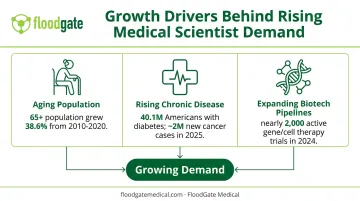
More disease, more drugs in development, more devices to test. That's a straightforward recipe for sustained hiring.
Where the Jobs Are
That sustained hiring isn't spread evenly across the industry, though. Scientific R&D services employ the largest share:
- Scientific R&D services: 34%
- Hospitals: 24%
- State colleges and universities: 11%
- Medical and diagnostic laboratories: 5%
- Pharmaceutical manufacturing: 3%
One caveat worth flagging: federal research funding drives a lot of this hiring, especially in academia. The NIH funds nearly 50,000 competitive grants supporting over 300,000 researchers, so when appropriations tighten, hiring can freeze fast, even while long-term occupational growth stays strong.
Several universities announced hiring freezes and shrunk PhD cohorts in 2025 amid funding uncertainty, according to the NIH's own budget reporting. Translation: the long-term outlook is solid, but grant cycles can create short-term bumps.
Medical Scientist Salary Guide: What You Can Expect to Earn
According to the Bureau of Labor Statistics, the median annual wage for medical scientists is $100,590. But that single number hides a wide range depending on where you work and how far along you are in your career.
- 10th percentile: under $61,860
- Median: $100,590
- 90th percentile: over $168,210
That's roughly a $106,000 spread between entry-level pay and top earners, one of the widest ranges you'll find in life sciences.
Salary by Industry & Specialization
Not all employers pay the same. Here's how median pay breaks down by industry:
| Industry | Median Salary |
|---|---|
| Scientific R&D services | $121,240 |
| Pharmaceutical manufacturing | $109,070 |
| Medical/diagnostic labs | $95,140 |
| Hospitals | $95,080 |
| State colleges/universities | $67,280 |
Private R&D pays the most, and it's not close. Scientific R&D services median pay beats academic institutions by nearly $54,000 a year.
So who earns at the very top? While there's no official government breakdown by job title, industry patterns consistently point to a few categories:
- Principal scientists at biotech and pharma companies, who lead research programs rather than execute individual studies
- MD/PhD dual-degree holders, who can run both the clinical and research sides of a trial
- Senior R&D directors, who combine scientific expertise with team and budget oversight
The premium these roles command comes down to scarcity. Combining deep research expertise with leadership or clinical licensure is rare, and companies pay accordingly.
Salary by Career Stage & Location
Pay climbs steadily with experience. Entry-level postdoctoral researchers working under NIH training grants start around $62,232, moving toward $75,564 for those with seven or more years of postdoc experience. That's the training-stage floor.
Scientists who move into permanent R&D or senior roles typically clear well beyond that range, landing closer to the $100,000+ median and above.
Location matters too. The highest-paying states include:
- New Jersey
- California
- District of Columbia
- Massachusetts
- Connecticut
Job concentration tells a different story. Iowa City, Boston-Cambridge-Nashua, and Durham-Chapel Hill have some of the densest clusters of medical scientist roles relative to their overall workforce, largely thanks to nearby research universities and biotech hubs.
Because compensation varies so much by role, sector, and geography, many candidates work with specialized recruiters to understand what's competitive. FloodGate Medical publishes a 2026 MedTech Compensation Guide that gives job seekers a clearer sense of where their offer stands before they negotiate.
What Does a Medical Scientist Do All Day?
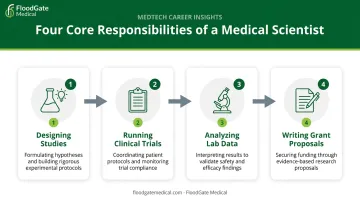
The day-to-day varies by employer, but the core responsibilities stay consistent:
- Designing studies — forming hypotheses and building research protocols to test disease prevention or treatment approaches
- Running clinical trials — analyzing trial data, often alongside licensed physicians when patients are involved
- Analyzing lab data — preparing and interpreting samples, investigating pathogens or chronic disease markers
- Writing grant proposals — securing funding and publishing findings in journals
Beyond these core tasks, work settings differ noticeably between sectors:
- Academic labs — split time between bench work and office duties, balancing research with publishing pressure
- Industry R&D — work inside pharma or device company facilities, often on tighter product timelines
- Hospital settings — work closer to clinical operations, sometimes supporting active patient trials
Regardless of setting, most medical scientists work full-time, and many exceed 40 hours a week during active trial phases. Anyone handling biological samples follows established safety protocols, including gloves, designated protective equipment, and decontamination procedures, all outlined under CDC biosafety guidance for labs handling infectious materials.
Education & Qualifications Needed to Become a Medical Scientist
The path into this field is fairly standardized:
- Bachelor's degree in biology, chemistry, or a related life science
- PhD in a life science (most common route), or an MD/PhD dual degree for those planning to run clinical trials directly
- Postdoctoral training, typically required before landing a permanent research position
Licensing requirements depend on the role: pure research positions don't require a medical license, but administering treatment during a clinical trial makes one mandatory.
Beyond the degree, employers consistently look for:
- Strong written and verbal communication (grant proposals live or die on clarity)
- Critical thinking to design sound experiments
- Data analysis skills to interpret complex results
- Decision-making under uncertainty, especially when trial data is inconclusive
These aren't just nice-to-haves: grant committees fund researchers who explain persuasively why their study matters and defend their methodology under scrutiny.
Professionals moving from academic research into industry roles often turn to specialized recruiters, such as FloodGate Medical's career coaching services, to translate these qualifications for MedTech employers.
The Future of Medical Science Careers: AI, Emerging Skills & Growth Strategy
Will AI replace medical lab scientists? Short answer: no, but it's changing what the job looks like day to day.
A McKinsey survey of more than 100 pharma and medtech leaders found that every single respondent had experimented with generative AI, yet only 32% had actually scaled it into real workflows. Research ranked as the top strategic priority for AI investment, but 75% of companies still lack a clear roadmap for how to use it.
That gap tells you something important: AI adoption right now is uneven, and the technology still functions as a tool rather than a replacement for hypothesis design, ethical oversight, or the judgment calls that come with interpreting ambiguous data. Machines can crunch data faster. They can't yet decide what a finding actually means for patient safety.
Skills Reshaping the Field
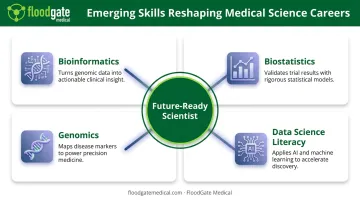
A few competencies are becoming table stakes for competitive candidates:
- Bioinformatics — interpreting large genomic datasets
- Biostatistics — applying statistical rigor to trial design
- Genomics — understanding disease at the molecular level
- Data science literacy — working comfortably with machine learning tools, even without building them from scratch
Where the Growth Is
Personalized medicine and gene therapy are creating genuinely new roles. Nearly 40% of new FDA-approved therapeutic molecules in 2024 fell into the personalized medicine category, and cell and gene therapy pipelines now include almost 3,000 active developers worldwide. These are new specialties that didn't exist in this volume a decade ago, not just incremental shifts within existing roles.
Staying competitive means continuous learning: certifications in bioinformatics tools, statistical software, or genomic analysis platforms all add real value to a resume.
It also helps to work with people who track this market closely. FloodGate Medical connects medical scientists with MedTech companies building research teams around these emerging specialties, often through roles that never get publicly posted.
Candidates also get access to a monthly newsletter covering industry trends and open positions. The FloodGate Futures program adds career coaching for those navigating a transition into a new specialty or sector.
Frequently Asked Questions
Will AI replace medical lab scientists?
No. AI speeds up data analysis and pattern recognition, but it can't replace human judgment in experimental design, ethical oversight, or interpreting what results actually mean for patients.
What is the highest paid medical scientist?
Principal scientists in biotech and pharma, MD/PhD clinical researchers, and senior R&D directors typically command the highest pay, often well above the $121,240 median for private R&D roles.
What is the job outlook for medical scientists over the next decade?
The BLS projects 9% growth from 2024 to 2034, nearly three times the average for all occupations, driven by aging demographics, chronic disease rates, and expanding biotech pipelines.
Do you need a PhD to become a medical scientist?
Yes, in most cases. Most roles require a PhD or MD/PhD in a life science, though some clinical-trial positions accept a medical degree alone.
What's the difference between a medical scientist and a medical laboratory scientist?
Medical scientists are research-focused and usually hold a PhD, designing studies and analyzing disease data. Medical laboratory scientists perform clinical diagnostic testing and typically hold a bachelor's degree.
Which industries offer the best career growth for medical scientists?
Pharmaceutical manufacturing, biotech R&D, and MedTech device companies currently offer the strongest pay and growth trajectories, with private scientific R&D leading on compensation.