
That's exactly why Medical Scribe hiring keeps climbing. But writing a job description that pulls in sharp, reliable candidates isn't simple. Post something vague, and you'll get a flood of unqualified applicants or none at all.
This guide breaks down core duties, a ready-to-use 2026 job description template, required skills, salary benchmarks, and common hiring questions. We'll also touch on how specialized healthcare recruiters — including firms like FloodGate Medical, which applies a DEI-driven lens to clinical support hiring — help organizations build stronger, more diverse teams.
Key Takeaways
- Medical Scribes document patient visits in real time, freeing physicians to focus on care, not keyboards.
- A high school diploma is typically the minimum; pre-health coursework and scribe experience help candidates stand out.
- Pay is usually hourly and varies by location, setting, and tenure.
- Postings that detail shift structure, EHR systems, and growth paths attract stronger applicants.
- Many scribes use the role as a launchpad toward medical, PA, or nursing school.
What Does a Medical Scribe Do? Key Duties and Responsibilities
A Medical Scribe is a paraprofessional who shadows a physician or provider through patient encounters, capturing everything in the electronic health record as it happens. Think of them as the provider's documentation partner, not a clinician.
Core clinical documentation tasks include:
- Recording the History of Present Illness (HPI) as the patient describes symptoms
- Logging exam findings, provider orders, and treatment plans into the EHR
- Capturing follow-up instructions and diagnostic orders in real time
Administrative and clerical duties typically cover:
- Preparing charts and pulling relevant history before each visit
- Drafting referral letters and after-visit summaries for provider review
- Maintaining HIPAA-compliant recordkeeping throughout the shift
Measurable Impact ( With Some Caveats)
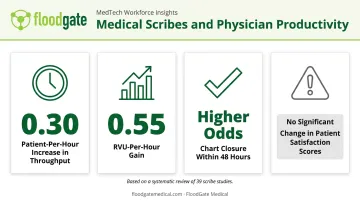
A systematic review of 39 human-scribe studies found scribes were associated with a 0.30 patient-per-hour increase in throughput and a 0.55 RVU-per-hour gain (RVU, or relative value unit, measures provider productivity). A separate crossover trial covering over 2,600 charts found scribed encounters had higher odds of chart closure within 48 hours.
One caution worth building into expectations: that same crossover trial found no significant difference in patient satisfaction scores. Don't promise patient satisfaction gains in a job posting, since the evidence doesn't support it as a guarantee.
Scribe vs. Medical Assistant vs. Transcriptionist
Misclassifying this role in a job posting creates compliance headaches and mismatched hires.
| Role | Primary Function | Hands-On Patient Care? |
|---|---|---|
| Medical Scribe | Real-time documentation at the provider's direction | No |
| Medical Assistant | Administrative + clinical tasks (vitals, injections, scheduling) | Yes |
| Medical Transcriptionist | Converts dictation into finished reports, often after the fact | No |
Scribes commonly work in emergency departments, urgent care centers, specialty outpatient clinics, and hospital systems, wherever documentation volume outpaces provider time.
Medical Scribe Job Description Template for 2026
Use this as a starting framework, then customize it to your facility's culture and patient population.
Sample intro paragraph:
"[Facility Name] is seeking a detail-oriented Medical Scribe to support our [specialty] team in delivering efficient, high-quality patient care. You'll work directly alongside providers in a fast-paced [ED/clinic/hospital] setting, gaining hands-on clinical exposure while helping reduce documentation burden."
Responsibilities:
- Accompany providers during patient encounters and document in real time
- Enter HPI, exam findings, orders, and treatment plans into the EHR
- Prepare charts before visits and draft after-visit summaries
- Maintain strict HIPAA compliance in all recordkeeping
Qualifications/Skills:
- Typing speed of at least 40–60 WPM with strong accuracy
- Familiarity with EHR platforms (specify your system, such as Epic or Cerner)
- Working knowledge of medical terminology
- Clear written and verbal communication skills
Education & Experience: High school diploma or equivalent required. Prior scribe or medical office experience preferred; pre-health college coursework is a plus.
Pay & Schedule:
- Pay: $[XX]–$[XX]/hour
- Schedule: [Full-time/Part-time], [shift pattern]
- To apply: submit your resume and availability to [contact/link]
Optional add-ons that make postings more competitive:
- Health benefits
- Paid training
- Shift differentials for nights/weekends
- Letters of recommendation for pre-health applicants
Skills, Qualifications, and Education Employers Should Require
Not every scribe needs the same background, but a few baseline expectations separate strong applicants from weak ones.
Technical skills:
- Typing proficiency: employer guidance generally lands between 40 and 70 WPM, with faster-paced settings like emergency departments leaning toward the higher end
- Comfort navigating your specific EHR software
- Ability to multitask while listening, typing, and tracking provider cues simultaneously
Soft skills:
- Sharp attention to detail (a missed order or mistyped dosage matters)
- Strong written and verbal communication
- Discretion handling confidential patient information
- Composure in fast-moving, high-pressure environments
Education and Certification Baseline
A high school diploma or equivalent is the standard floor. Many employers prefer candidates pursuing a bachelor's degree, especially in pre-health tracks like biology or pre-med.
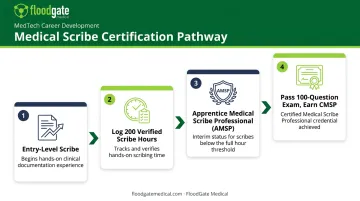
Certification isn't required, but it can differentiate a candidate. AHDPG's pathway offers a Certified Medical Scribe Professional (CMSP) credential after candidates pass a 100-question exam and log 200 verified scribe hours; those with fewer hours earn Apprentice Medical Scribe Professional (AMSP) status first.
Experience expectations: Beyond certification, most postings still prefer prior scribe or medical office experience. Plenty of facilities (RWJBarnabas Health among them) run structured multi-week onboarding programs for entry-level hires with zero prior experience, though.
Medical Scribe Salary Expectations in 2026
Medical Scribe pay is almost universally hourly, and it varies more by location and setting than by title alone.
According to Indeed's 2026 salary data, the national average sits at $18.94/hour, with a typical range of $13.80 to $26.00/hour. Other platforms show a similar spread: PayScale reports figures closer to $16.52/hour on average, while entry-level scribes with under a year of experience often start nearer $14/hour.
What moves the number:
- Location: Indeed shows New York City averaging $23.07/hour, well above the national figure
- Care setting: hospital systems and specialty clinics sometimes post higher ranges than smaller outpatient offices
- Experience: scribes with one to four years typically out-earn first-year hires by a noticeable margin
Once you factor in these variables, the bigger question emerges: are medical scribes well paid? The honest answer: it depends on your lens. Hourly wages sit closer to entry-level administrative pay than clinical salaries. But most scribes aren't chasing top dollar — they're building a resume line and clinical exposure that pays off later in medical, PA, or nursing school applications.
Tips for Writing a Job Posting That Attracts Top Medical Scribe Candidates
A vague posting wastes everyone's time. Here's what actually moves the needle.
Be specific upfront:
- State shift hours and days clearly (nights, weekends, rotating schedules)
- Name the EHR system candidates will use
- List the typing speed and experience expectations directly, rather than burying them
This alone cuts down on mismatched applications and reduces early turnover.
Use inclusive, bias-free language. Broadening your applicant pool starts with the words in the posting itself. Avoid gendered phrasing, unnecessary credential requirements, and jargon that filters out otherwise strong candidates.
Recruitment firms with a DEI-driven methodology, like FloodGate Medical, offer hiring-manager training that shows healthcare teams how small wording changes in a posting can widen and diversify the applicant pool.
Highlight growth opportunities. Many applicants are pre-med or pre-PA students weighing multiple offers. Mentioning mentorship access, letters of recommendation, and clear advancement paths often matters as much as the pay rate itself.
Frequently Asked Questions
Are medical scribes well paid?
Pay is typically hourly and ranges roughly from $14 to $26/hour depending on location and experience. Many scribes value the role more for career-building experience toward medical or PA school than for the wage itself.
What are the duties of a medical scribe?
Scribes document patient visits in real time, entering HPI notes, exam findings, and provider orders into the EHR. They also handle clerical tasks like chart prep, referral letters, and after-visit summaries.
How long does it take to become a medical scribe?
Most scribes start with minimal formal training, often just days to a few weeks of on-site onboarding. Some employers, like RWJBarnabas Health, run structured four-week paid training programs.
What qualifications do I need to hire a medical scribe?
At minimum, look for a high school diploma, solid typing speed (40–70 WPM), and basic EHR comfort. Prior scribe or medical office experience is preferred but not always required.
What's the difference between a medical scribe and a medical assistant?
Scribes handle documentation only and never touch patients directly. Medical assistants perform both administrative work and hands-on clinical tasks like taking vitals or giving injections.
Do medical scribes need certification?
No, certification isn't mandatory. Credentials like CMSP (Certified Medical Scribe Professional) can strengthen an application, but most employers hire based on typing skill, attention to detail, and trainability.
![Medical Scheduler Job Description [Updated for 2026]](https://file-host.link/website/floodgatemedical-yc9tym/assets/blog-images/692cc1a1-aabe-486c-8c34-f627625d633f/1785145458154350_2bcaf2d1c39c43d58f2b1428a008affc/1080.webp)
![Medical Secretary Job Description [Updated for 2026]](https://file-host.link/website/floodgatemedical-yc9tym/assets/blog-images/ffc7c265-22d6-4d39-95d7-59dd45a456e3/1785145414676453_53d552d20c524f7f901d8b062c4fe371/1080.webp)